


Histocompatibility and liver transplant outcome. Does HLA exert a dualistic effect?
- PMID: 3047927
- PMCID: PMC2956422
Histocompatibility and liver transplant outcome. Does HLA exert a dualistic effect?
Abstract
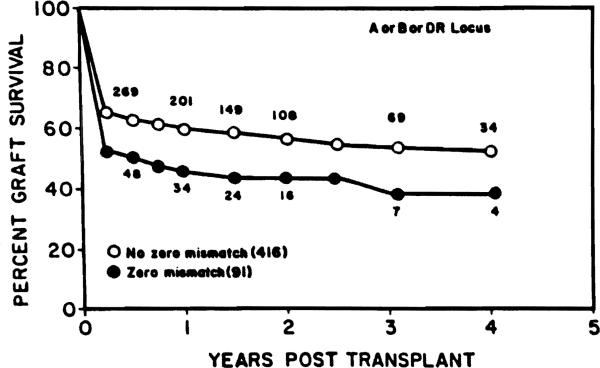
An analysis of more than 500 liver transplants has demonstrated that HLA compatibility is associated with diminished allograft survival. Liver transplants with zero mismatches for class I and/or class II HLA antigens have shown significantly lower actuarial survival rates than transplants with one or more mismatches for these loci. In a group of 119 failed liver allografts from patients undergoing retransplantation, a higher incidence of failure due to rejection correlated with a lower degree of HLA compatibility especially for HLA-DR. In contrast, the incidence of liver transplant failures due to primary nonfunction was relatively higher with HLA-DR compatible transplants. Considering the role of HLA as a restriction element in cellular interactions during the immune response, these findings suggest that HLA compatibility may have a dualistic effect on liver transplant outcome. On one hand, HLA compatibility reduced transplant rejection--and on the other hand, it may enhance other immunological mechanisms leading to allograft dysfunction, particularly in patients at risk of developing recurrent autoimmune diseases or infection.
Figures


References
-
- Cecka JM. The changing role of HLA matching. In: Terasaki PI, editor. Clinical kidney transplants 1986. UCLA Tissue Typing Laboratory; Los Angeles: 1986. p. 141. - PubMed
-
- Opelz G. Effect of HLA matching in 10,000 cyclosporine-treated cadaver kidney transplants. Transplant Proc. 1987;19:641. - PubMed
-
- Sanfilippo F, Vaughn WK, Spees EK, Light JA, LeFor WM. Benefits of HLA-A and HLA-B matching on graft and patient outcome after cadaveric-donor renal transplantation. N Engl J Med. 1984;311:358. - PubMed
-
- Yacoub M, Festenstein p, Doyle P, et al. The influence of HLA matching in cardiac allograft recipients receiving cyclosporine and azathioprine. Transplant Proc. 1987;19:2487. - PubMed
Publication types
MeSH terms
Substances
Grants and funding
LinkOut - more resources
Full Text Sources
Medical
Research Materials