


Cardiometabolic and Muscular Fatigue Responses to Different CrossFit® Workouts
- PMID: 30479537
- PMCID: PMC6243628
Cardiometabolic and Muscular Fatigue Responses to Different CrossFit® Workouts
Abstract
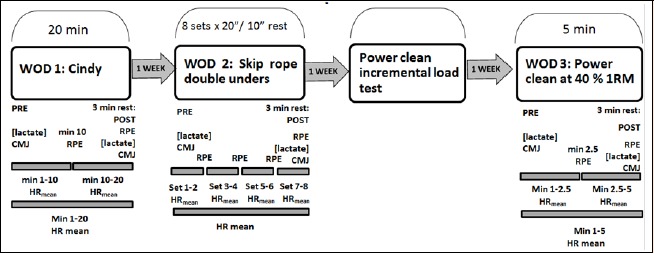
CrossFit® consists of workouts of the day (WODs) in which different exercises are conducted at high intensity with minimal or no rest periods. This study sought to quantify exercise intensity and muscular fatigue in the three CrossFit® session modalities: gymnastics (G), metabolic conditioning (M) and weightlifting (W). Thirty two, young, strength-trained, healthy men completed the three WODs: G ("Cindy"), M (double skip rope jumps) and W (power cleans). The variables measured in the sessions were: mean heart rate (HR), rate of perceived exertion (RPE), blood lactate [lactate], and jump height (H), average power (AP) and maximum take-off velocity (Vmax) in a counter movement jump test. In all three WODs, elevated HR values (≥90% of the theoretical HRmax) were recorded at the time points mid-session and end-session. Mean RPEs were 17.6 ± 1.6 (G WOD), 16.0 ± 2.3 (M WOD), and 15.7 ± 2.0 (W WOD). Postexercise [lactate] was higher than 10 mmol·L-1 for the three WODs. Following the G ("Cindy") and W (power cleans) WODs, respectively, significant muscular power losses were observed in H (7.3% and 8.1%), Vmax (13.8% and 3.3%), AP relative (4.6% and 8.3%) and AP total (4.2% and 8.2%) while losses in the M WOD were not significant (p > 0.05). A vigorous intensity of exercise was noted in all three WODs, with greater mean HRs detected in the "Cindy" and skip rope WODs than power clean WOD. Muscular fatigue was produced in response to the "Cindy" and power clean WODs but not the skip rope WOD.
Keywords: Heart rate; blood lactate; cardiovascular responses; countermovement test; high intensity interval training; muscle fatigue.
Figures
References
-
- Alberton C.L., Antunes A.H., Beilke D.D., Pinto S.S., Kanitz A.C., Tartaruga M.P., Kruel L.F.M. (2013) Maximal and Ventilatory Thresholds of Oxygen Uptake and Rating of Perceived Exertion Responses to Water Aerobic Exercises. Journal of Strength and Conditioning Research 27(7), 1897-1903. - PubMed
-
- Barbado C., Foster C., Vicente-Campos D., López-Chicharro J. (2017) Intensidad del ejercicio en ciclismo indoor / Exercise Intensity During Indoor Cycling. Revista Internacional de Medicina y Ciencias de la Actividad Física y el Deporte 17(67), 481-491.
-
- Barker LA, Harry J.R., Mercer J.A. (2018) Relationships between countermovement jump ground reaction forces and jump height, reactive strength index, and jump time. Journal of Strength and Conditioning Research 32(1), 248-254. - PubMed
-
- Bigland-Ritchie B., Woods J. (1984) Changes in muscle contractile properties and neural control during human muscular fatigue. Muscle Nerve 7, 691-699. - PubMed
-
- Borg G. (1970) Perceived exertion as an indicator of somatic stress. Scandinavian Journal of Rehabilitation Medicine 2, 92-98. - PubMed
MeSH terms
Substances
LinkOut - more resources
Full Text Sources