


10-Year Epidemiology of Ankle Injuries in Men's and Women's Collegiate Basketball
- PMID: 30480010
- PMCID: PMC6240983
- DOI: 10.1177/2325967118805400
10-Year Epidemiology of Ankle Injuries in Men's and Women's Collegiate Basketball
Erratum in
-
Corrigenda.Orthop J Sports Med. 2019 Mar 29;7(3):2325967119837985. doi: 10.1177/2325967119837985. eCollection 2019 Mar. Orthop J Sports Med. 2019. PMID: 30968050 Free PMC article.
Abstract
Background: Ankle injury is the most common injury in men's and women's basketball, regardless of the level of competition.
Purpose: To use the National Collegiate Athletic Association (NCAA) Injury Surveillance Program/System (ISP/ISS) to review the 10-year epidemiology of ankle injuries in men's and women's collegiate basketball players.
Study design: Descriptive epidemiology study.
Methods: The NCAA ISP was queried for men's and women's collegiate basketball ankle injury data from the 2004 through 2014 academic years. Ankle injury rates were calculated based on injuries per athlete-exposure (AE). Injury proportion ratios (IPRs) were determined by comparing variables between sexes. Activity and position of injury were also studied.
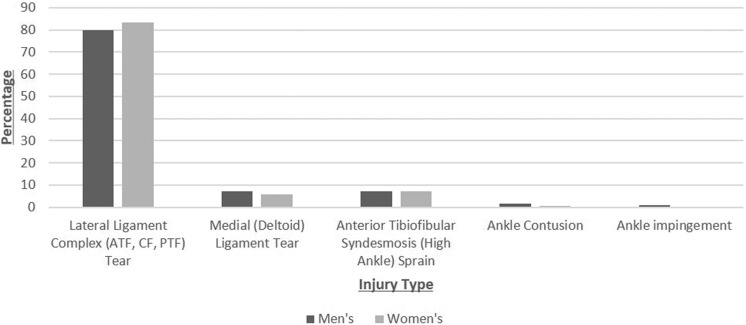
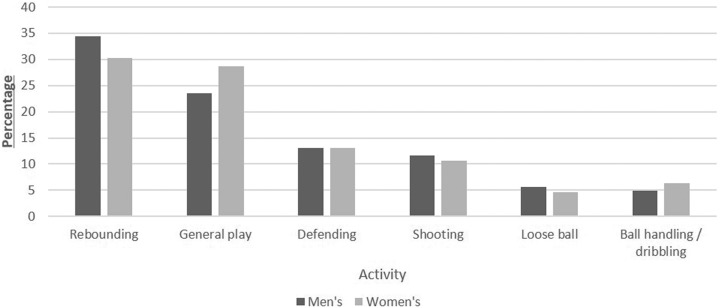
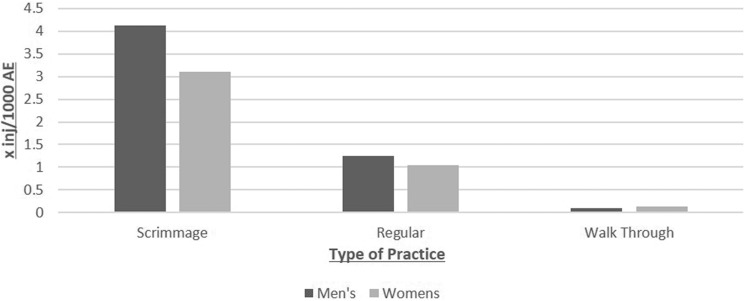
Results: Over the 10-year study period, most ankle injuries in collegiate basketball occurred in the preseason (female, 1.45/1000 AEs; male, 2.00/1000 AEs), were contact related (female, 50.4%; male, 57.6%), were treated conservatively (female, 98.5%; male, 99.3%), and were new injuries (female, 78.0%; male, 78.9%), resulting in a time loss of less than 7 days (female, 62.7%; male, 65.2%). The most common injury types were lateral ligament complex tears (female, 83.5%; male, 80.0%), deltoid ligament tears (female, 5.6%; male, 7.2%), and high ankle sprains (female, 7.1%; male, 7.0%). Guards experienced the highest rate of ankle injuries in competition (female, 50.1%; male, 43.3%), and rebounding was found to be the most common activity during an injury (female, 30.3%; male, 34.4%). The rate of ankle injuries was significantly lower in women than in men (IPR, 0.81 [95% CI, 0.75-0.88]).
Conclusion: This study found that most ankle injuries in collegiate basketball occurred during the preseason, were contact related, were treated conservatively, and were new injuries that resulted in a time loss of less than 7 days.
Keywords: NCAA; ankle; basketball; prevention; sex comparison.
Conflict of interest statement
One or more of the authors has declared the following potential conflict of interest or source of funding: D.E.H. is a consultant for Arthrex and has received educational support from Smith & Nephew. A.C. is a consultant for Arthrex and Cayenne Medical. AOSSM checks author disclosures against the Open Payments Database (OPD). AOSSM has not conducted an independent investigation on the OPD and disclaims any liability or responsibility relating thereto.
Figures



References
-
- Arnason A, Sigurdsson SB, Gudmundsson A, Holme I, Engebretsen L, Bahr R. Risk factors for injuries in football. Am J Sports Med. 2004;32(suppl 1):5S–16S. - PubMed
-
- Barrett JR, Tanji JL, Drake C, Fuller D, Kawasaki RI, Fenton RM. High- versus low-top shoes for the prevention of ankle sprains in basketball players: a prospective randomized study. Am J Sports Med. 1993;21(4):582–585. - PubMed
LinkOut - more resources
Full Text Sources
Medical
