


Closing the Capacity-Ability Gap: Using Technology to Support Aging With Disability
- PMID: 30480132
- PMCID: PMC6176980
- DOI: 10.1093/geroni/igy008
Closing the Capacity-Ability Gap: Using Technology to Support Aging With Disability
Abstract
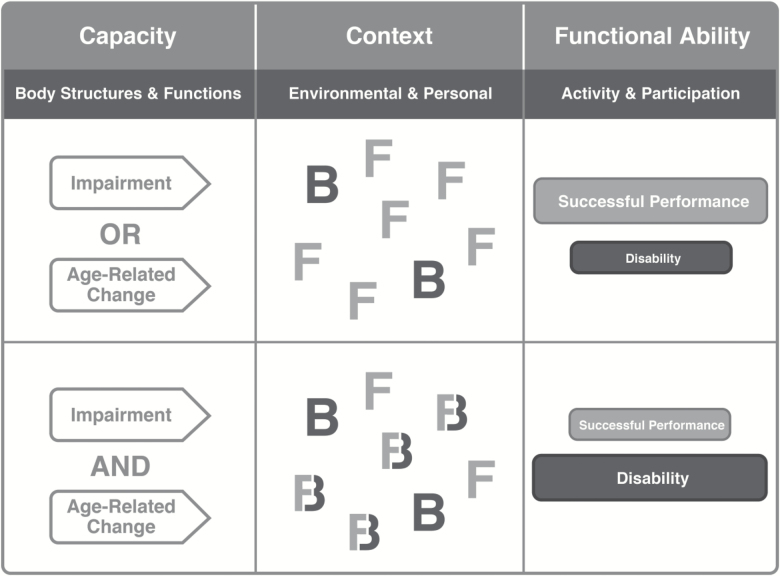
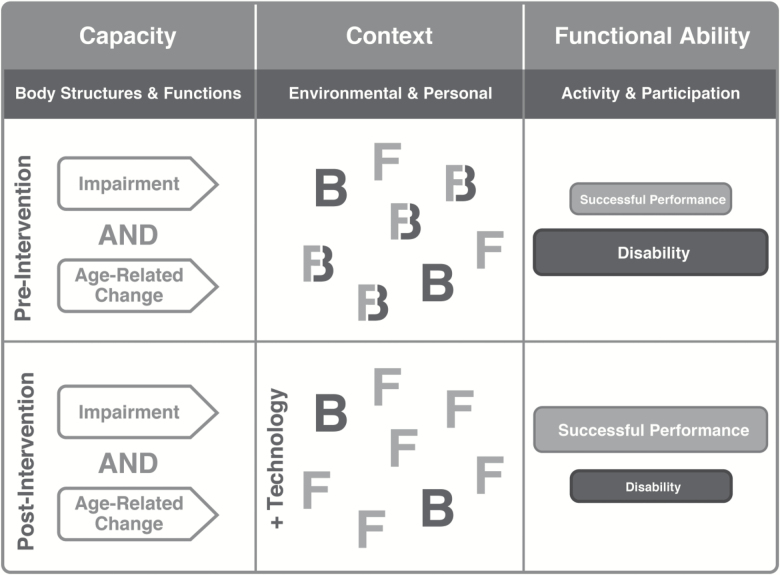
There is a critical need to develop supports for older adults who have a wide range of abilities, including those aging with long-term impairments. Without appropriate support, many individuals will be functioning below optimal levels and will face participation barriers. Technology holds great promise to provide individualized support for a wide range of abilities and for a variety of domains. To ensure technology interventions are designed well and meet research-documented user requirements, we need more specific, actionable models to provide guidance for those developing and designing interventions. In this paper, we present the TechSAge Aging and Disability Model to bridge models from the aging and disability literatures and to disambiguate the population of individuals aging into disability from those aging with disability (i.e., pre-existing impairments). We also present the TechSAge Technology Intervention Model to support aging with pre-existing impairments, which provides direction and touch points for technology interventions. These models reflect the complex and dynamic interaction between age-related changes and an individual's prior capabilities and limitations. We describe the need for these models with respect to filling a gap in the disability and aging literature by highlighting the importance of differentiating between age-related changes and long-term impairments when designing interventions. We also show the need for quantitative and qualitative data to refine the models given complexities of the current state of the literature and survey data. The TechSAge Technology Intervention Model can be used to drive and inform technology redesign and development.
Keywords: Age-related declines; Disabilities; Intervention; Successful aging; Technology.
Figures
References
-
- Americans with Disabilities Act of 1990, Pub. L. No. 101–336 § 104, 328 Stat (1990). Retrieved from https://www.congress.gov/bill/101st-congress/senate-bill/933.
-
- Beer J. M., Mitzner T. L., Stuck R. E., & Rogers W. A (2015). Design considerations for technology interventions to support social and physical wellness for older adults with disability. International Journal of Automation and Smart Technology (AUSMT), 5, 249–264. doi:10.5875/ausmt.v5i4.959
-
- Birren J. E., & Schaie K. W (2006). Handbook of the psychology of aging (5th ed). San Diego, CA: Academic Press.
-
- Brault M. W. (2012). Americans with Disabilities: 2010- Household Economic Studies Washington DC: U.S. Census Bureau; Retrieved from www.census.gov/prod/2012pubs/p70-131.pdf
Grants and funding
LinkOut - more resources
Full Text Sources
Miscellaneous
