


Validity and Reliability of the Major Depression Inventory for Persons With Dual Sensory Loss
- PMID: 30480134
- PMCID: PMC6177090
- DOI: 10.1093/geroni/igy010
Validity and Reliability of the Major Depression Inventory for Persons With Dual Sensory Loss
Abstract
Background and objectives: Research has shown that dual sensory loss is a risk factor for depression in older adults. However, validated measures of depression for people with dual sensory loss are lacking. The purpose of the present study was to investigate the construct validity and reliability of the Major Depression Inventory for use among elderly persons with acquired dual sensory loss.
Research design and methods: A cross-sectional questionnaire survey was conducted in a national sample of people ≥50 years of age with functional acquired dual sensory loss. Of the invited participants, 302 (66%) returned the questionnaire and 207 complete cases were included for analysis. Rasch models and graphical log-linear Rasch models were used for item analysis. Lack of differential item functioning was tested relative to severity of vision and hearing impairment, mode of questionnaire completion, age, sex, comorbidity, instrumental activities of daily living, social position, and cohabitation status.
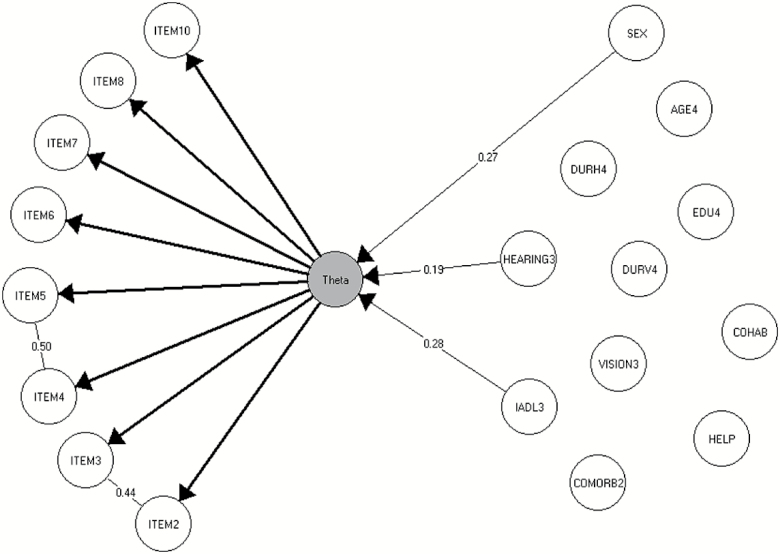
Results: The 10-item Major Depression Inventory did not fit the Rasch model. An 8-item version, excluding the items "feeling sad" and "sleep problems," fit a graphical log-linear Rasch model. No evidence of differential item functioning was discovered, thus the 8-item Major Depression Inventory was measurement invariant across severity of impairments and mode of completing the questionnaire. The overall reliability was 0.81 and ranged from acceptable to good for all subgroups of participants, except males with severe hearing impairment and low functional status. Consequently, the 8-item version of the Major Depression Inventory was considered construct valid and reliable within the frame of reference.
Discussion and implications: An 8-item version of the Major Depression Inventory can be used to screen for depressive symptoms in elderly persons with acquired dual sensory loss.
Keywords: Depression and anxiety; Disabilities; Psychometrics; Vision.
Figures
References
-
- Alexopoulos G. S. (2005). Depression in the elderly. Lancet (London, England), 365, 1961–1970. doi:10.1016/S0140-6736(05)66665-2 - PubMed
-
- Amris K., Omerovic E., Danneskiold-Samsøe B., Bliddal H., & Wæhrens E. E (2016). The validity of self-rating depression scales in patients with chronic widespread pain: A Rasch analysis of the major depression inventory. Scandinavian Journal of Rheumatology, 45, 1–11. doi:10.3109/03009742.2015.1067712 - PubMed
-
- Andersen E. B. (1973). A goodness of fit test for the rasch model. Psychometrika, 38, 123–140. doi:10.1007/BF02291180
-
- Ask Larsen F., & Damen S (2014). Definitions of deafblindness and congenital deafblindness. Research in Developmental Disabilities, 35, 2568–2576. doi:10.1016/j.ridd.2014.05.029 - PubMed
-
- Bech P. (2012). Clinical Psychometrics. Oxford, UK: Wiley-Blackwell. doi:10.1002/9781118511800
LinkOut - more resources
Full Text Sources
