


The impact of failure to achieve symptom control after resection of functional neuroendocrine tumors: An 8-institution study from the US Neuroendocrine Tumor Study Group
- PMID: 30481383
- PMCID: PMC10181271
- DOI: 10.1002/jso.25306
The impact of failure to achieve symptom control after resection of functional neuroendocrine tumors: An 8-institution study from the US Neuroendocrine Tumor Study Group
Abstract
Background: The goals of resection of functional neuroendocrine tumors (NETs) are two-fold: Oncological benefit and symptom control. The interaction between the two is not well understood.
Methods: All patients with functional NETs of the pancreas, duodenum, and ampulla who underwent curative-intent resection between 2000 and 2016 were identified. Using Cox regression analysis, factors associated with reduced recurrence-free survival (RFS) were identified.
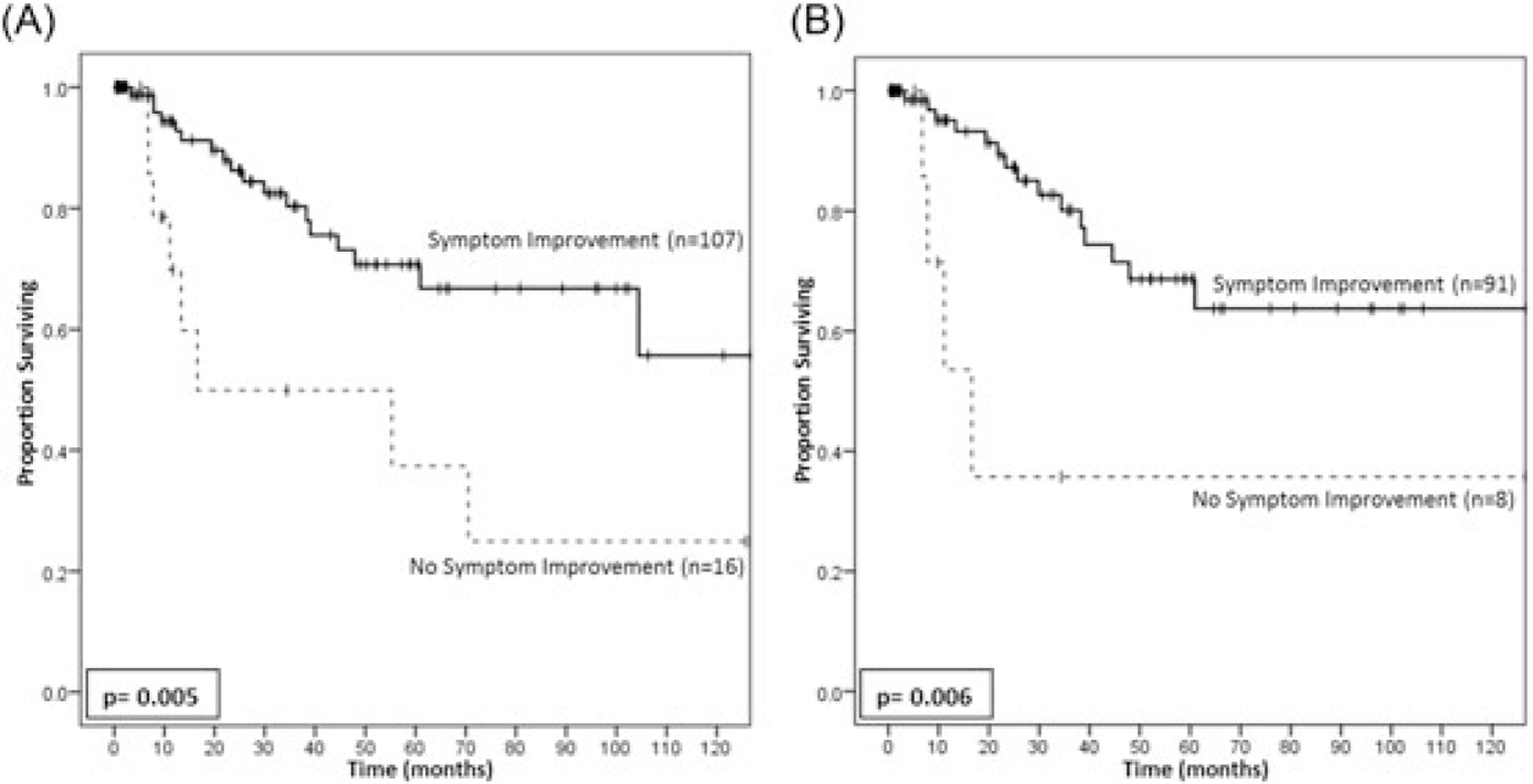
Results: Two-hundred and thirty patients underwent curative-intent resection. Fifty-three percent were insulinomas, 35% gastrinomas, and 12% were other types. Twenty-one percent had a known genetic syndrome, 23% had lymph node (LN) positivity, 80% underwent an R0 resection, and 14% had no postoperative symptom improvement (SI). Factors associated with reduced RFS included noninsulinoma histology, the presence of a known genetic syndrome, LN positivity, R1 margin, and lack of SI. On multivariable analysis, only the failure to achieve SI following resection was associated with reduced RFS. Considering only those patients with an R0 resection, failure to achieve SI was associated with worse 3-year RFS compared with patients having SI (36% vs 80%; P = 0.006).
Conclusions: Failure to achieve symptomatic improvement after resection of functional NETs is associated with worse RFS. These patients may benefit from short-interval surveillance imaging postoperatively to assess for earlier radiographical disease recurrence.
Keywords: VIPoma; gastrinoma; glucagonoma; insulinoma; recurrence; symptomatic.
© 2018 Wiley Periodicals, Inc.
Conflict of interest statement
CONFLICTS OF INTEREST
No financial or material disclosures to report.
Figures
References
-
- Dickson PV, Behrman SW. Management of pancreatic neuroendocrine tumors. Surg Clin North Am 2013;93(3):675–691. - PubMed
-
- Parbhu SK, Adler DG. Pancreatic neuroendocrine tumors: contemporary diagnosis and management. Hosp Pract (1995) 2016;44(3):109–119. - PubMed
-
- Anderson CW, Bennett JJ. Clinical presentation and diagnosis of pancreatic neuroendocrine tumors. Surg Oncol Clin N Am 2016;25(2):363–374. - PubMed
-
- Cougard P, Goudet P, Peix JL, et al. Insulinomas in multiple endocrine neoplasia type 1. Report of a series of 44 cases by the multiple endocrine neoplasia study group. Ann Chir 2000;125(2):118–123. - PubMed
