


The growth of assisted reproductive treatment-conceived children from birth to 5 years: a national cohort study
- PMID: 30482203
- PMCID: PMC6260690
- DOI: 10.1186/s12916-018-1203-7
The growth of assisted reproductive treatment-conceived children from birth to 5 years: a national cohort study
Abstract
Background: Birth weight and early child growth are important predictors of long-term cardiometabolic disease risk, in line with the Developmental Origins of Health and Disease hypothesis. As human assisted reproductive technologies (ARTs) occur during the sensitive periconceptional window of development, it has recently become a matter of urgency to investigate risk in ART-conceived children.
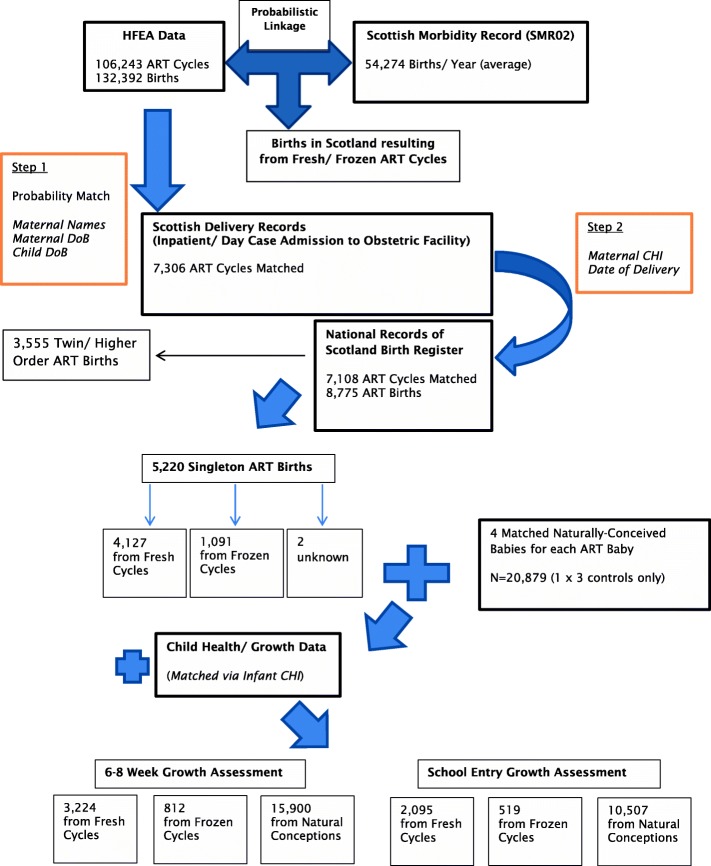
Methods: We have conducted the first large-scale, national cohort study of early growth in ART children from birth to school age, linking the register of ART, held by the UK's Human Fertilisation and Embryology Authority, to Scottish maternity and child health databases.
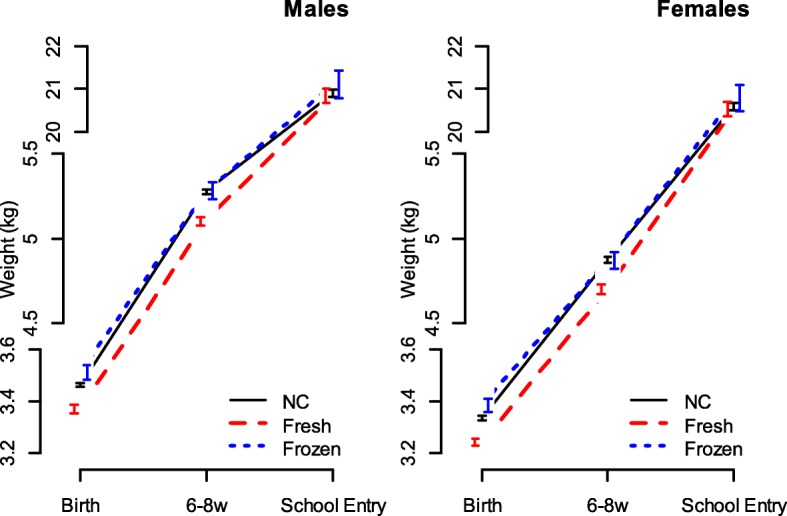
Results: In this study of 5200 ART and 20,800 naturally conceived (NC) control children, linear regression analysis revealed the birthweight of babies born from fresh embryo transfer cycles is 93.7 g [95% CI (76.6, 110.6)g] less than NC controls, whereas babies born from frozen embryo transfer (FET) cycles are 57.5 g [95% CI (30.7, 86.5)g] heavier. Fresh ART babies grew faster from birth (by 7.2 g/week) but remained lighter (by 171 g), at 6-8 weeks, than NC babies and 133 g smaller than FET babies; FET and NC babies were similar. Length and occipital-frontal circumference followed the same pattern. By school entry (4-7 years), weight, length and BMI in boys and girls conceived by fresh ART and FET were similar to those in NC children.
Conclusions: ART babies born from fresh embryo transfer grow more slowly in utero and in the first few weeks of life, but then show postnatal catch up growth by school age, compared to NC and FET babies. As low birth weight and postnatal catch-up are independent risk factors for cardiometabolic disease over the life-course, we suggest that further studies in this area are now warranted.
Keywords: Assisted reproductive technology; Birth weight; Child growth; Data linkage.
Conflict of interest statement
Ethics approval and consent to participate
Ethical approval was granted by the Greater Manchester Central NHS Ethics Committee on September the 11th 2013 (Ref: 13/NW/0585).
Consent for publication
Not applicable.
Competing interests
The authors declare that they have no competing interests.
Publisher’s Note
Springer Nature remains neutral with regard to jurisdictional claims in published maps and institutional affiliations.
Figures
References
-
- Helmerhorst FM, Perquin DA, Donker D, Keirse MJ. Perinatal outcome of singletons and twins after assisted conception: a systematic review of controlled studies. Bmj. 2004;328(7434):261. doi: 10.1136/bmj.37957.560278.EE. - DOI - PMC - PubMed
Publication types
MeSH terms
Grants and funding
LinkOut - more resources
Full Text Sources
Medical
Research Materials
