


[Combination of clonidine-bupivacaine in caudal epidural anesthesia for hypospadias surgery in children: prospective, randomized, blind study]
- PMID: 30482552
- PMCID: PMC9391797
- DOI: 10.1016/j.bjan.2018.09.008
[Combination of clonidine-bupivacaine in caudal epidural anesthesia for hypospadias surgery in children: prospective, randomized, blind study]
Abstract
Background and objectives: The combination of clonidine with local anesthetic administered for epidural anesthesia via caudal route seems to improve the quality of postoperative analgesia, but with conflicting results. This study compared the postoperative analgesia of three different doses of clonidine combined with bupivacaine in caudal epidural anesthesia in children undergoing hypospadias repair.
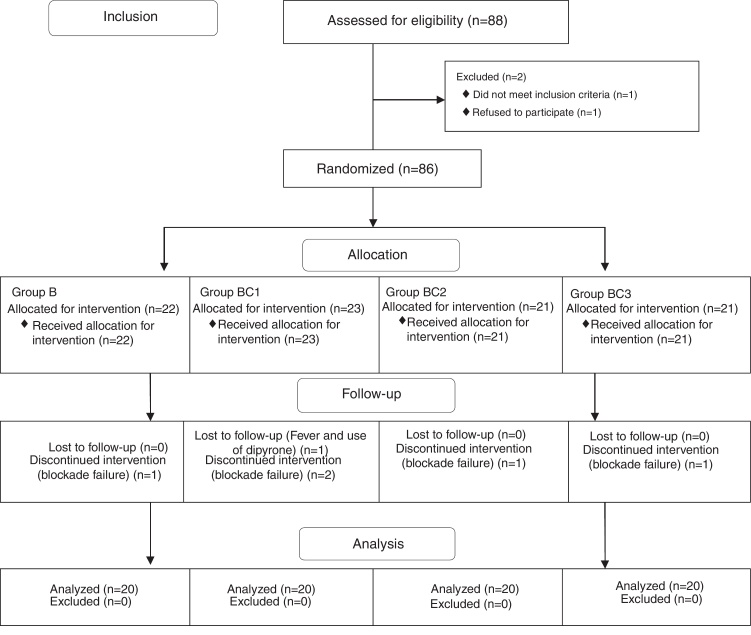
Methods: Eighty children aged 1–10 years, candidates for surgical repair of hypospadias, were randomly divided into four groups of 20 patients to receive general anesthesia combined with caudal epidural anesthesia with bupivacaine 0.165% alone or in combination with 1, 2 or 3 μg.kg−1 of clonidine. The primary outcome was morphine consumption in the first 24 h postoperatively. Mean arterial pressure, heart rate, end-tidal concentration of sevoflurane, time to awakening, pain severity (FLACC scale), level of sedation (RAMSAY), duration of analgesia, and occurrence of adverse effects were also compared.
Results: Intraoperatively, there was no difference between groups regarding mean arterial pressure, heart rate, end-tidal concentration of sevoflurane, and time to awakening. Postoperative morphine consumption and pain severity were similar between groups, but the group receiving clonidine (3 μg.kg−1) had lower heart rate and higher sedation level than the group receiving bupivacaine alone.
Conclusions: The combination of clonidine at doses of 1, 2 or 3 μg.kg−1 with bupivacaine 0.16% via caudal epidural route did not alter the consumption of morphine in the early postoperative period of children undergoing hypospadias repair.
Keywords: Analgesia; Anestesia peridural caudal; Bupivacaine; Bupivacaína; Caudal epidural anesthesia; Clonidina; Clonidine; Dor pós‐operatória; Post‐operative pain.
Copyright © 2018 Sociedade Brasileira de Anestesiologia. Publicado por Elsevier Editora Ltda. All rights reserved.
Figures
References
-
- Morton N.S. Pain assessment in children. Paediatr Anaesth. 1997;4:26772. - PubMed
-
- Tsui B.C., Berde C.B. Caudal analgesia and anesthesia techniques in children. Curr Opin Anaesthesiol. 2005;18:283–288. - PubMed
-
- Wolf A.R., Valley R.D., Fear D.W., et al. Bupivacaine for caudal analgesia in infants and children: The optimal effective concentration. Anesthesiology. 1988;69:102–106. - PubMed
-
- Fernandes M.L., Pires K.C.C., Tibúrcio M.A., et al. Caudal bupivacaine supplemented with morphine or clonidine, or supplemented with morphine plus clonidine in children undergoing infra-umbilical urological and genital procedures: a prospective, randomized and double-blind study. J Anesth. 2011;26:213–218. - PubMed
-
- De Beer D.A., Thomas M.L. Caudal additives in children – solutions or problems? Br J Anaesth. 2003;90:487–498. - PubMed
Publication types
MeSH terms
Substances
LinkOut - more resources
Full Text Sources
