


Diversity of resistance mechanisms in carbapenem-resistant Enterobacteriaceae at a health care system in Northern California, from 2013 to 2016
- PMID: 30482638
- PMCID: PMC7155946
- DOI: 10.1016/j.diagmicrobio.2018.10.004
Diversity of resistance mechanisms in carbapenem-resistant Enterobacteriaceae at a health care system in Northern California, from 2013 to 2016
Abstract
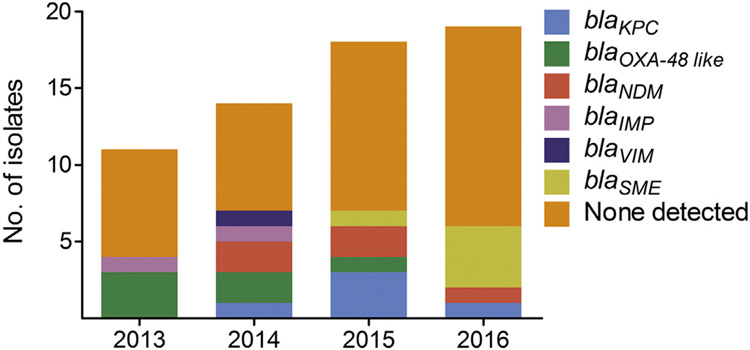
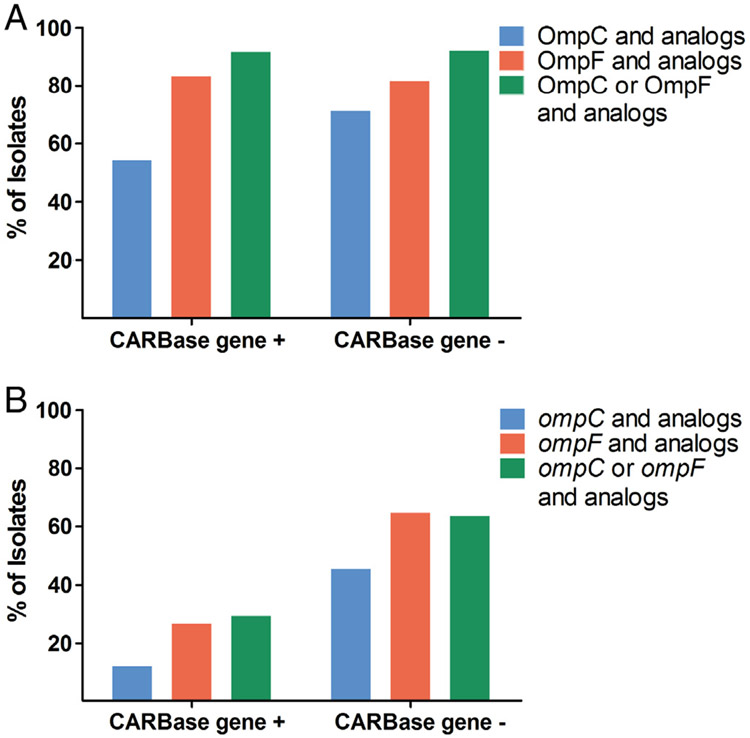
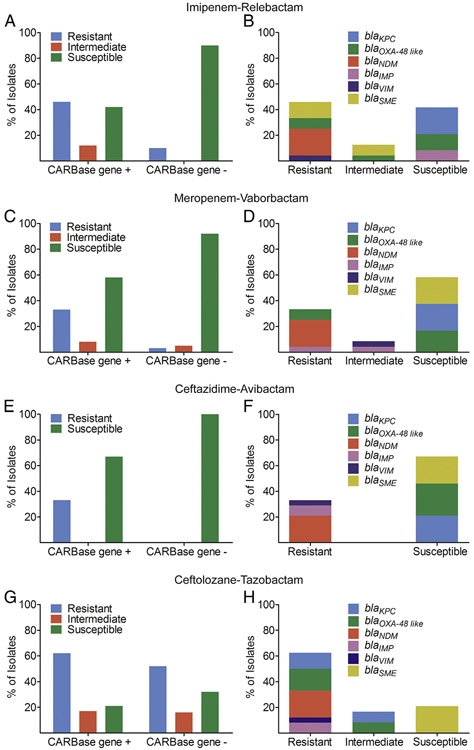
The mechanism of resistance in carbapenem-resistant Enterobacteriaceae (CRE) has therapeutic implications. We comprehensively characterized emerging mechanisms of resistance in CRE between 2013 and 2016 at a health system in Northern California. A total of 38.7% (24/62) of CRE isolates were carbapenemase gene-positive, comprising 25.0% (6/24) blaOXA-48 like, 20.8% (5/24) blaKPC, 20.8% (5/24) blaNDM, 20.8% (5/24) blaSME, 8.3% (2/24) blaIMP, and 4.2% (1/24) blaVIM. Between carbapenemases and porin loss, the resistance mechanism was identified in 95.2% (59/62) of CRE isolates. Isolates expressing blaKPC were 100% susceptible to ceftazidime-avibactam, meropenem-vaborbactam, and imipenem-relebactam; blaOXA-48 like-positive isolates were 100% susceptible to ceftazidime-avibactam; and metallo β-lactamase-positive isolates were nearly all nonsusceptible to above antibiotics. Carbapenemase gene-negative CRE were 100% (38/38), 92.1% (35/38), 89.5% (34/38), and 31.6% (12/38) susceptible to ceftazidime-avibactam, meropenem-vaborbactam, imipenem-relebactam, and ceftolozane-tazobactam, respectively. None of the CRE strains were identical by whole genome sequencing. At this health system, CRE were mediated by diverse mechanisms with predictable susceptibility to newer β-lactamase inhibitors.
Keywords: Avibactam; Carbapenem-resistant Enterobacteriaceae; Carbapenemase; Porin; Relebactam; Vaborbactam.
Copyright © 2018 Elsevier Inc. All rights reserved.
Conflict of interest statement
Declarations of interest: none.
Figures
References
-
- Castanheira M, Huband MD, Mendes RE, Flamm RK. Meropenem–vaborbactam tested against contemporary gram-negative isolates collected worldwide during 2014, including carbapenem-resistant, KPC-producing, multidrug-resistant, and extensively drug-resistant Enterobacteriaceae. Antimicrob Agents Chemother 2017;61:e00567–17. - PMC - PubMed
-
- Clinical and Laboratory Standards institute (CLSI). Performance standards for antimicrobial susceptibility testing: twenty-sixth informational supplement. M100–S26; 2016.
MeSH terms
Substances
Grants and funding
LinkOut - more resources
Full Text Sources
Medical
Miscellaneous
