


Correlation over time of toenail metals among participants in the VA normative aging study from 1992 to 2014
- PMID: 30482937
- PMCID: PMC6536369
- DOI: 10.1038/s41370-018-0095-0
Correlation over time of toenail metals among participants in the VA normative aging study from 1992 to 2014
Abstract
Background: Scientists use biomarkers to evaluate metal exposures. One biomarker, toenails, is easily obtained and minimally invasive, but less commonly used as a biomarker of exposure. Their utility will depend on understanding characteristics of their variation in a population over time. The objective of our study is to describe the correlation of toenail metal levels many years apart among participants in the VA Normative Aging Study (NAS).
Methods: Toenail clippings from 825 participants of the NAS from year 1992 to 2014 were analyzed for lead (Pb), Arsenic (As), Cadmium (Cd), Manganese (Mn), and Mercury (Hg). We utilized linear mixed models to assess correlation between toenail metal concentrations in multiple toenail samples from the same subject collected years apart and identified the optimal covariance pattern by likelihood ratio tests and Akaike's information criterion (AIC). Correlations among different metals were described using Spearman correlations.
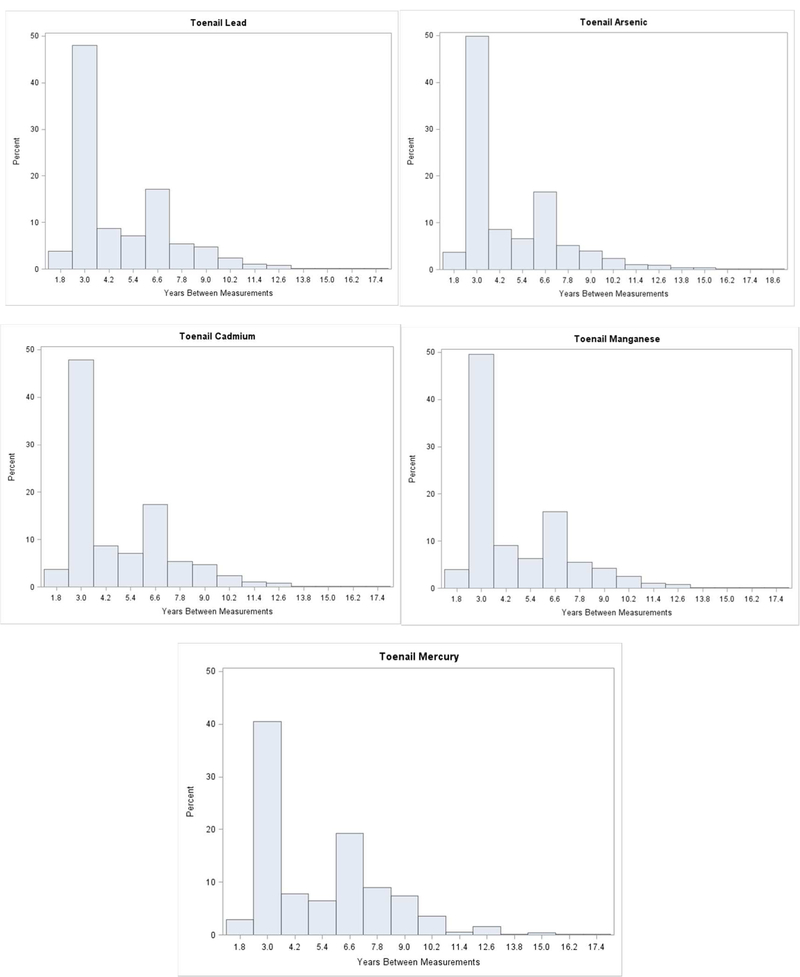
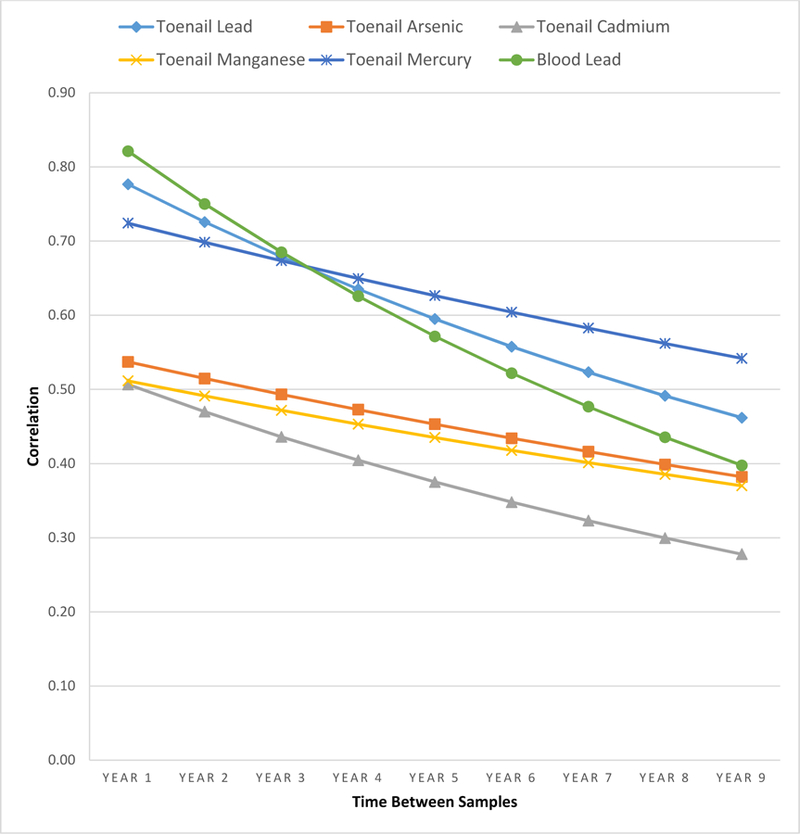
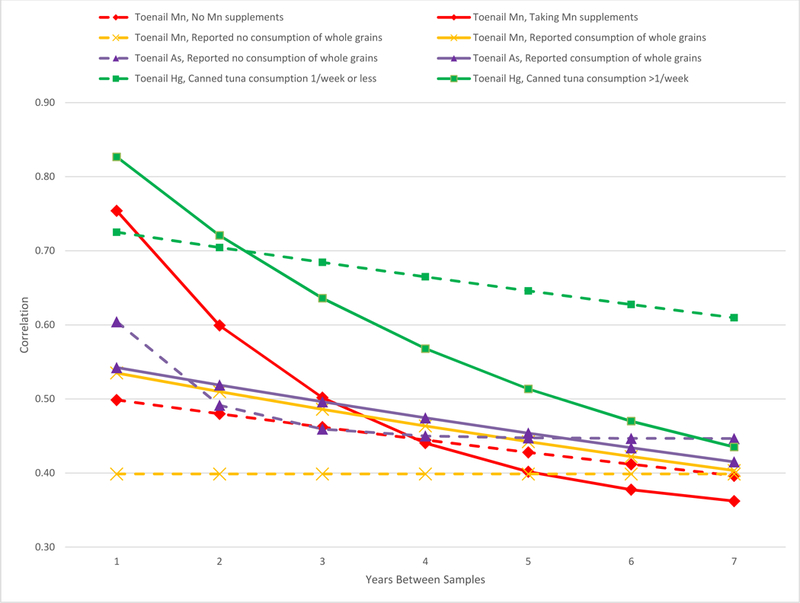
Results: The average number of times toenail samples were collected from each subject ranged from 1.63 (Hg) to 2.04 (As). The average number of years between toenails collected per subject ranged from 4.73 (SD = 2.44) (Mn) to 5.35 (SD = 2.69) (Hg). Metal concentrations had slightly different correlation patterns over time, although for all metals correlations decreased with increasing time between samples. Estimated correlations over a 3-year span were highest for toenail Pb (0.68) and Hg (0.67), while As, Cd, and Mn had lower correlations of 0.49, 0.44, and 0.47, respectively. Even across a 6-year span, the lowest correlation was 0.35 (Cd).
Conclusions: Our results suggest that Pb, As, Cd, Mn, and Hg levels from toenail clippings can reasonably reflect exposures over several years in elderly men in the NAS. Even across 6 years, toenail metal levels were generally well correlated among NAS participants. As such, they may be useful as biomarkers of exposure in epidemiological studies of similar populations.
Conflict of interest statement
Conflict of Interest
The authors declare they have no competing financial interests.
Figures
References
-
- Garland M, Morris JS, Rosner BA, Stampfer MJ, Spate VL, Baskett CJ, et al. Toenail trace element levels as biomarkers: reproducibility over a 6-year period. Cancer Epidemiol Biomarkers Prev 1993;2(5):493–7. - PubMed
-
- LeBlanc A, Dumas P, Lefebvre L. Trace element content of commercial shampoos: impact on trace element levels in hair. Sci Total Environ 1999;229(1–2):121–4. - PubMed
-
- Hunter, Morris J, Chute C, Kushner E, Colditz G, Stampfer M, et al. Predictors of Selenium Concentration in Human Toenails. American Journal of Epidemiology 1990;132(1):114. - PubMed
-
- Longnecker PM, Stram OD, Taylor RP, Levander AO, Howe AM, Veillon YC, et al. Use of Selenium Concentration in Whole Blood, Serum, Toenails, or Urine as a Surrogate Measure of Selenium Intake. Epidemiology 1996;7(4):384–90. - PubMed
-
- Ovaskainen ML, Virtamo J, Alfthan G, Haukka J, Pietinen P, Taylor PR, et al. Toenail selenium as an indicator of selenium intake among middle-aged men in an area with low soil selenium. The American journal of clinical nutrition 1993;57(5):662. - PubMed
Publication types
MeSH terms
Substances
Grants and funding
LinkOut - more resources
Full Text Sources
Research Materials
