


The drivers and extent of poison use by Namibia's communal farmers: Implications for averting the African vulture crisis
- PMID: 30484066
- PMCID: PMC6541661
- DOI: 10.1007/s13280-018-1128-6
The drivers and extent of poison use by Namibia's communal farmers: Implications for averting the African vulture crisis
Abstract
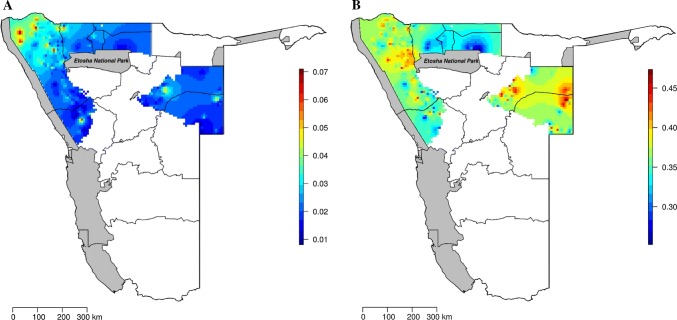
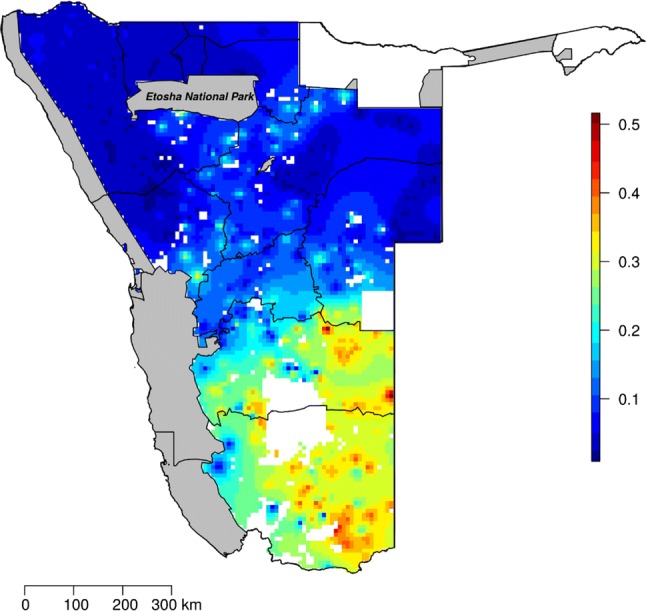
The use of poison by farmers to control livestock predators is a major threat to vulture populations across Eurasia and Africa. While there is now some understanding of poison use on freehold farmland regions in southern Africa, the prevalence and drivers of this practice are still unknown in communal farmlands. We surveyed 353 communal farmers in Namibia to assess the prevalence of reported poison use and intended poison use and the factors associated with both. We used the Randomised Response Technique, a method deemed to yield more robust estimates of the prevalence of sensitive behaviours compared to direct questioning. We found 1.7% of communal farmers admitted to using poison in the last year. Furthermore, across the study region, predicted poison use was the highest (up to 7%) in areas of the upper north-west. The identified 'hotspots' of poison use will assist conservation practitioners to focus their poison-mitigation efforts centred in the areas of the highest need.
Keywords: African vulture crisis; Communal; Conservancy; Farmer; Human–wildlife conflict; Poison use.
Figures
References
-
- Ajzen I, Fishbein M. The influence of attitudes on behavior. In: Albarracin D, Johnston B, Zanna M, editors. Handbook of attitudes and attitude change: Basic principles. New York: Psychology Press; 2005. pp. 173–221.
-
- Babbie E, Mouton J, Vorster P, Prozesky B. The practice of social research (South African edition) Cape Town: Oxford University Press; 2014.
-
- Blair G, Imai K, Zhou Y-Y. Design and analysis of the randomized response technique. Journal of the American Statistical Association. 2015;110:1304–1319. doi: 10.1080/01621459.2015.1050028. - DOI
-
- Broekhuis F, Kaelo M, Sakat DK, Elliot NB. Human–wildlife coexistence: Attitudes and behavioural intentions towards predators in the Maasai Mara, Kenya. Oryx. 2018
-
- Brown, C. 2011. Analysis of human-wildlife conflict in the MCA-supported conservancies for the five-year period of 2006–2010. Namibia Nature Foundation.
MeSH terms
Substances
Grants and funding
LinkOut - more resources
Full Text Sources
