


Rising Mortality Rate of Cervical Cancer in Younger Women in Urban China
- PMID: 30484099
- PMCID: PMC6374275
- DOI: 10.1007/s11606-018-4732-z
Rising Mortality Rate of Cervical Cancer in Younger Women in Urban China
Abstract
Background: In recent decades, much effort has been made in China to reduce the burden of cervical cancer.
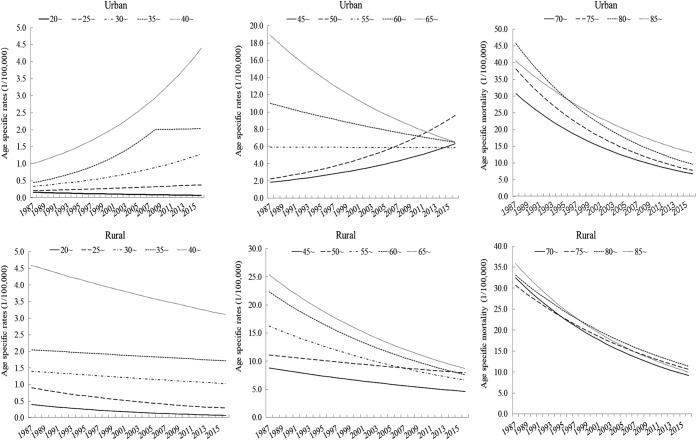
Objective: Our study's purpose was to examine trends of cervical cancer mortality in each 5-year age group for urban and rural Chinese women, respectively.
Designs: Retrospective analysis of cervical cancer mortality from 1987 to 2015 from the World Health Organization Cancer Mortality Database and China Health Statistical Yearbooks.
Participants: Chinese women.
Main measures: Trends were examined using annual percent change (APC) and average annual percent change (AAPC) via Joinpoint regression models for each 5-year age group in urban and rural areas, respectively.
Results: In urban China, mortality rate of cervical cancer increased significantly among urban women aged 25-54 years (AAPC 2.12~5.49%), in contrast to a decline trend among urban women older than 60 years (AAPC - 3.61~- 5.35%). In rural China, cervical cancer rates declined in all age groups, but the magnitude was smaller in women aged 30-54 years (AAPC - 0.59~- 2.20%) compared to women older than 55 years (AAPC - 3.06~- 4.33%).
Conclusion: Mortality rate of cervical cancer is rising at an alarming rate in younger women in urban China. Timely intervention is required for these vulnerable populations.
Keywords: age-specific mortality; cervical cancer; disparity; trend.
Conflict of interest statement
The authors declare that they do not have a conflict of interest.
Figures
Comment in
-
Rising Mortality Rate of Cervical Cancer in Younger Women in Urban China.J Gen Intern Med. 2020 Feb;35(2):593. doi: 10.1007/s11606-019-05174-5. Epub 2019 Jul 15. J Gen Intern Med. 2020. PMID: 31309406 Free PMC article. No abstract available.
-
Cervical Cancer Mortality in Younger Women.J Gen Intern Med. 2020 Feb;35(2):592. doi: 10.1007/s11606-019-05183-4. J Gen Intern Med. 2020. PMID: 31346905 Free PMC article. No abstract available.
References
-
- Fidler MM, Gupta S, Soerjomataram I, Ferlay J, Steliarova-Foucher E, Bray F. Cancer incidence and mortality among young adults aged 20-39 years worldwide in 2012: a population-based study. Lancet Oncol 2017; 18(12): 1579–1589. - PubMed
-
- Zhao FH, Lin MJ, Chen F, et al. Performance of high-risk human papillomavirus DNA testing as a primary screen for cervical cancer: a pooled analysis of individual patient data from 17 population-based studies from China. Lancet Oncol. 2010;11:1160–1171. doi: 10.1016/S1470-2045(10)70256-4. - DOI - PMC - PubMed
