Expression and Significance of TRIM 28 in Squamous Carcinoma of Esophagus
- PMID: 30484263
- PMCID: PMC6815281
- DOI: 10.1007/s12253-018-0558-6
Expression and Significance of TRIM 28 in Squamous Carcinoma of Esophagus
Abstract
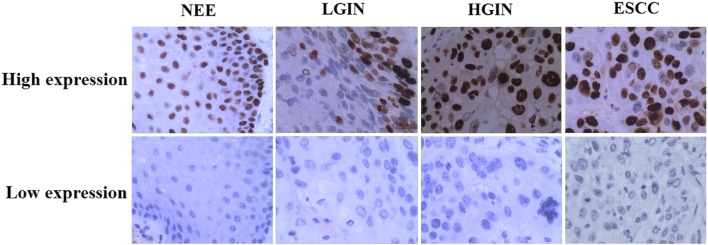
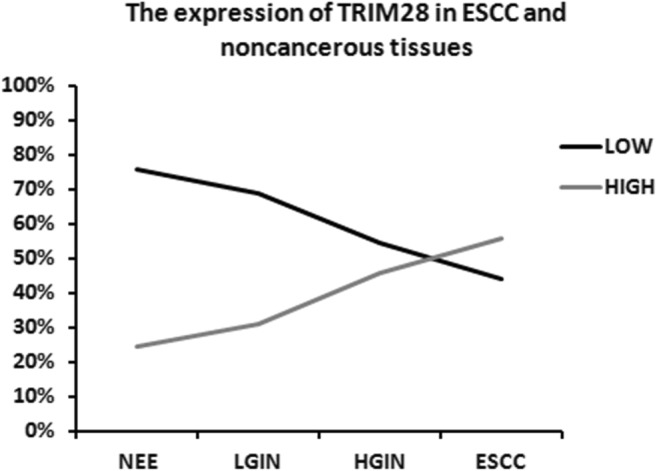
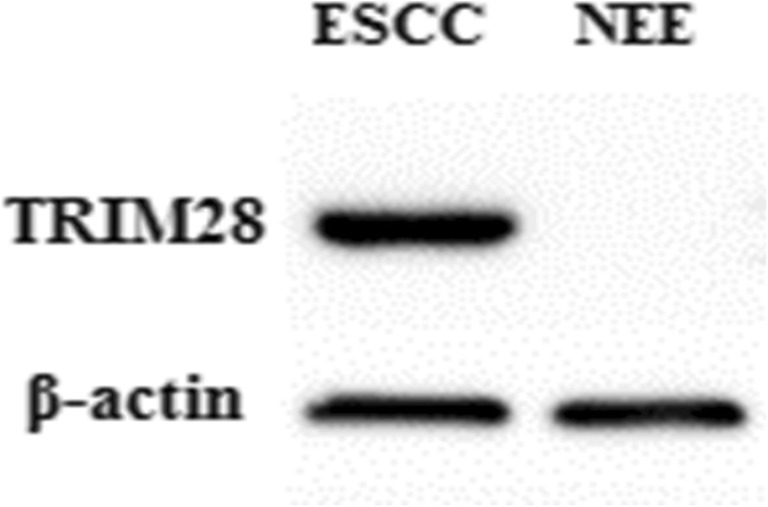
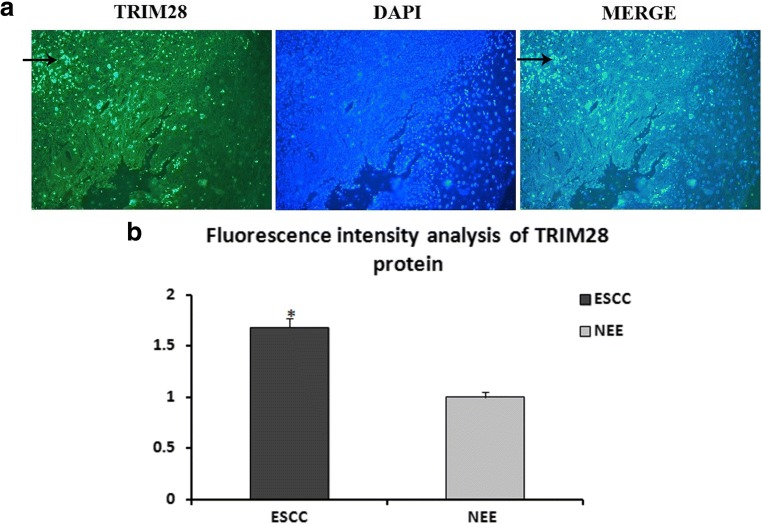
Tripartite motif-containing protein 28 (TRIM28) has been proved to accelerate cell proliferation and metastasis in a variety of human cancers. However, the role of TRIM28 in esophageal squamous cell carcinoma (ESCC) remains unclear. In this study, to compare the biological effect and significance of TRIM28 expression in ESCC, immunohistochemistry (streptavidin-perosidase, S-P) method was used firstly to examine the expression of TRIM28 in 136 cases of ESCC, 35 cases of high grade intraepithelial neoplasia (HGIN), 29 cases of low grade intraepithelial neoplasia (LGIN) and 37 cases of normal esophageal epithelium (NEE). Then the associations of TRIM28 expression with clinicopathological data and overall survival (OS) were also analyzed. Western blot was performed to evaluate TRIM28 protein in a total of 20 matched human ESCC and NEE tissues. Moreover, the localization of TRIM28 protein in ESCC and NEE tissues was also detected by immunofluorescence. TRIM28 protein was mainly distributed in the nucleus of ESCC. The expression of TRIM28 increased progressively from NEE to LGIN, to HGIN, and to ESCC, and it was also related to invasive depth, pTNM stage and lymph node metastasis in ESCC (P < 0.05). The results of western blot and immunofluorescence all showed that the relative expression of TRIM28 protein was markedly upregulated in ESCC compared with the NEE tissues (P < 0.01). However, prognostic analysis showed that TRIM28 may not be a prognostic factor of patients with ESCC. In conclusion, the overexpression of TRIM28 may play an important role for development and metastasis in ESCC.
Keywords: Esophageal squamous cell carcinoma; Immunofluorescence; Immunohistochemistry; Overall survival; TRIM28; Western blot.
Conflict of interest statement
The authors declare that there is no conflict of interest regarding the publication of this paper.
Figures
References
-
- Chen W, Zheng RS, Zhang SW, Zheng RS, Zhang SW, Zeng HM, Zou XN, Gu XY, He J (2016). Report of Cancer incidence and mortality in China, 2012. China Cancer 25:1–8. [In Chinese, English abstract]
-
- Worni M, Martin J, Gloor B, Pietrobon R, D'Amico TA, Akushevich I, Berry MF. Does surgery improve outcomes for esophageal squamous cell carcinoma? An analysis using the surveillance epidemiology and end results registry from 1998 to 2008. J Am Coll Surg. 2012;215:643–651. doi: 10.1016/j.jamcollsurg.2012.07.006. - DOI - PMC - PubMed
-
- Luo LL, Zhao L, Xi M, He LR, Shen JX, Li QQ, Liu SL, Zhang P, Xie D, Liu MZ. Association of insulin-like growth factor-binding protein-3 with radiotherapy response and prognosis of esophageal squamous cell carcinoma. Chin J Cancer. 2015;34:514–521. doi: 10.1186/s40880-015-0046-2. - DOI - PMC - PubMed
MeSH terms
Substances
Grants and funding
LinkOut - more resources
Full Text Sources
Other Literature Sources
Medical
Research Materials
Miscellaneous