Trends in Serious Psychological Distress and Outpatient Mental Health Care of US Adults
- PMID: 30484838
- PMCID: PMC6439744
- DOI: 10.1001/jamapsychiatry.2018.3550
Trends in Serious Psychological Distress and Outpatient Mental Health Care of US Adults
Abstract
Importance: Reports of a recent increase in US outpatient mental health care raise questions about whether it has been driven by rising rates of psychological distress and whether mental health treatment has become either more or less focused on people with higher levels of distress.
Objective: To characterize national trends in serious psychological distress and trends in outpatient mental health service use by adults with and without serious psychological distress.
Design, setting, and participants: The 2004-2005, 2009-2010, and 2014-2015 Medical Expenditure Panel Surveys (MEPS) were nationally representative surveys taken in US households. The analysis was limited to participants 18 years or older. Dates of this analysis were February 2018 to April 2018.
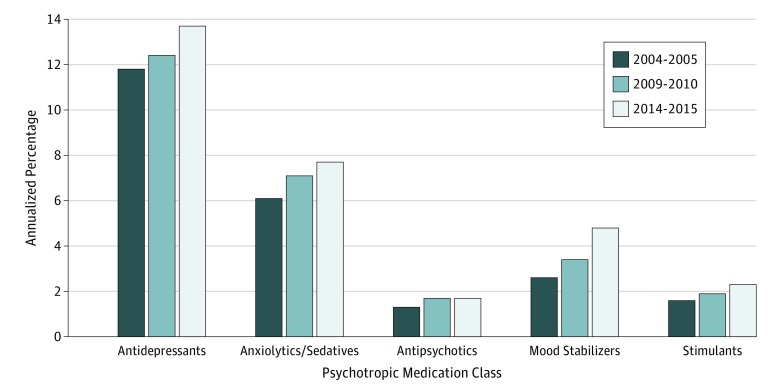
Main outcomes and measures: Annual national trends in the percentages of adults with serious psychological distress (Kessler 6 scale score ≥13), outpatient mental health service use (outpatient visit with a mental disorder diagnosis, psychotherapy visit, or psychotropic medication), and type of psychotropic medication use (antidepressants, anxiolytics/sedatives, antipsychotics, mood stabilizers, and stimulants). Age- and sex-adjusted odds ratios of the associations of survey period with the odds of serious psychological distress, outpatient mental health service use, and outpatient mental health service use were stratified by level of psychological distress.
Results: The analysis involved 139 862 adult participants from the 2004-2005, 2009-2010, and 2014-2015 MEPS, including 51.67% women, 48.33% men, 67.11% white adults, and 32.89% nonwhite adults, with an overall mean (SE) age of 46.41 (0.14) years. Serious psychological distress declined overall from 4.82% (2004-2005) to 3.71% (2014-2015), including significant declines among young (3.94% to 3.07%), middle-aged (5.52% to 4.36%), and older adults (5.24% to 3.79%); men (3.94% to 3.09%) and women (5.64% to 4.29%); and major racial/ethnic groups (white, 4.52% to 3.82%; African American, 5.12% to 3.64%; Hispanic, 6.03% to 3.55%; and other, 5.22% to 3.26%). Overall, the percentage of adults receiving any outpatient mental health service increased from 19.08% (2004-2005) to 23.00% (2014-2015) (adjusted odds ratio, 1.25; 95% CI, 1.17-1.34). Although the proportionate increase in outpatient mental health service use for adults with serious psychological distress (54.17% to 68.40%) was larger than that for adults with less serious or no psychological distress (17.26% to 21.08%), the absolute increase in outpatient mental health service use was almost completely the result of growth in outpatient mental health service use by individuals with less serious or no psychological distress.
Conclusions and relevance: The recent increase in outpatient mental health service use occurred during a period of decline in serious psychological distress. Adults with less serious psychological distress accounted for most of the absolute increase in outpatient mental health service use, while adults with serious psychological distress experienced a greater relative increase in outpatient mental health service use.
Conflict of interest statement
Figures
References
-
- National Center for Health Statistics , Centers for Disease Control and Prevention. Health, United States, 2016. —individual charts and tables: spreadsheet, PDF, and PowerPoint files. Table 080. https://www.cdc.gov/nchs/hus/contents2016.htm#080 Accessed May 5, 2018.
-
- Curtin SC, Warner M, Hedegaard H Suicide rates for females and males by race and ethnicity: United States, 1999 and 2014. NCHS health E-stat. National Center for Health Statistics. April 2016.
Publication types
MeSH terms
Substances
LinkOut - more resources
Full Text Sources
Medical
Miscellaneous