


A head-to-head comparison of personal and professional continuous glucose monitoring systems in people with type 1 diabetes: Hypoglycaemia remains the weak spot
- PMID: 30484947
- PMCID: PMC6590188
- DOI: 10.1111/dom.13598
A head-to-head comparison of personal and professional continuous glucose monitoring systems in people with type 1 diabetes: Hypoglycaemia remains the weak spot
Abstract
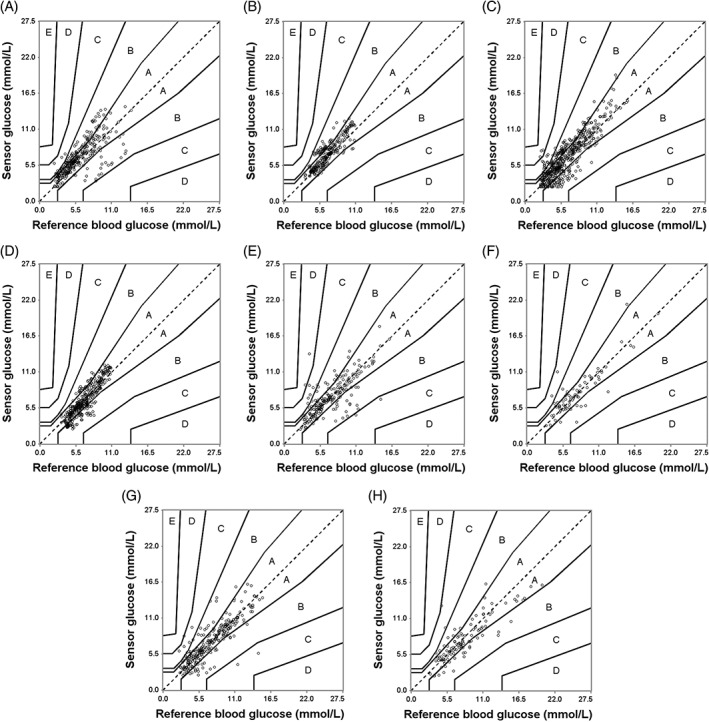
To compare the performance of a professional continuous glucose monitoring (proCGM) and a personal continuous glucose monitoring (persCGM) system worn in parallel under standardized conditions in individuals with type 1 diabetes (T1D), two CGM systems (iPro2 - proCGM; Minimed 640G - persCGM) worn in parallel using the same sensor (Enlite 2) were compared. Ten people with T1D were included in this single-centre, open-label study in which CGM performance was evaluated. The study consisted of a 24-hours inpatient phase (meals, exercise, glycaemic challenges) and a 4-day home phase. Analyses included fulfilment of ISO 15197:2013 criteria, mean absolute relative difference (MARD), Parkes Error Grid and Bland-Altman plots. During the inpatient stay, ISO 15197:2013 criteria fulfilment was 58.4% (proCGM) and 57.8% (persCGM). At home, the systems met ISO 15197:2013 criteria by 66.5% (proCGM) and 65.3% (persCGM). No difference of MARD in inpatient phase (19.1 ± 16.7% vs. 19.0 ± 19.6; P = 0.83) and home phase (18.6 ± 26.8% vs. 17.4 ± 21.3%, P = 0.87) was observed. All sensors performed less accurately during hypoglycaemia. ProCGM and persCGM showed similar performance during daytime and night-time for the inpatient and the home phase. However, sensor performance was reduced during hypoglycaemia for both systems.
Keywords: clinical trial; continuous glucose monitoring (CGM); hypoglycaemia; type 1 diabetes.
© 2018 The Authors. Diabetes, Obesity and Metabolism published by John Wiley & Sons Ltd.
Conflict of interest statement
Author contributions
O.M. and M.P. drafted the manuscript. T.R.P., H.S. and J.K.M. designed and performed the study, interpreted data and contributed to discussions. T.A. performed statistical analyses and reviewed the manuscript. F.A., H.K., D.H., P.K. and M. M. performed the study. All authors critically revised the article and approved the final version of the manuscript. J.K.M. is the guarantor of this work.
Figures
References
-
- Fonseca VA, Grunberger G, Anhalt H, et al. Continuouse glucose monitoring: a consensus conference of the American Association of Clinical Endocrinologists and American College of endocrinology. Endocr Pract. 2016;22:1008‐1021. - PubMed
-
- Bolinder J, Antuna R, Geelhoed‐Duijvestijn P, Kröger J, Weitgasser R. Novel glucose‐sensing technology and hypoglycaemia in type 1 diabetes: a multicentre, non‐masked, randomised controlled trial. Lancet. 2016;388:2254‐2263. - PubMed
-
- Oskarsson P, Antuna R, Geelhoed‐Duijvestijn P, Kröger J, Weitgasser R, Bolinder J. Impact of flash glucose monitoring on hypoglycaemia in adults with type 1 diabetes managed with multiple daily injection therapy: a pre‐specified subgroup analysis of the IMPACT randomised controlled trial. Diabetologia. 2018;61:539‐550. - PMC - PubMed
Publication types
MeSH terms
Substances
LinkOut - more resources
Full Text Sources
Medical
Miscellaneous
