


Would government compensation of living kidney donors exploit the poor? An empirical analysis
- PMID: 30485269
- PMCID: PMC6261427
- DOI: 10.1371/journal.pone.0205655
Would government compensation of living kidney donors exploit the poor? An empirical analysis
Abstract
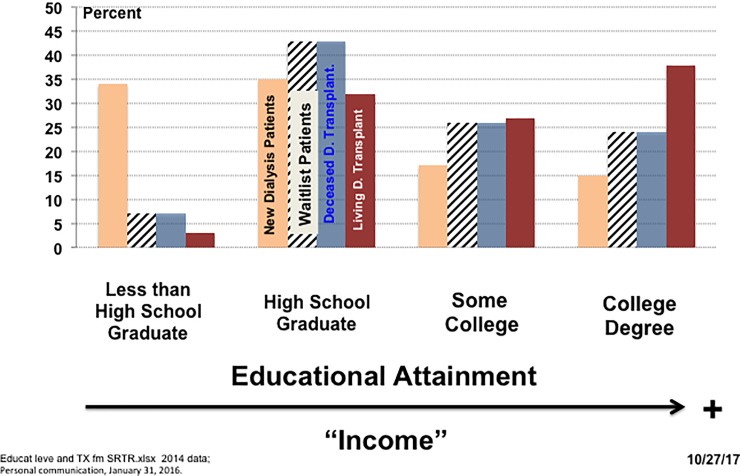
Government compensation of kidney donors would likely increase the supply of kidneys and prevent the premature deaths of tens of thousands of patients with kidney failure each year. The major argument against it is that it would exploit the poor who would be more likely to accept the offers of compensation. This overlooks the fact that many poor patients desperately need a kidney transplant and would greatly benefit from an increased supply of kidneys. The objective of this study is to empirically test the hypothesis that government compensation of kidney donors would exploit the poor. Exploitation is defined by economists and several noted ethicists as paying donors less than the fair market value of their kidney. Exploitation is expressed in monetary terms and compared with the economic benefit recipients receive from a transplant. Data are from the Scientific Registry of Transplant Recipients and the United States Renal Data System annual data reports. Educational attainment is used as a proxy for income. We estimate that if the government rewards living donors with a package of non-cash benefits worth $75,000 per kidney, donors would not be exploited. Much more important, this compensation would likely end the kidney shortage, enabling many more patients with kidney failure to obtain transplants and live longer and healthier lives. The value of kidney transplantation to a U.S. recipient is about $1,330,000, which is an order of magnitude greater than any purported exploitation of a living donor (zero to $75,000). Consequently, the aggregate net benefit to the poor alone from kidney transplantation would increase to about $12 billion per year from $1 billion per year currently. Most of the benefit would accrue to poor kidney recipients. But poor donors would receive the fair market value of their kidney, and hence would not be exploited. If the government wanted to ensure that donors also received a net benefit, it could easily do so by increasing the compensation above $75,000 per donor.
Conflict of interest statement
The authors have declared that no competing interests exist.
Figures

References
-
- U.S. Renal Data System (USRDS) 2017 Annual Data Report: Atlas of Chronic Kidney Disease and End-Stage Renal Disease in the United States, National Institutes of Health, National Institute of Diabetes and Digestive and Kidney Diseases, Bethesda, MD.
-
- U.S. Department of Health & Human Services, Organ Procurement and Transplantation Network. https://optn.transplant.hrsa.gov/data/view-data-reports/national-data/#. Accessed June 22, 2017.
-
- Kaserman D, Barnett A. The U.S. Organ Procurement System AEI Press; 2002.
-
- Tabarrok A, editor. The Organ Shortage: A Tragedy of the Commons In: Entrepreneurial Economics: Bright Ideas from the Dismal Science. Oxford: Oxford University Press; 2002.
-
- Becker GS, Elías JJ. Introducing incentives in the market for live and cadaveric organ donations. Journal of Economic Perspectives. 2007;21(3): 3–24. - PubMed
