


Prognostic factors and outcome of surgically treated patients with brain metastases of non-small cell lung cancer
- PMID: 30485664
- PMCID: PMC6360214
- DOI: 10.1111/1759-7714.12913
Prognostic factors and outcome of surgically treated patients with brain metastases of non-small cell lung cancer
Abstract
Background: Brain metastases (BM) are a common consequence of lung cancer and surgery is effective; however, the factors affecting survival after surgery are unclear. The aim of this study was to identify the outcomes and prognoses of post-metastasectomy patients with BM from non-small cell lung cancer (NSCLC) at a single institution over a 15-year period.
Methods: NSCLC patients who had undergone BM surgery were retrospectively identified. Survival was analyzed using the Kaplan-Meier curve, and univariate and multivariate factors associated with survival were identified using the Cox proportional hazards model.
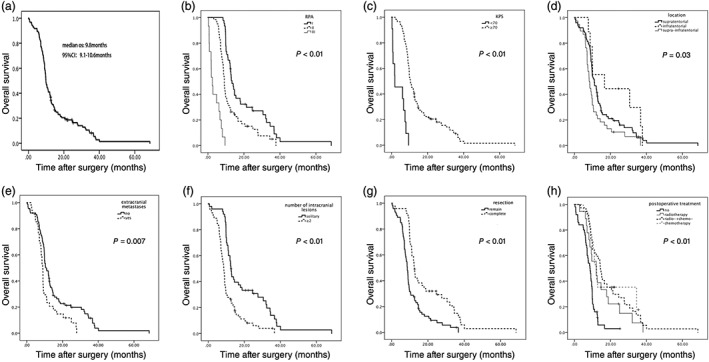
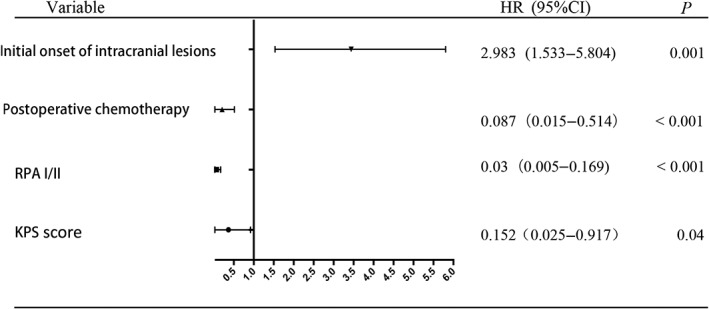
Results: The median overall survival was 9.8 months, 18 (14.8%) patients survived > 24 months, and 6 (4.9%) > 36 months. The one and two-year survival rates were 41% and 18.6%, respectively. Univariate analysis revealed that recursive partitioning analysis (RPA) classification, Karnofsky Performance Scale (KPS) scores, BM number, extracranial metastasis status, different lesion locations, resection extent, postoperative treatment, and salvage therapy after recurrence significantly influenced patient survival. The different treatment modalities for primary lesions also affected postoperative survival. KPS ≥ 70, RPA class I/II, and postoperative chemotherapy were independent factors that decreased the risk of death from BM. Interestingly, the initial onset of intracranial lesions could increase the risk of death from BM.
Conclusion: A KPS score ≥ 70, RPA class I/II, and postoperative chemotherapy could benefit post-metastasectomy patients with BM from NSCLC. Conversely, the initial onset of intracranial lesions is an unfavorable factor that increases the risk of death. These findings support the use of personalized therapy for patients with BM from NSCLC.
Keywords: Brain metastases; non-small cell lung cancer (NSCLC); prognostic factor; recursive partitioning analysis (RPA).
© 2018 The Authors. Thoracic Cancer published by China Lung Oncology Group and John Wiley & Sons Australia, Ltd.
Figures
References
-
- Chen W, Zheng R, Baade PD et al Cancer statistics in China, 2015. CA Cancer J Clin 2016; 66: 115–32. - PubMed
-
- Ramalingam SS, Owonikoko TK, Khuri FR. Lung cancer: New biological insights and recent therapeutic advances. CA Cancer J Clin 2011; 61: 91–112. - PubMed
-
- Travis WD, Brambilla E, Noguchi M et al American Thoracic Society, International Association for the Study of Lung Cancer/American Thoracic Society/European Respiratory Society: International multidisciplinary classification of lung adenocarcinoma: Executive summary. Proc Am Thorac Soc 2011; 8 (5): 381. - PubMed
-
- Hubbs JL, Boyd JA, Hollis D, Chino JP, Saynak M, Kelsey CR. Factors associated with the development of brain metastases: Analysis of 975 patients with early stage nonsmall cell lung cancer. Cancer 2010; 116: 5038–46. - PubMed
-
- Hsiao SH, Chung CL, Chou YT, Lee HL, Lin SE, Liu HE. Identification of subgroup patients with stage IIIB/IV non‐small cell lung cancer at higher risk for brain metastases. Lung Cancer 2013; 82: 319–23. - PubMed
Publication types
MeSH terms
LinkOut - more resources
Full Text Sources
Medical
