


Complex Investigation of a Pediatric Haematological Case: Haemophagocytic Syndrome Associated with Visceral Leishmaniasis and Epstein⁻Barr (EBV) Co-Infection
- PMID: 30486459
- PMCID: PMC6313770
- DOI: 10.3390/ijerph15122672
Complex Investigation of a Pediatric Haematological Case: Haemophagocytic Syndrome Associated with Visceral Leishmaniasis and Epstein⁻Barr (EBV) Co-Infection
Abstract
Background: Visceral leishmaniasis (VL) is an anthropozoonosis caused by an intracellular parasite belonging to the genus Leishmania. In the Mediterranean region, L. donovani and L. infantum are responsible for VL and dogs are the main reservoir. Haemophagocytic lymphohistiocytosis (HLH) represents a complication of VL and consists of unrestrained activation and proliferation of lymphocytes and macrophages, leading to uncontrolled immune activation. Haemophagocytic lymphohistiocytosis may also develop during viral infection, and Epstein⁻Barr virus (EBV) infection is one of the main HLH causes. Macrophage haemophagocytosis in the bone marrow aspirate is pathognomonic.
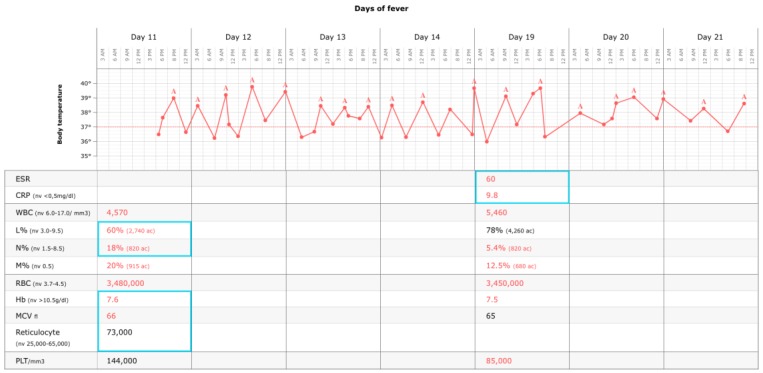
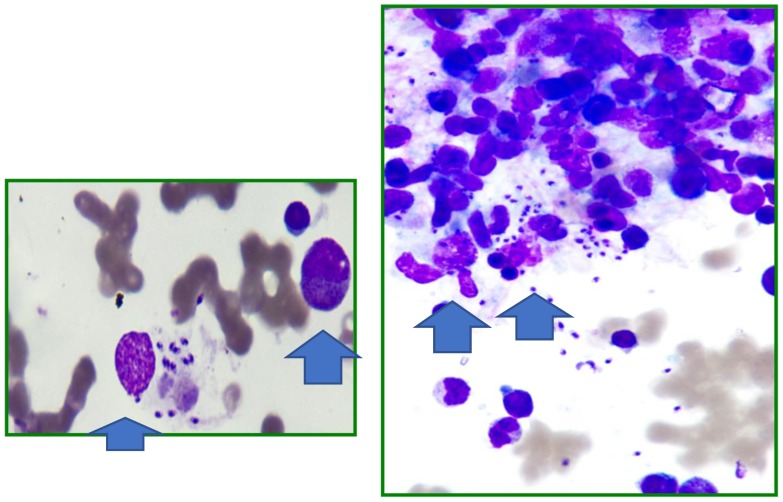
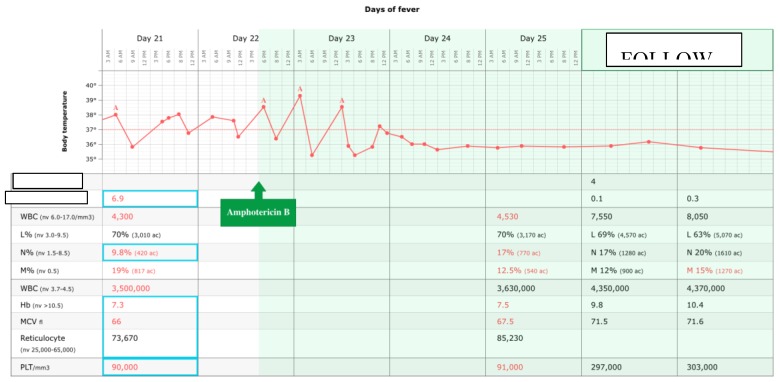
Case presentation: The case involves a 19-month-old male infant presenting with a high persistent fever with a fluctuating pattern, pancytopaenia, hepatosplenomegaly, and a high triglyceride level. Initial investigations showed an EBV infection. Considering the persistent signs and symptoms, bone marrow aspiration was performed and confirmed the suspicion of HLH. In addition, the presence of Leishmania infection was shown. The patient was treated with liposomal amphotericin B and had complete resolution of his symptoms.
Conclusion: Diagnosis of VL represents a demanding challenge in endemic and non-endemic areas. Our case demonstrates that leishmaniasis should always be considered in the differential diagnosis in patients presenting with hepatosplenomegaly and cytopaenia with a persistent fever, even in cases of infectious mononucleosis. Moreover, the execution of bone marrow aspiration should not be delayed in order to diagnose and treat at an early stage the potential occurrence of VL, especially if complicated with HLH.
Keywords: Epstein–Barr virus; Leishmania; haemophagocytic syndrome; mononucleosis; visceral leishmaniasis.
Conflict of interest statement
The authors declare no conflict of interest.
Figures
References
-
- Moriconi M., Rugna G., Calzolari M., Bellini R., Albieri A., Angelini P., Cagarelli R., Landini M.P., Charrel R.N., Varani S. Phlebotomine sand fly–borne pathogens in the Mediterranean Basin: Human leishmaniasis and phlebovirus infections. PLoS Negl. Trop. Dis. 2017;11:1–19. doi: 10.1371/journal.pntd.0005660. - DOI - PMC - PubMed
-
- World Health Organization . Control of the Leishmaniases: Report of a Meeting of the WHO Expert Commitee on the Control of Leishmaniases. WHO; Geneva, Switzerland: Mar 22–26, 2010.
-
- Svobodová M., Alten B., Zídková L., Dvorák V., Hlavacková J., Mysková J., Seblová V., Kasap O.E., Belen A., Votýpka J., et al. Cutaneous leishmaniasis caused by Leishmania infantum transmitted by Phlebotomus tobbi. Int. J. Parasitol. 2009;39:251–256. doi: 10.1016/j.ijpara.2008.06.016. - DOI - PubMed
-
- Rogers M.B., Downing T., Smith B.A., Imamura H., Sanders M., Svobodova M., Volf P., Berriman M., Cotton J.A., Smith D.F. Genomic confirmation of hybridisation and recent inbreeding in a vector-isolated Leishmania population. PLoS Genet. 2014;10:e1004092. doi: 10.1371/journal.pgen.1004092. - DOI - PMC - PubMed
Publication types
MeSH terms
Substances
LinkOut - more resources
Full Text Sources
