


Duration of unilateral auditory deprivation is associated with reduced speech perception after cochlear implantation: A single-sided deafness study
- PMID: 30486762
- PMCID: PMC6335158
- DOI: 10.1080/14670100.2018.1550469
Duration of unilateral auditory deprivation is associated with reduced speech perception after cochlear implantation: A single-sided deafness study
Abstract
Objective: Examine the relationship between duration of unilateral deafness and speech perception outcomes after cochlear implantation in adults with single-sided deafness.
Methods: A systematic review of PubMed articles containing individual speech perception and duration of deafness data from single-sided deaf adults. Studies were selected for detailed review and duration of deafness and speech perception outcomes were extracted, with speech scores reported as percent correct. A linear regression as a function of study and length of deafness was performed.
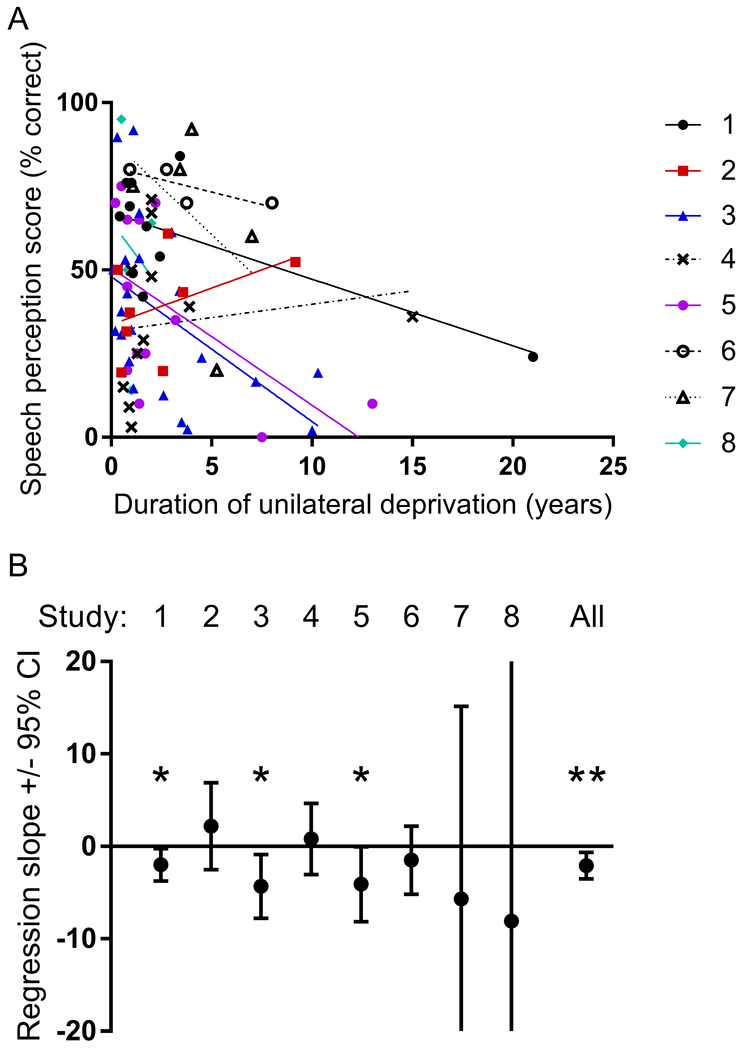
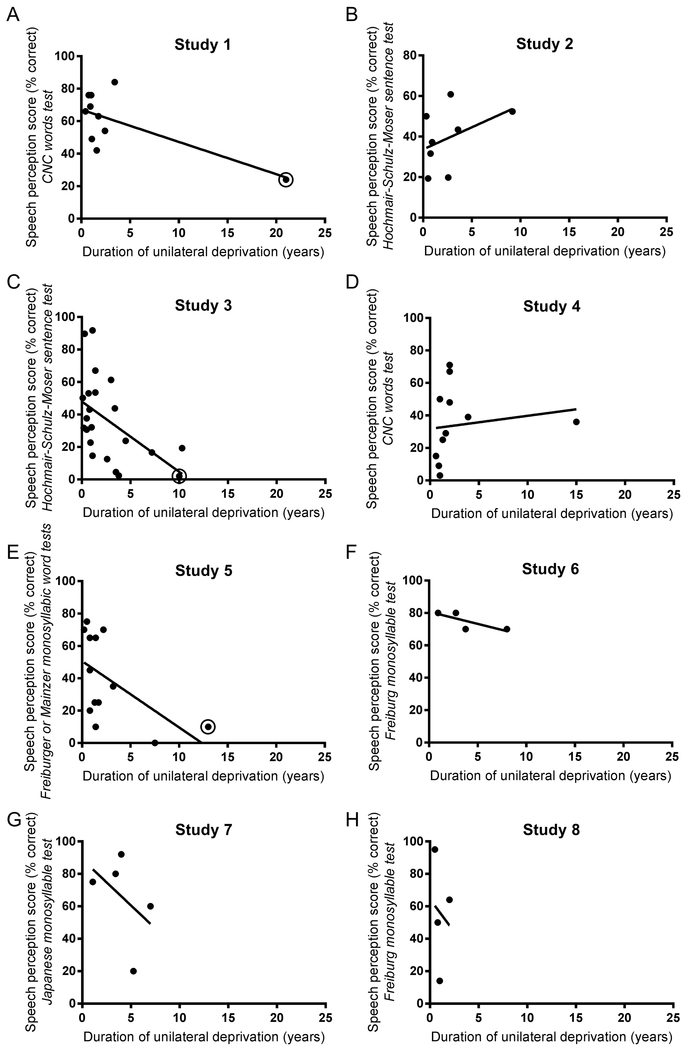
Results: A statistically significant negative effect of duration of unilateral deafness on speech perception was found, but there was substantial uncertainty regarding the strength of the effect.
Discussion: Existing data make it difficult to either support or reject a hard 5- or 10-year unilateral auditory deprivation limit on cochlear implant (CI) candidacy for patients with single-sided deafness. This is because the totality of available data are consistent with a very small effect, perhaps negligible in practical terms, and just as consistent with a very large effect. Regardless of effect size, the present results have important basic implications. They suggest that unilateral sound deprivation may have a deleterious effect on auditory processing even though more central parts of the auditory system have continued to receive input from a contralateral normal ear.
Conclusions: Speech perception scores in SSD patients are negatively correlated with duration of deafness, but the limited amount of data from cochlear implant users with long-term single-sided deafness leads to substantial uncertainly, which in turn precludes any strong clinical recommendations. Further study of SSD CI users with long-term deafness will be necessary to generate evidence-based guidelines for implantation criteria in this population.
Keywords: Cochlear Implant; Single-sided Deaf; Speech Perception.
Figures
References
-
- Arndt S, Aschendorff A, Laszig R, Beck R, Schild C, Kroeger S, et al. (2011). Comparison of pseudobinaural hearing to real binaural hearing rehabilitation after cochlear implantation in patients with unilateral deafness and tinnitus. Otol Neurotol, 32(1), 39–47. doi: 10.1097/MAO.0b013e3181fcf271 - DOI - PubMed
-
- Arndt S, Laszig R, Aschendorff A, Schild C, Beck R, Kroeger S, et al. (2011). The University of Freiburg Asymmetric Hearing Loss Study. Audiology and Neuro-Otology, 16(suppl 1), 3–25.
-
- Balkany TJ, Hodges AV, Eshraghi AA, Butts S, Bricker K, Lingvai J, et al. (2002). Cochlear implants in children--a review. Acta Otolaryngol, 122(4), 356–362. - PubMed
Publication types
MeSH terms
Grants and funding
LinkOut - more resources
Full Text Sources
