


"Sometimes it is difficult for us to stand up and change this": an analysis of power within priority-setting for health following devolution in Kenya
- PMID: 30486867
- PMCID: PMC6264027
- DOI: 10.1186/s12913-018-3706-5
"Sometimes it is difficult for us to stand up and change this": an analysis of power within priority-setting for health following devolution in Kenya
Abstract
Background: Practices of power lie at the heart of policy processes. In both devolution and priority-setting, actors seek to exert power through influence and control over material, human, intellectual and financial resources. Priority-setting arises as a consequence of the needs and demand exceeding the resources available, requiring some means of choosing between competing demands. This paper examines the use of power within priority-setting processes for healthcare resources at sub-national level, following devolution in Kenya.
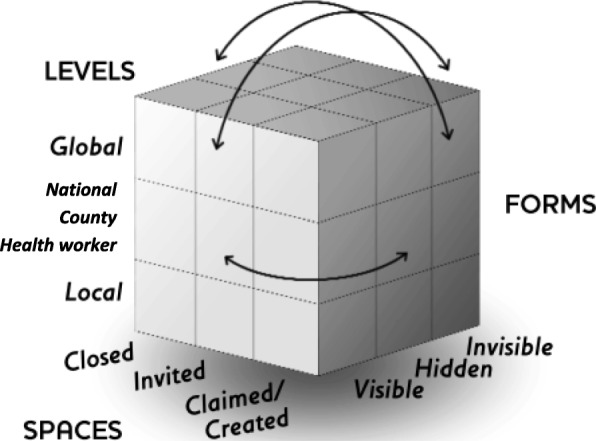
Methods: We interviewed 14 national level key informants and 255 purposively selected respondents from across the health system in ten counties. These qualitative data were supplemented by 14 focus group discussions (FGD) involving 146 community members in two counties. We conducted a power analysis using Gaventa's power cube and Veneklasen's expressions of power to interpret our findings.
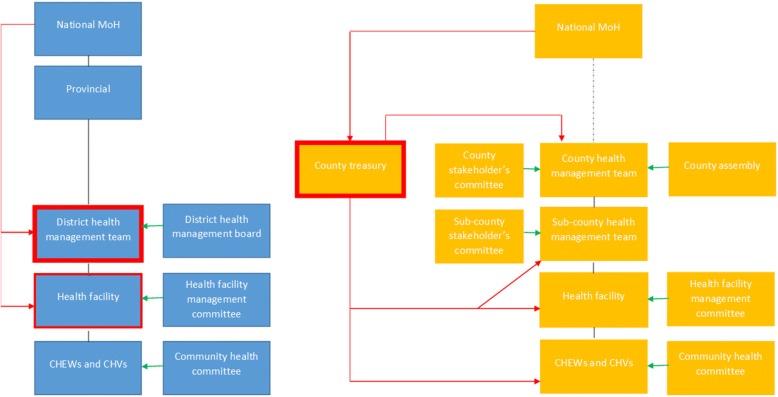
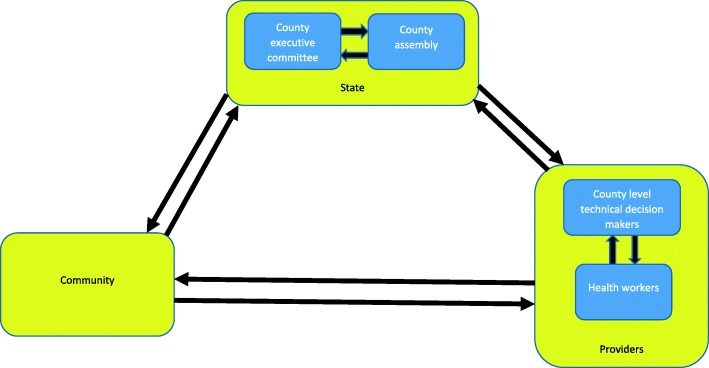
Results: We found Kenya's transition towards devolution is transforming the former centralised balance of power, leading to greater ability for influence at the county level, reduced power at national and sub-county (district) levels, and limited change at community level. Within these changing power structures, politicians are felt to play a greater role in priority-setting for health. The interfaces and tensions between politicians, health service providers and the community has at times been felt to undermine health related technical priorities. Underlying social structures and discriminatory practices generally continue unchanged, leading to the continued exclusion of the most vulnerable from priority-setting processes.
Conclusions: Power analysis of priority-setting at county level after devolution in Kenya highlights the need for stronger institutional structures, processes and norms to reduce the power imbalances between decision-making actors and to enable community participation.
Keywords: Devolution; Kenya; Power; Priority-setting.
Conflict of interest statement
Ethics approval and consent to participate
Ethical approval was received from Kenya Medical Research Institute (KEMRI) and Liverpool School of Tropical Medicine, with research permit from National Commission for Science Technology and Innovation (NACOSTI). Written informed consent was sought from and signed by all interviewed respondents.
Consent for publication
The manuscript has anonymised information to ensure confidentiality.
Competing interests
The authors declare that they have no competing interests.
Publisher’s Note
Springer Nature remains neutral with regard to jurisdictional claims in published maps and institutional affiliations.
Figures
References
-
- L. VeneKlasen, V. Miller, D. Budlender, and C. Clark, “power and empowerment,” in A New Weave of Power, People and Politics: The Action Guide for Advocacy and Citizen Participation, vol. 43, 2002, pp. 39–41.
-
- Confederation TNHS. London, UK. 2007. Priority setting : an overview the voice of NHS leadership.
MeSH terms
Grants and funding
LinkOut - more resources
Full Text Sources
Medical
