


Aortic stiffness in aortic stenosis assessed by cardiovascular MRI: a comparison between bicuspid and tricuspid valves
- PMID: 30488106
- PMCID: PMC6443917
- DOI: 10.1007/s00330-018-5775-6
Aortic stiffness in aortic stenosis assessed by cardiovascular MRI: a comparison between bicuspid and tricuspid valves
Abstract
Objectives: To compare aortic size and stiffness parameters on MRI between bicuspid aortic valve (BAV) and tricuspid aortic valve (TAV) patients with aortic stenosis (AS).
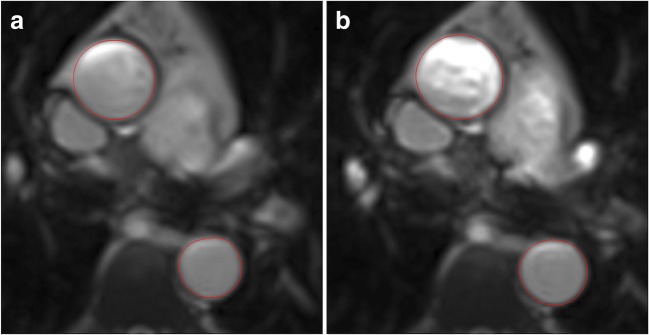
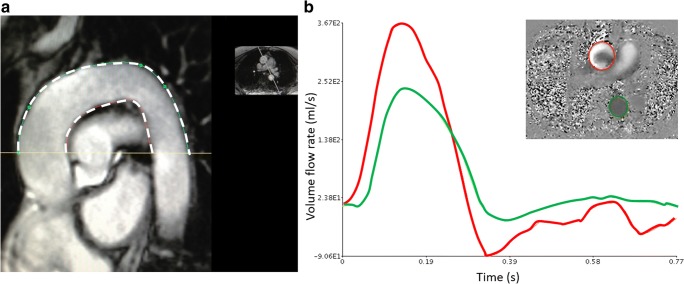
Methods: MRI was performed in 174 patients with asymptomatic moderate-severe AS (mean AVAI 0.57 ± 0.14 cm2/m2) and 23 controls on 3T scanners. Valve morphology was available/analysable in 169 patients: 63 BAV (41 type-I, 22 type-II) and 106 TAV. Aortic cross-sectional areas were measured at the level of the pulmonary artery bifurcation. The ascending and descending aorta (AA, DA) distensibility, and pulse wave velocity (PWV) around the aortic arch were calculated.
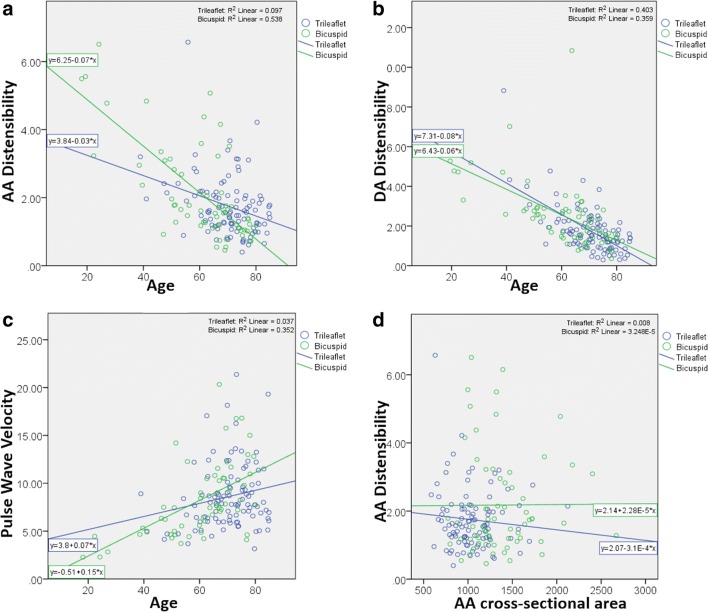
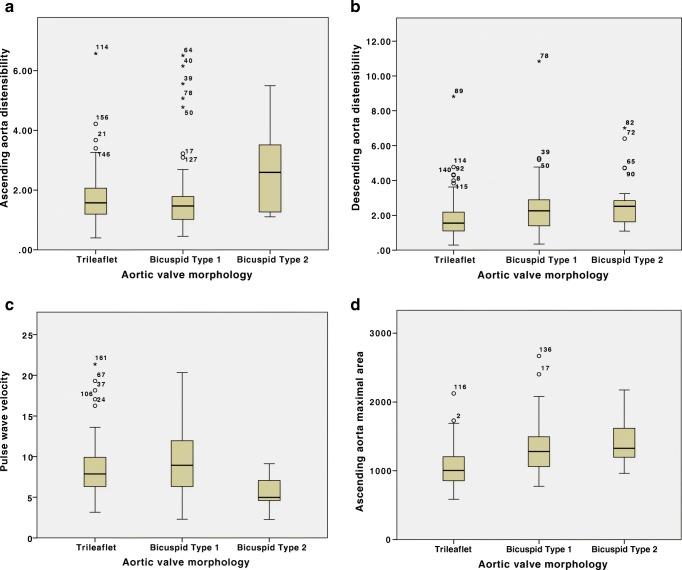
Results: The AA and DA areas were lower in the controls, with no difference in DA distensibility or PWV, but slightly lower AA distensibility than in the patient group. With increasing age, there was a decrease in distensibility and an increase in PWV. After correcting for age, the AA maximum cross-sectional area was higher in bicuspid vs. tricuspid patients (12.97 [11.10, 15.59] vs. 10.06 [8.57, 12.04] cm2, p < 0.001), but there were no significant differences in AA distensibility (p = 0.099), DA distensibility (p = 0.498) or PWV (p = 0.235). Patients with BAV type-II valves demonstrated a significantly higher AA distensibility and lower PWV compared to type-I, despite a trend towards higher AA area.
Conclusions: In patients with significant AS, BAV patients do not have increased aortic stiffness compared to those with TAV despite increased ascending aortic dimensions. Those with type-II BAV have less aortic stiffness despite greater dimensions. These results demonstrate a dissociation between aortic dilatation and stiffness and suggest that altered flow patterns may play a role.
Key points: • Both cellular abnormalities secondary to genetic differences and abnormal flow patterns have been implicated in the pathophysiology of aortic dilatation and increased vascular complications associated with bicuspid aortic valves (BAV). • We demonstrate an increased ascending aortic size in patients with BAV and moderate to severe AS compared to TAV and controls, but no difference in aortic stiffness parameters, therefore suggesting a dissociation between dilatation and stiffness. • Sub-group analysis showed greater aortic size but lower stiffness parameters in those with BAV type-II AS compared to BAV type-I.
Keywords: Aorta, thoracic; Aortic valve stenosis; Aortic valve, bicuspid; Magnetic resonance imaging; Pulse wave velocity.
Conflict of interest statement
Guarantor
The scientific guarantor of this publication is Professor Gerry McCann.
Conflict of interest
MAH is the owner of Xinapse Systems software which was used to quantify distensibility and PWV in this study. There are no other competing interests to declare.
Statistics and biometry
No complex statistical methods were necessary for this paper.
Informed consent
Written informed consent was obtained from all subjects before participation.
Ethical approval
The study was approved by the United Kingdom National Research Ethics Service (11/EM/0410).
Study subjects or cohort overlaps
Some study subjects have been previously reported in the main results of the PRIMID-AS study (as mentioned in reference 15 under the “Materials and methods” section of the manuscript). However, the aortic stiffness parameters are novel in this manuscript, as is the comparison of bicuspid and tricuspid sub-groups.
Methodology
• Prospective
• Multi-centre
• Observational study
Figures
References
Publication types
MeSH terms
Grants and funding
LinkOut - more resources
Full Text Sources
Medical
Research Materials
