


Fluid administration rate for uncontrolled intraabdominal hemorrhage in swine
- PMID: 30496239
- PMCID: PMC6264836
- DOI: 10.1371/journal.pone.0207708
Fluid administration rate for uncontrolled intraabdominal hemorrhage in swine
Abstract
Background: We hypothesized that slow crystalloid resuscitation would result in less blood loss and a smaller hemoglobin decrease compared to a rapid resuscitation during uncontrolled hemorrhage.
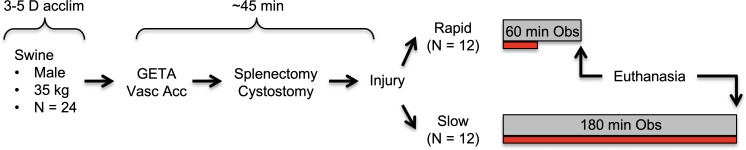
Methods: Anesthetized, splenectomized domestic swine underwent hepatic lobar hemitransection. Lactated Ringers was given at 150 or 20 mL/min IV (rapid vs. slow, respectively, N = 12 per group; limit of 100 mL/kg). Primary endpoints were blood loss and serum hemoglobin; secondary endpoints included survival, vital signs, coagulation parameters, and blood gases.
Results: The slow group had a less blood loss (1.6 vs. 2.7 L, respectively) and a higher final hemoglobin concentration (6.0 vs. 3.4 g/dL).
Conclusions: Using a fixed volume of crystalloid resuscitation in this porcine model of uncontrolled intraabdominal hemorrhage, a slow IV infusion rate produced less blood loss and a smaller hemoglobin decrease compared to rapid infusion.
Conflict of interest statement
The authors have declared that no competing interests exist.
Figures
References
-
- Blackbourne LH, Czarnik J, Mabry R, Eastridge B, Baer D, Butler F, et al. Decreasing killed in action and died of wounds rates in combat wounded. The Journal of trauma. 2010;69 Suppl 1:S1–4. 10.1097/TA.0b013e3181e4206f . - DOI - PubMed
-
- Eastridge BJ, Hardin M, Cantrell J, Oetjen-Gerdes L, Zubko T, Mallak C, et al. Died of wounds on the battlefield: causation and implications for improving combat casualty care. The Journal of trauma. 2011;71(1 Suppl):S4–8. 10.1097/TA.0b013e318221147b . - DOI - PubMed
-
- Shrestha B, Holcomb JB, Camp EA, Del Junco DJ, Cotton BA, Albarado R, et al. Damage-control resuscitation increases successful nonoperative management rates and survival after severe blunt liver injury. The journal of trauma and acute care surgery. 2015;78(2):336–41. 10.1097/TA.0000000000000514 . - DOI - PubMed
-
- Butler F, Holcomb J, Schreiber M, Kotwal R, Jenkins D, Champion H, et al. Fluid Resuscitation for Hemorrhagic Shock in Tactical Combat Casualty Care: TCCC Guidelines Change 14-01-2 June 2014. J Spec Op Med. 2013;14(3):13–38. . - PubMed
-
- Committee on Tactical Combat Casualty Care. TCCC Guidelines for Medical Personnel (1 August 2018): United States Department of Defense; 2018 [Accessed September 11, 2018]. Available from: URL: https://www.jsomonline.org/TCCC.php.
Publication types
MeSH terms
Substances
LinkOut - more resources
Full Text Sources
Other Literature Sources
