


Guideline-Based Physical Activity and Survival Among US Men With Nonmetastatic Prostate Cancer
- PMID: 30496346
- PMCID: PMC6395165
- DOI: 10.1093/aje/kwy261
Guideline-Based Physical Activity and Survival Among US Men With Nonmetastatic Prostate Cancer
Abstract
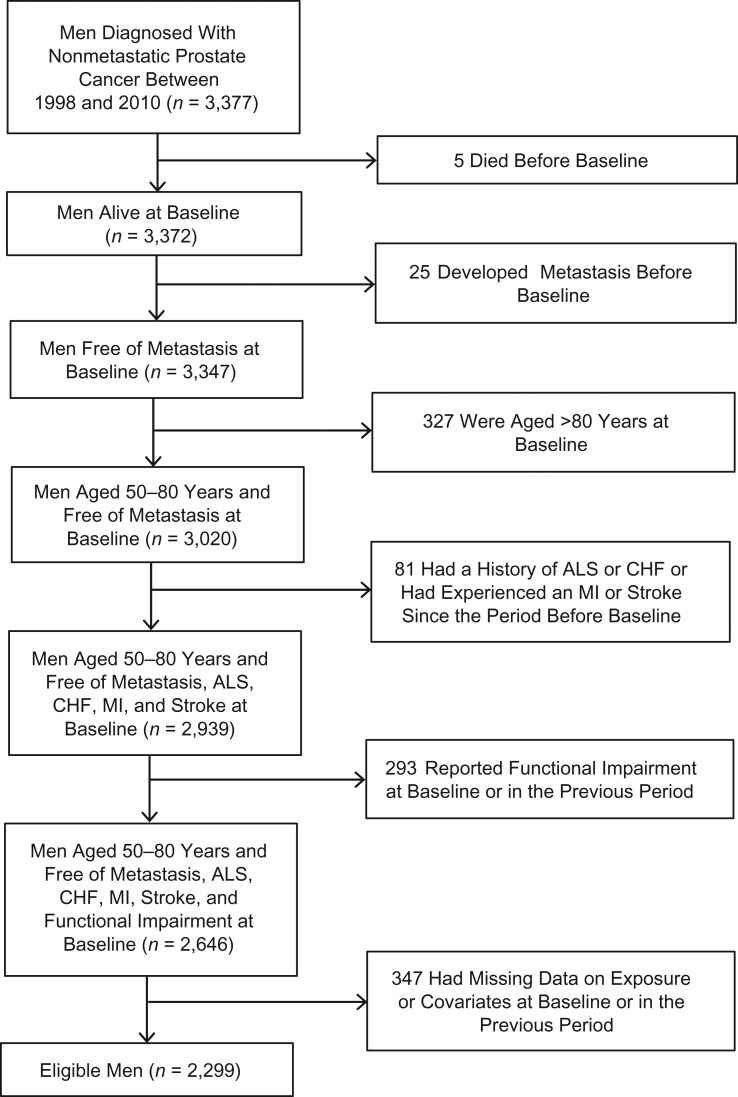
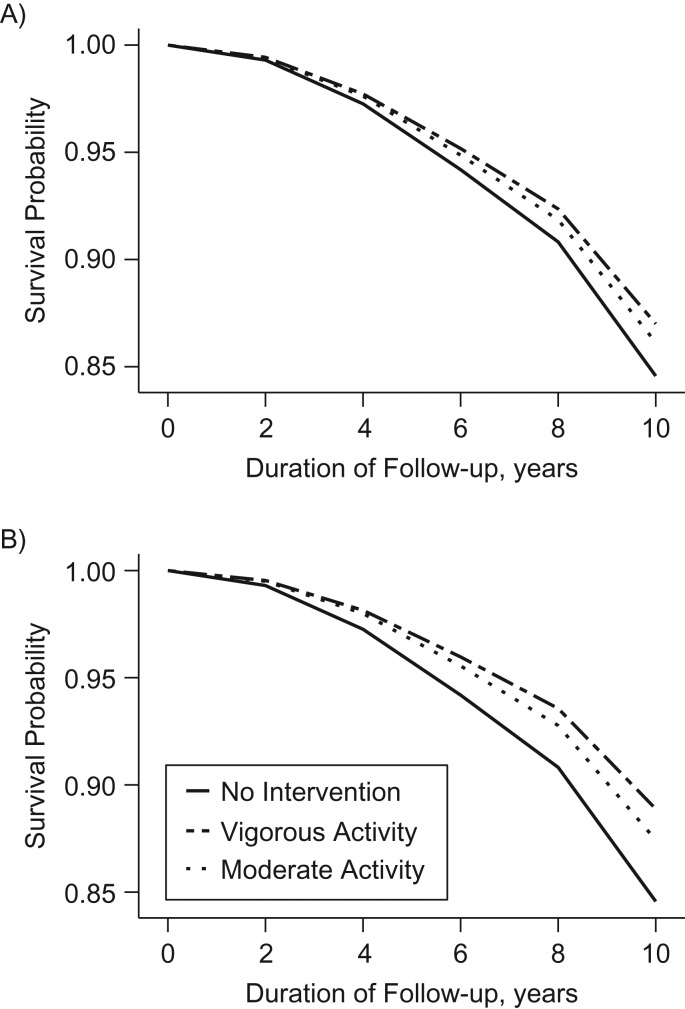
The survival impact of adhering to current physical activity guidelines after prostate cancer diagnosis is unknown. We therefore emulated a target trial of guideline-based physical activity interventions and 10-year survival among US men with nonmetastatic prostate cancer. We used observational data on 2,299 men in the Health Professionals Follow-up Study who were diagnosed with nonmetastatic prostate cancer from 1998 to 2010 and were free of conditions that might have precluded participation at baseline (first postdiagnostic questionnaire). We estimated their survival under several guideline-based physical activity interventions starting at baseline and ending at the development of conditions limiting physical ability. We adjusted for baseline and time-varying risk factors for death using the parametric g-formula. Compared with the observed 15.4% mortality risk, the estimated 10-year risks of mortality were 13.0% (95% confidence interval (CI): 10.9, 15.4) and 11.1% (95% CI: 8.7, 14.1) for ≥1.25 hours/week and ≥2.5 hours/week of vigorous activity, respectively, and 13.9% (95% CI: 12.0, 16.0) and 12.6% (95% CI: 10.6, 14.7) for ≥2.5 hours/week and ≥5 hours/week of moderate activity, respectively. We estimated that these men would have experienced clinically meaningful reductions in mortality had they followed current physical activity recommendations until the development of conditions limiting physical ability. These findings may help guide clinical recommendations for prostate cancer patients and the design of future randomized trials.
Keywords: causal inference; cohort studies; lifestyle; parametric g-formula; physical activity; prostate cancer; survival.
© The Author(s) 2019. Published by Oxford University Press on behalf of the Johns Hopkins Bloomberg School of Public Health. All rights reserved. For permissions, please e-mail: journals.permissions@oup.com.
Figures
References
-
- Bonn SE, Sjölander A, Lagerros YT, et al. Physical activity and survival among men diagnosed with prostate cancer. Cancer Epidemiol Biomarkers Prev. 2015;24(1):57–64. - PubMed
-
- Wang Y, Jacobs EJ, Gapstur SM, et al. Recreational physical activity in relation to prostate cancer-specific mortality among men with nonmetastatic prostate cancer. Eur Urol. 2017;72(6):931–939. - PubMed
-
- Friedenreich CM, Wang Q, Neilson HK, et al. Physical activity and survival after prostate cancer. Eur Urol. 2016;70(4):576–585. - PubMed
