


Hot beverages and oesophageal cancer risk in western Kenya: Findings from the ESCCAPE case-control study
- PMID: 30496610
- PMCID: PMC6519248
- DOI: 10.1002/ijc.32032
Hot beverages and oesophageal cancer risk in western Kenya: Findings from the ESCCAPE case-control study
Abstract
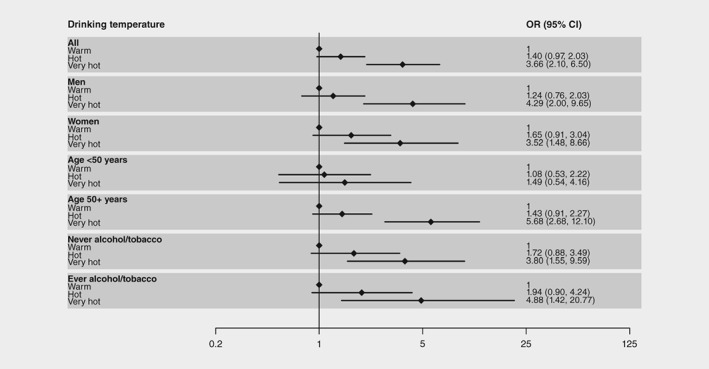
Oesophageal squamous cell carcinoma (ESCC) has markedly high incidence rates in Kenya and much of East Africa, with a dire prognosis and poorly understood aetiology. Consumption of hot beverages-a probable carcinogen to humans-is associated with increased ESCC risk in other settings and is habitually practiced in Kenya. We conducted a case-control study in Eldoret, western Kenya between August 2013 and March 2018. Cases were patients with endoscopically confirmed oesophageal cancer whose histology did not rule out ESCC. Age and sex-matched controls were hospital visitors and hospital out and in-patients excluding those with digestive diseases. Odds ratios (ORs) and 95% confidence intervals (CIs) were estimated for self-reported drinking temperatures; consumption frequency; mouth burning frequency and hot porridge consumption using logistic regression models adjusted for potential confounders. Drinking temperature association with tumour sub-location was also investigated. The study included 430 cases and 440 controls. Drinkers of 'very hot' and 'hot' beverages (>95% tea) had a 3.7 (95% CI: 2.1-6.5) and 1.4-fold (1.0-2.0) ESCC risk, respectively compared to 'warm' drinkers. This trend was consistent in males, females, never and ever alcohol/tobacco and was stronger over than under age 50 years. The tumour sub-location distribution (upper/middle/lower oesophagus) did not differ by reported drinking temperature. Our study is the first comprehensive investigation in this setting to-date to observe a link between hot beverage consumption and ESCC in East Africa. These findings provide further evidence for the role of this potentially modifiable risk factor in ESCC aetiology.
Keywords: Africa; aetiology; hot beverages; oesophageal cancer.
© 2018 The Authors. International Journal of Cancer published by John Wiley & Sons Ltd on behalf of UICC.
Figures
References
-
- Ferlay J, Soerjomataram I, Dikshit R, et al. Cancer incidence and mortality worldwide: sources, methods and major patterns in GLOBOCAN 2012. Int J Cancer 2015;136:E359–E86. - PubMed
Publication types
MeSH terms
Grants and funding
LinkOut - more resources
Full Text Sources
Medical
