


Availability and affordability of priority life-saving medicines for under-five children in health facilities of Tigray region, northern Ethiopia
- PMID: 30497441
- PMCID: PMC6267819
- DOI: 10.1186/s12884-018-2109-2
Availability and affordability of priority life-saving medicines for under-five children in health facilities of Tigray region, northern Ethiopia
Abstract
Background: In developing countries, child health outcomes are influenced by the non-availability of priority life-saving medicines at public sector health facilities and non-affordability of medicines at private medicine outlets. This study aimed to assess availability, price components and affordability of priority life-saving medicines for under-five children in Tigray region, Northern Ethiopia.
Methods: A cross-sectional study was conducted in Tigray region from December 2015 to July 2016 using a standard method developed by the World Health Organization and Health Action International (WHO/HAI). Data on the availability and price of 27 priority life-saving medicines were collected from 31 public and 10 private sectors. Availability and prices were expressed in percent and median price ratios (MPRs), respectively. Affordability was reported in terms of the daily wage of the lowest-paid unskilled government worker.
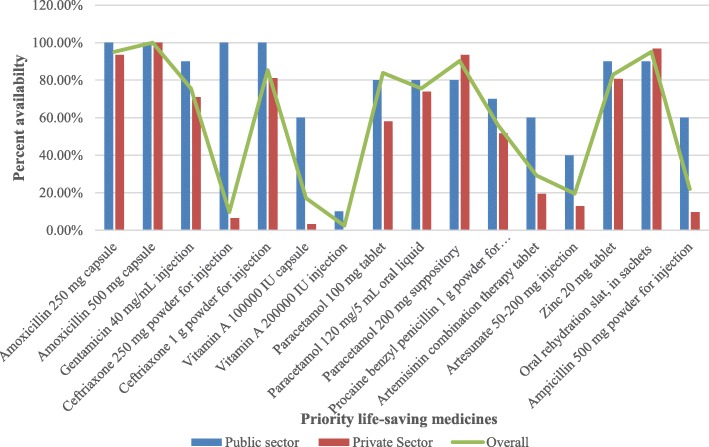
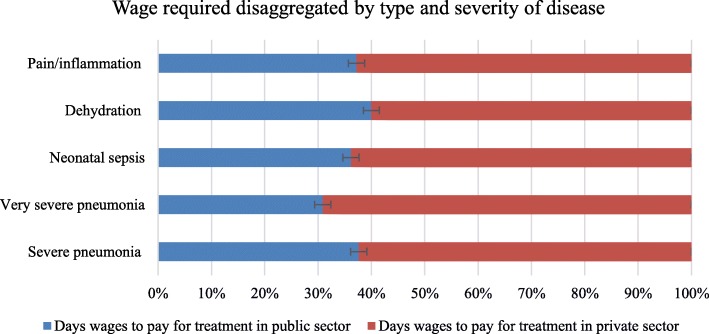
Results: The overall availability of priority life-saving drugs in this study was low (34.1%). The average availabilities of all surveyed medicines in public and private sectors were 41.9 and 31.5%, respectively. The overall availability of medicines for malaria was found to be poor with average values of 29.3% for artemisinin combination therapy tablet, 19.5% for artesunate injection and 0% for rectal artesunate. Whereas, the availability of oral rehydration salt (ORS) and zinc sulphate dispersible tablets for the treatment of diarrhea was moderately high (90% for ORS and 82% for zinc sulphate). Medicines for pneumonia showed an overall percent availability in the range of 0% (ampicillin 250 mg and 1 g powder for injection and oxygen medicinal gas) to 100% (amoxicillin 500 mg capsule). The MPRs of 12 lowest price generic medicines were 1.5 and 2.7 times higher than the international reference prices (IRPs) for the private and public sectors, respectively. About 30% of priority life-saving medicines in the public sector and 50% of them in the private sector demanded above a single daily wages to purchase the standard treatment of the prevalent diseases of children.
Conclusions: The lower availability, high price and low affordability of lowest price generic priority life-saving medicines in public and private sectors reflect a failure to implement the health policy on priority life-saving medicines in the region.
Keywords: Affordability; Availability; Medicine Price; Priority life-saving medicines; Tigray Ethiopia; Under-five children.
Conflict of interest statement
Ethics approval and consent to participate
The study was approved by Mekelle University Health Sciences College Ethical Review Committee (MUHSCERC). After approval of ethical issues, official letters of permission were obtained from Tigray Regional Health Bureau for each health care facilities. The permission letters were distributed to administrators of the respective medicine outlets and permission was obtained from them to conduct the study. The aim of the study was then clarified to the study participants, confidentiality was ensured and written consent was obtained prior to data collection.
Consent for publication
Not applicable.
Competing interests
The authors declare that they have no competing interests.
Publisher’s Note
Springer Nature remains neutral with regard to jurisdictional claims in published maps and institutional affiliations.
Figures
References
-
- United Nations, Department of Economic and Social Affairs, Population Division. World Mortality Report 2015: Mortality Data Inventory 2015 (POP/DB/MORT/2015). Available online at: http://www.un.org/en/development/desa/population/theme/mortality. Accessed 28 May 2017.
-
- You D, Hug L, Ejdemyr S, Idele P, Hogan D, Mathers C, et al. Global, regional, and national levels and trends in under-5 mortality between 1990 and 2015, with scenario-based projections to 2030: a systematic analysis by the UN inter-agency Group for Child Mortality Estimation. Lancet. 2015;386:2275–2286. doi: 10.1016/S0140-6736(15)00120-8. - DOI - PubMed
-
- WHO. United Nations Children’s Fund, The World Bank. Population Division. Levels & Trends in Child Mortality Report 2015 Estimates. Available at: http://www.who.int/maternal_child_adolescent/documents/levels_trends_chi.... Accessed 22 May 2017.
-
- Central Statistical Agency (CSA) [Ethiopia] and ICF . Key indicators report. Addis Ababa, Ethiopia, and Rockville. USA: Maryland; 2016. Ethiopia Demographic and Health Survey; p. 2016.
-
- WHO. UN Commission on Life-Saving Commodities for Women and Children. 2012. http://www.unfpa.org/publications/un-commission-life-saving-commodities-.... Accessed 21 June 2017.
MeSH terms
Substances
Grants and funding
LinkOut - more resources
Full Text Sources
Medical
