


Vaccine-preventable disease control in the People's Republic of China: 1949-2016
- PMID: 30497834
- PMCID: PMC7115483
- DOI: 10.1016/j.vaccine.2018.10.005
Vaccine-preventable disease control in the People's Republic of China: 1949-2016
Abstract
Background: China's immunization program is one of the oldest and largest in the world. Rates of vaccine-preventable diseases (VPD) are comparable to those in high-income countries. The program's evolution has been characterized by ambitious target setting and innovative strategies that have not been widely described.
Methods: We reviewed national and provincial health department archives; analyzed disease surveillance, vaccination coverage, and serosurvey data from 1950 through 2016; and, conducted in-depth interviews with senior Chinese experts involved early VPD control efforts.
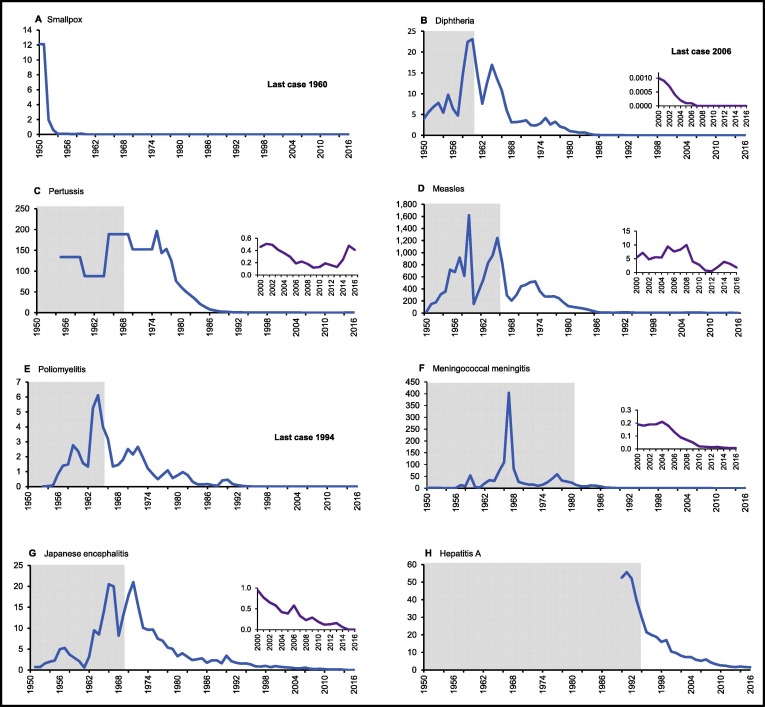
Results: Widespread immunization began in the 1950s with smallpox, diphtheria, and Bacillus-Calmette Guerin vaccines, and in the 1960s with pertussis, tetanus, polio, measles, and Japanese encephalitis (JE) vaccines. The largest drops in absolute VPD burden occurred in the 1970s with establishment of the Rural Cooperative Medical System and a cadre of trained peasant health workers whose responsibilities included vaccinations. From 1970 to 1979, incidence per 100,000 population dropped 48% from 3.3 to 1.75 for diphtheria, 50% from 152.2 to 49.4 for pertussis, 77% from 2.5 to 0.6 for polio, 60% from 450.5 to 178.3 for measles, and 72% from 18.0 to 5.1 for JE, averting an average of 4 million VPD cases each year. Until the early 1980s, vaccines were delivered through annual winter campaigns using a coordinated 'rush-relay' system to expedite transport while leveraging vaccine thermostability. Establishment of the cold chain system during in the 1980s allowed bi-monthly vaccination rounds and more timely vaccination resulting in rates of diphtheria, pertussis, measles and meningitis falling over 90% from 1980 to 1989, while polio and JE rates fell 40-50%. In the 1990s, progress stalled as financing for public health was weakened by broad market reforms. Large investments in public health and immunizations by the central government since 2004 has led to further declines in VPD burden and increased equity. During 2011-2016, the incidence per 100,000 population was <2.0 for measles and <0.2 for pertussis, JE, meningococcal meningitis, and hepatitis A. From 1992 to 2014, the prevalence of chronic hepatitis B infection in children <5 years fell from 9.7% to 0.3%, a 97% decline. China was certified polio-free in 2000 and diphtheria was last reported in 2006.
Conclusions: Long-term political commitment to immunizations as a basic right, ambitious targets, use of disease incidence as the primary metric to assess program performance, and nationwide scale-up of successful locally developed strategies that optimized use of available limited resources have been critical to China's success in controlling vaccine-preventable diseases.
Keywords: China; Immunization; Incidence; Vaccine-preventable disease.
Copyright © 2018 Elsevier Ltd. All rights reserved.
Figures
References
-
- Wang Guoqiang. China Population Publishing House; Beijing: 2015. A 60-year history of disease prevention and control in China; pp. 257–305.
-
- Kung F.C. New China’s achievements in health work. Chin Med J. March 1953:7187–7192.
-
- Chinese Communist Party. Constitutional principles of the Shaanxi-Gansu-Ningxia Border Region. 23 April 1946 [Chinese].
-
- Dai Z.C., Qi G.M. Beijing; Beijing Science and Technology Press: 1997. Viral hepatitis in China. Seroepidemiological survey in Chinese population (Part one) 1992–1995; pp. 39–58. [Chinese]
-
- Liang X., Bi S., Yang W., Wang L., Cui G., Cui F. Epidemiological serosurvey of hepatitis B in China – declining HBV prevalence due to hepatitis B vaccination. Vaccine. 2009;27:6550–6557. - PubMed
Publication types
MeSH terms
LinkOut - more resources
Full Text Sources
