Review
. 2019 Feb;15(2):77-90.
doi: 10.1038/s41584-018-0123-4.

Intra-articular treatment options for knee osteoarthritis

Affiliations
Review

Intra-articular treatment options for knee osteoarthritis

Ian A Jones et al. Nat Rev Rheumatol. 2019 Feb.

Abstract

Intra-articular drug delivery has a number of advantages over systemic administration; however, for the past 20 years, intra-articular treatment options for the management of knee osteoarthritis (OA) have been limited to analgesics, glucocorticoids, hyaluronic acid (HA) and a small number of unproven alternative therapies. Although HA and glucocorticoids can provide clinically meaningful benefits to an appreciable number of patients, emerging evidence indicates that the apparent effectiveness of these treatments is largely a result of other factors, including the placebo effect. Biologic drugs that target inflammatory processes are used to manage rheumatoid arthritis, but have not translated well into use in OA. A lack of high-level evidence and methodological limitations hinder our understanding of so-called 'stem' cell therapies and, although the off-label administration of intra-articular cell therapies (such as platelet-rich plasma and bone marrow aspirate concentrate) is common, high-quality clinical data are needed before these treatments can be recommended. A number of promising intra-articular treatments are currently in clinical development in the United States, including small-molecule and biologic therapies, devices and gene therapies. Although the prospect of new, non-surgical treatments for OA is exciting, the benefits of new treatments must be carefully weighed against their costs and potential risks.


Conflict of interest statement

Competing interests

I.A.J., R.T., M.L.W. and N.H. declare no competing interests. C.T.V.Jr. declares that he holds shares in CarthroniX Inc. and in Parcus Medical.

Figures
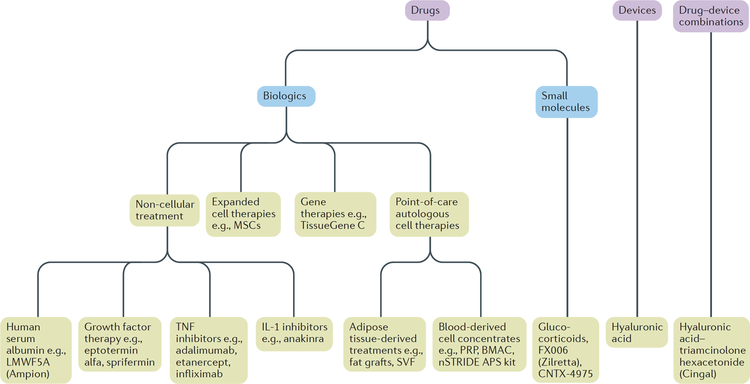
Figure 1.
Figure 1.. Intra-articular treatments for osteoarthritis.
Intra-articular treatments for osteoarthritis are approved by the FDA as drugs, devices or drug-device combination products. Drugs are classified as small molecules (<900 Daltons) or biologics, which can be further broken down into four sub-categories (non-cellular therapies, expanded cell therapies, gene therapies and point-of-care autologous cell therapies). The therapeutic effects of non-cellular biologic drugs depend on single large complex molecules or on specific mixtures of molecules. For the sake of simplicity, only clinically investigated human serum albumin, TNF inhibitors, IL-1 inhibitors and growth factors are included. Expanded cell therapies are biologic drug ‘factories’ that are subject to strict regulatory oversight, whereas gene therapies introduce genes that make beneficial protein(s) or compensate for abnormal genes. Point-of-care autologous cell therapies are heterogeneous mixtures containing cells (or cell products) that are derived from autologous blood, bone marrow or adipose tissue and are often given to patients off-label. APS, autologous protein solution; BMAC, bone marrow aspirate concentrate; MSC, mesenchymal stem cell; PRP, platelet-rich plasma; SVF, stromal vascular fraction.
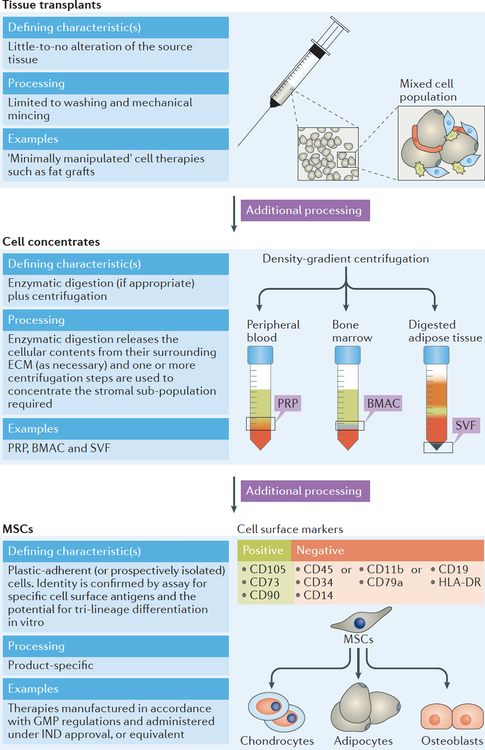
Figure 2.
Figure 2.. Intra-articular cell therapies.
Cell therapies can be broadly characterized by the method used to produce them or, because processing tissue concentrates specific cell population(s), by their relative heterogeneity compared with the source tissue. Intra-articular tissue injections (such as fat grafts) are the least processed and most heterogeneous treatments, whereas mesenchymal stromal (or stem) cells (MSCs) are the most processed and least heterogeneous. Within each treatment category, therapies (and the regulations governing their clinical use) tend to differ widely. As such, treatment categories should only be used as a conceptual framework and should not be used to draw false equivalencies concerning the efficacy or safety of different treatments. BMAC, bone marrow aspirate concentrate; GMP, good manufacturing practices; IND, investigational new drug, PRP, platelet-rich plasma; SVF, stromal vascular fraction.
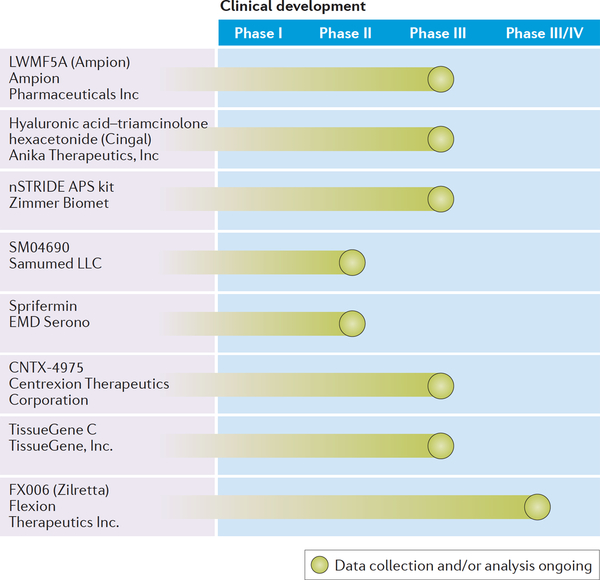
Figure 3.
Figure 3.. Intra-articular osteoarthritis therapy pipeline.
Current developmental status of intra-articular therapies for osteoarthritis. The information in this figure is derived from clinicaltrials.gov listings and company press releases, and does not reflect or provide an approximate time to market.

References

    1. Sinusas K Osteoarthritis: diagnosis and treatment. Am Fam Physician (2012). - PubMed
    1. Liu-Bryan R Synovium and the innate inflammatory network in osteoarthritis progression. Curr Rheumatol Rep 15, 323 (2013). - PMC - PubMed
    1. Haseeb A & Haqqi TM Immunopathogenesis of osteoarthritis. Clin. Immunol 146, 185–196 (2013). - PMC - PubMed
    1. Aigner T, Söder S, Gebhard PM, McAlinden A & Haag J Mechanisms of disease: role of chondrocytes in the pathogenesis of osteoarthritis--structure, chaos and senescence. Nature clinical practice. Rheumatology 3, 391–399 (2007). - PubMed
    1. Chevalier X, Eymard F & Richette P Biologic agents in osteoarthritis: hopes and disappointments. Nature Reviews Rheumatology 9, 400–410 (2013). - PubMed

Publication types

MeSH terms

Substances