


What is the impact of GOLD 2017 recommendations in primary care? - a descriptive study of patient classifications, treatment burden and costs
- PMID: 30498338
- PMCID: PMC6207393
- DOI: 10.2147/COPD.S173664
What is the impact of GOLD 2017 recommendations in primary care? - a descriptive study of patient classifications, treatment burden and costs
Erratum in
-
Erratum: What is the impact of GOLD 2017 recommendations in primary care? - a descriptive study of patient classifications, treatment burden and costs [Erratum].Int J Chron Obstruct Pulmon Dis. 2018 Dec 5;13:3899. doi: 10.2147/COPD.S194746. eCollection 2018. Int J Chron Obstruct Pulmon Dis. 2018. PMID: 30584290 Free PMC article.
Abstract
Purpose: The changes in grading of disease severity and treatment recommendations for patients with COPD in the 2017 GOLD strategy may present an opportunity for reducing treatment burden for the patients and costs to the health care system. The aim of this study was to assess the implications of the GOLD 2017 grading system in terms of change in distribution across GOLD groups A-D for existing patients in UK primary care and estimate the potential cost savings of implementing GOLD 2017 treatment recommendations in UK primary care.
Patients and methods: Using electronic health record data from the Clinical Practice Research Datalink (CPRD), patients aged ≥35 years with spirometry-confirmed COPD, receiving care during 2016, were included. The cohort was graded according to the GOLD 2017 groups (A-D), and treatment costs were calculated, according to corresponding recommendations, to observe the difference in actual vs predicted costs.
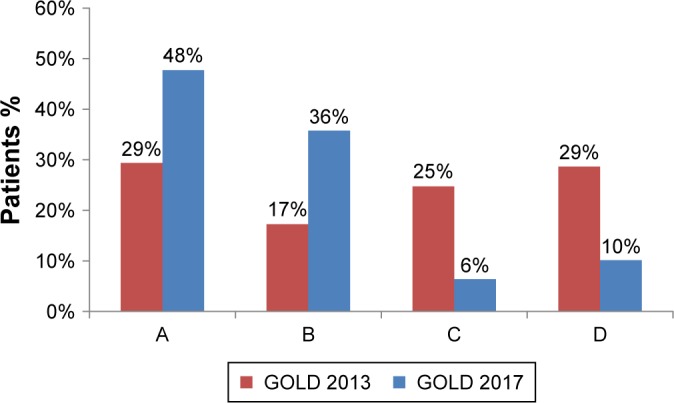
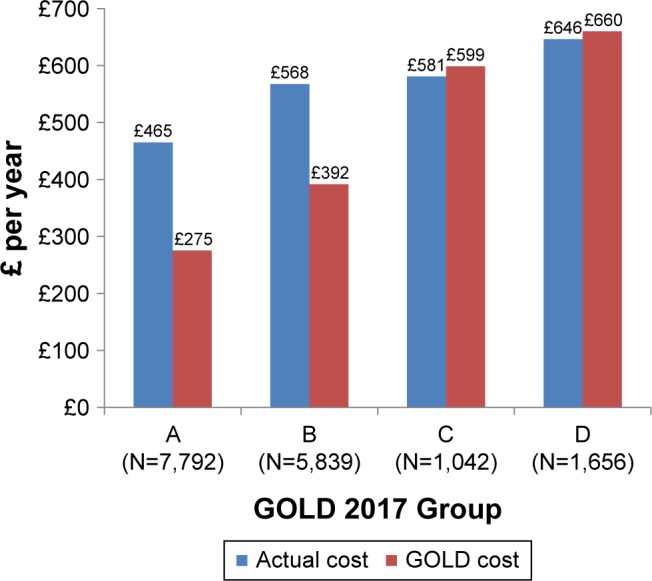
Results: When applying GOLD 2013 criteria, less than half of the cohort (46%) was assigned to GOLD A or B, as compared to 86% when applying the GOLD 2017 grading. The actual mean annual maintenance treatment cost was £542 per patient vs a predicted £389 for treatment according to the 2017 GOLD strategy.
Conclusion: There is a potential to make significant cost savings by implementing the grading and treatment recommendations from the 2017 GOLD strategy.
Keywords: COPD; GOLD; economics; severity.
Conflict of interest statement
Disclosure AG, SD, KM and CP are employees of Boehringer Ingelheim Ltd. JV has received honoraria from AstraZeneca, Boehringer-Ingelheim, Chiesi and Novartis within the last 3 years for advising and presenting. AGM has received honoraria from Boehringer-Ingelheim and GlaxoSmithKline within the last 3 years. The authors report no other conflicts of interest in this work.
Figures
References
-
- Agusti A, Bel E, Thomas M, et al. Treatable traits: toward precision medicine of chronic airway diseases. Eur Respir J. 2016;47(2):410–419. - PubMed
-
- Global Strategy for the Diagnosis, Management and Prevention of COPD. Global Initiative for Chronic Obstructive Lung Disease, Inc.; 2016. - PubMed
-
- NICE [homepage on the Internet] Chronic obstructive pulmonary disease: management of chronic obstructive pulmonary disease in adults in primary and secondary care [cited 2016 6/12/2016] [Accessed September 20, 2018]. Available from: https://www.nice.org.uk/guidance/cg101.
-
- NICE . Surveillance report 2016 – Chronic obstructive pulmonary disease in over 16s: diagnosis and management 2010 NICE guideline CG101. [Willett S, Anderson P, Sparrow K, et al; 2016]
-
- Global Initiative for Chronic Obstructive Lung Disease (GOLD) Report. 2017
Publication types
MeSH terms
Substances
LinkOut - more resources
Full Text Sources
Medical
