


doi: 10.3762/bjoc.14.251.
eCollection 2018.
Photocatalyic Appel reaction enabled by copper-based complexes in continuous flow
Affiliations
- PMID: 30498523
- PMCID: PMC6244115
- DOI: 10.3762/bjoc.14.251
Item in Clipboard
Photocatalyic Appel reaction enabled by copper-based complexes in continuous flow
Beilstein J Org Chem.
.
Abstract
A copper-based photocatalyst, Cu(tmp)(BINAP)BF4, was found to be active in a photoredox Appel-type conversion of alcohols to bromides. The catalyst was identified from a screening of 50 complexes and promoted the transformation of primary and secondary alcohols to their corresponding bromides and carboxylic acids to their anhydrides. The protocol was also amendable and optimized under continuous flow conditions.
Keywords: Appel; continuous flow; copper; halides; photocatalysis.
Figures
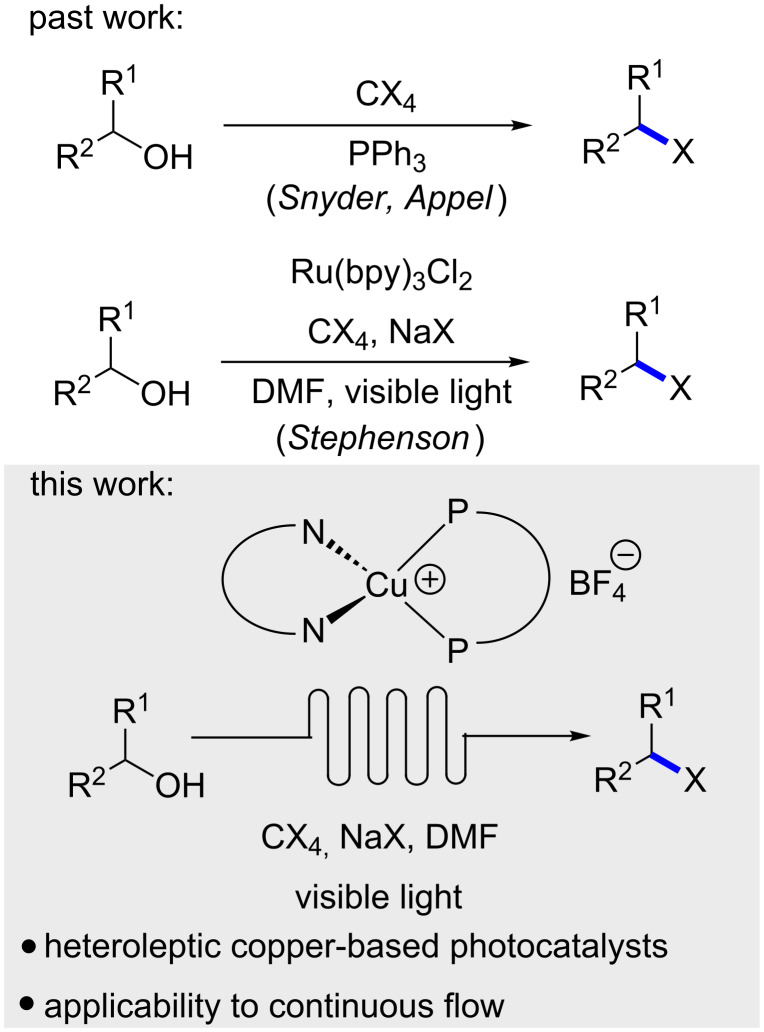
Alcohol→bromide functional group transformations.
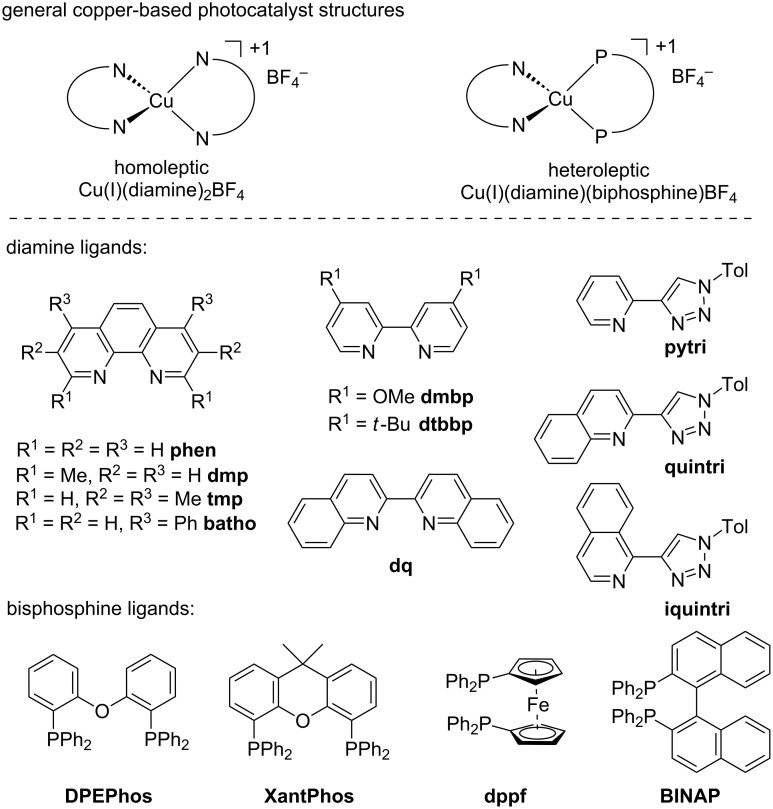
Ligands used in the library generation of heteroleptic copper(I)-based complexes for photocatalysis.
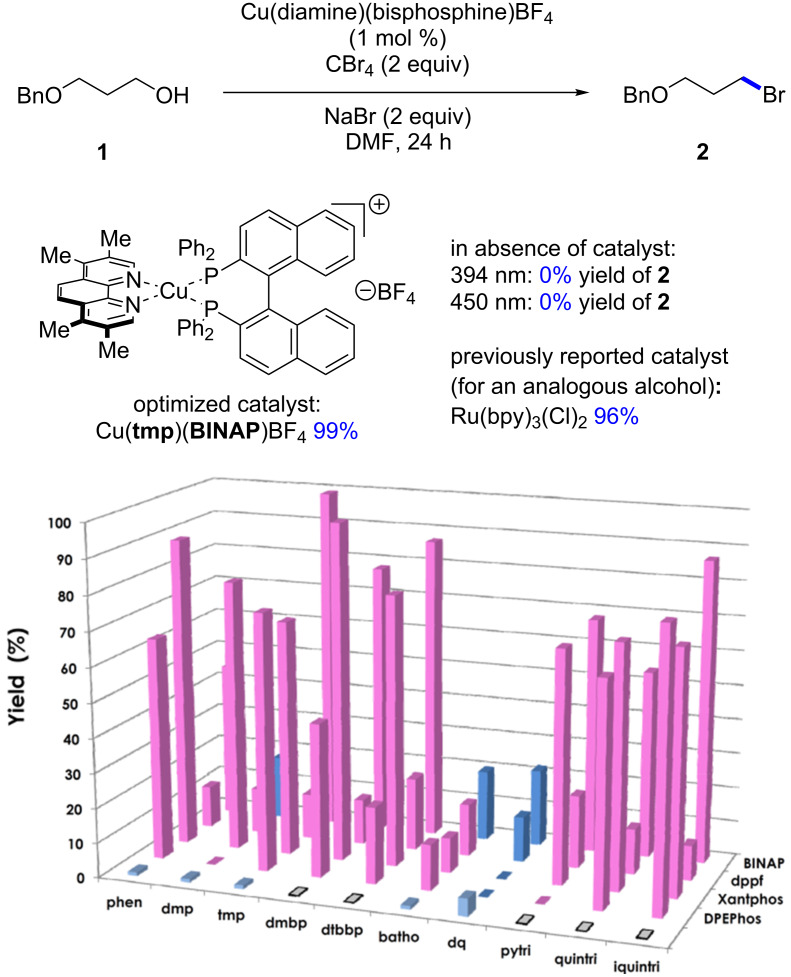
Evaluation of the library of copper-based complexes in photocatalytic alcohol→bromide conversion. Reactions irradiated with 394 nm light (pink) or 450 nm (blue). Front entries without an indicated phosphine ligand pertain to homoleptic Cu(diamine)2BF4 complexes and are colored in lighter blue. Entries without a color indicate reactions which could not be performed due to solubility or overoxidation of the complex.
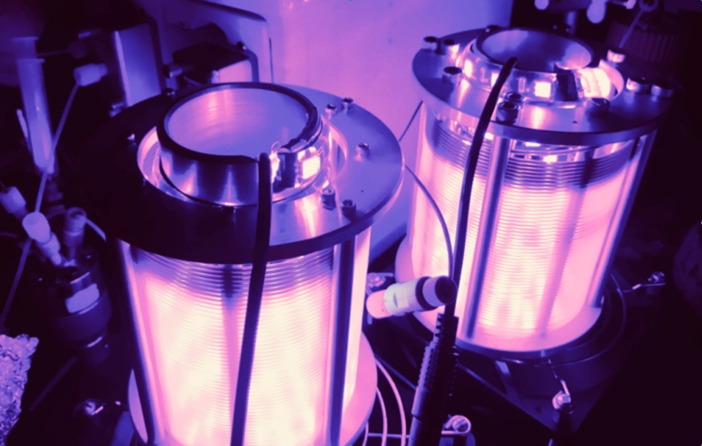
Experimental set-up for the photocatalytic conversion of alcohols to bromides. PFA tubing is wrapped around purple LEDs (394 nm) and fans are placed underneath reactors to maintain cooling.
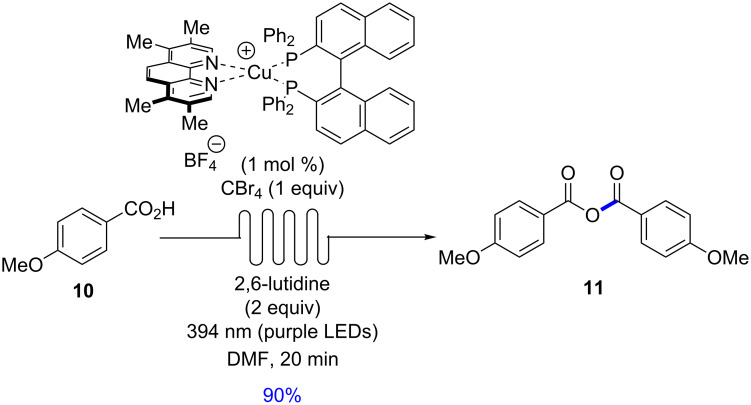
Copper-based photocatalysis for photocatalytic synthesis of an anhydride.
References
-
- Stephenson C R J, Yoon T P, MacMillan D W C, editors. Visible Light Photocatalysis in Organic Chemistry. Hoboken, New Jersey: Wiley-VCH; 2018.
-
- Albini A, Fagnoni M, editors. Handbook of Synthetic Photochemistry. Germany: Wiley-VCH; 2010.
-
- Rackl D, Kreitmeier P, Reiser O. Green Chem. 2016;18:214–219. doi: 10.1039/C5GC01792K. - DOI
-
- Lima C G S, de M. Lima T, Duarte M, Jurberg I D, Paixão M W. ACS Catal. 2016;6:1389–1407. doi: 10.1021/acscatal.5b02386. - DOI
-
- Appel R. Angew Chem, Int Ed Engl. 1975;14:801–811. doi: 10.1002/anie.197508011. - DOI
LinkOut - more resources
Full Text Sources
Miscellaneous