Moving from formative research to co-creation of interventions: insights from a community health system project in Mozambique, Nepal and Peru
- PMID: 30498592
- PMCID: PMC6254743
- DOI: 10.1136/bmjgh-2018-001183
Moving from formative research to co-creation of interventions: insights from a community health system project in Mozambique, Nepal and Peru
Abstract
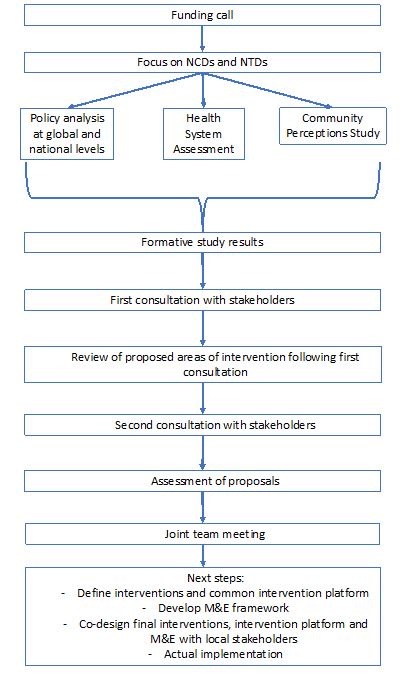
Different methodological approaches for implementation research in global health focusing on how interventions are developed, implemented and evaluated are needed. In this paper, we detail the approach developed and implemented in the COmmunity HEalth System InnovatiON (COHESION) Project, a global health project aimed at strengthening health systems in Mozambique, Nepal and Peru. This project developed innovative formative research at policy, health system and community levels to gain a comprehensive understanding of the barriers, enablers, needs and lessons for the management of chronic disease using non-communicable and neglected tropical diseases as tracer conditions. After formative research, COHESION adopted a co-creation approach in the planning of interventions. The approach included two interactions with each type of stakeholder at policy, health system and community level in each country which aimed to develop interventions to improve the delivery of care of the tracer conditions. Diverse tools and methods were used in order to prioritise interventions based on support, resources and impact. Additionally, a COHESION score that assessed feasibility, sustainability and scaling up was used to select three potential interventions. Next steps for the COHESION Project are to further detail and develop the interventions propositioned through this process. Besides providing some useful tools and methods, this work also highlights the challenges and lessons learned from such an approach.
Keywords: health services research; study design.
Conflict of interest statement
Competing interests: None declared.
Figures
References
-
- WHO Prioritized research agenda for prevention and control of noncommunicable diseases : Mendis S, Alwan A, Geneva: World Health Organization, 2011.
LinkOut - more resources
Full Text Sources
Medical