. 2019 Feb 5;27(2):302-314.e4.
doi: 10.1016/j.str.2018.10.012. Epub 2018 Nov 29.

Engineering an Osmosensor by Pivotal Histidine Positioning within Disordered Helices

Affiliations

Engineering an Osmosensor by Pivotal Histidine Positioning within Disordered Helices

Madhubrata Ghosh et al. Structure. .

Abstract

Histidine kinases (HKs) funnel diverse environmental stimuli into a single autophosphorylation event at a conserved histidine residue. The HK EnvZ is a global sensor of osmolality and cellular acid pH. In previous studies, we discovered that osmosensing in EnvZ was mediated through osmolyte-induced stabilization of the partially disordered helical backbone spanning the conserved histidine autophosphorylation site (His243). Here, we describe how backbone stabilization leads to changes in the microenvironment of His243, resulting in enhanced autophosphorylation through relief of inhibition and repositioning of critical side chains and imidazole rotamerization. The conserved His-Asp/Glu dyad within the partially structured helix is equally geared to respond to acid pH, an alternative environmental stimulus in bacteria. This high-resolution "double-clamp" switch model proposes that a His-Asp/Glu dyad functions as an integrative node for regulating autophosphorylation in HKs. Because the His-Asp/Glu dyad is highly conserved in HKs, this study provides a universal model for describing HK function.

Keywords: EnvZ; H bonding; His-Asp/Glu dyad; amide hydrogen-deuterium exchange mass spectrometry; helix stabilization; histidine rotamerization; osmosensing; protein dynamics; two-component signal transduction.


Conflict of interest statement

DECLARATION OF INTEREST

The authors report no conflict of interest with the findings reported in this manuscript.

Figures
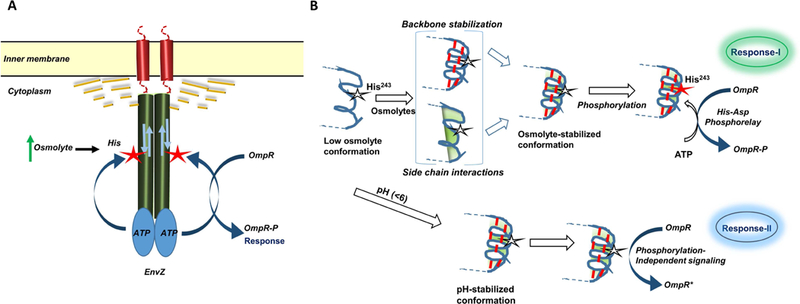
Figure 1
Figure 1. (A) Mechanism of osmosensing by EnvZ
EnvZ is an inner membrane anchored dimeric receptor that responds to changes in osmolyte concentrations by altering the conformation of a cytoplasmic helical subdomain. These conformational changes lead to enhanced autophosphorylation at a conserved His residue (red asterix) that are transferred to OmpR. This signaling relay can also be modulated through alternate allosteric mechanisms (bidirectional arrow). The phospholipid membrane in particular, is a critical regulator of EnvZ receptor function effected through changes in mechanical and physicochemical forces such as membrane curvature, fluidity, lateral pressure and lipid composition. Alternately, allosteric regulation of the cytoplasmic kinase domain can also be achieved through peripheral interactions between the phospholipid membrane and the non-embedded soluble cytoplasmic kinase domain (yellow dashed lines). Mutations in the cytoplasmic domain can in turn modulate the interactions between the phospholipid bilayer, the transmembrane segments and the cytoplasmic domain thereby altering EnvZ response to stimuli. (B) Deconstructing the osmosensing switch in EnvZ Cartoon representation of the His243 locus shows local disorder in helical structure under low osmolality conditions. High osmolality promotes stabilization through backbone H-bonds (red dashed lines) measured by HDXMS (Wang et al. (2012)) and side chain microenvironment (shaded green) leading to enhanced autophosphorylation at His243 denoted by star, phosphorylation in red. In brackets are the varying and integrative effects that osmolytes might induce on the His243 locus. Direct osmolyte-mediated changes in His side chain microenvironment (shaded green), backbone H-bonds (red) and how stabilization of backbone might indirectly the His243 rotamer and its microenvironment. Dual pathways for osmolyte and low pH signaling by EnvZ:OmpR. Osmolyte-stabilized conformation of the cytoplasmic subdomain enhances His243 autophosphorylation, which is transferred to OmpR to trigger changes in porin gene expression (Response-I). The same locus also operated to detect lowering of pH through non-canonical activation of OmpR when acid pH does not favor phosphorylation (Response-II).
Figure 2:
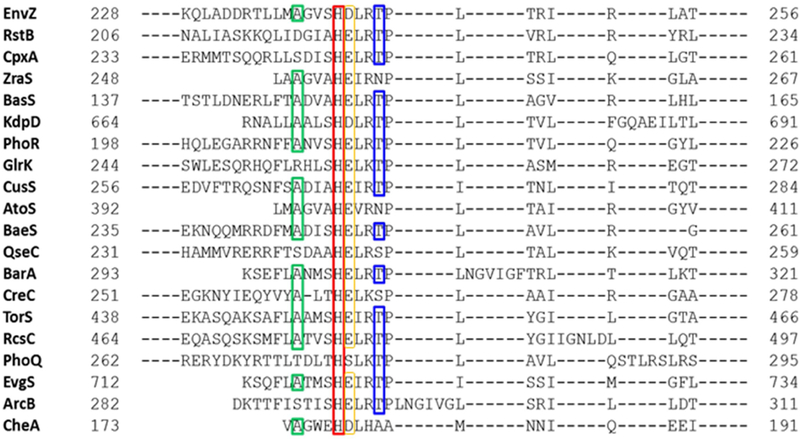
Figure 2:. Alanine and threonine flanking the invariant histidine are evolutionarily conserved
Sequence alignment of various bacterial histidine kinases using Basic Local Alignment Search Tool (BLAST) (54) showed that Ala (green box) and Thr residues (blue box) at flanking positions one helical turn away from the conserved His (red box) are common in most histidine kinases. An Asp/Glu is conserved in all but one HK (yellow box). This highlights an evolutionary conservation in histidine kinases that may have an important role for enzymatic functions. Sensor histidine kinases shown in the search with known functions are: ArcB, anaerobic respiration control; AtoS, conversion of short-chain fatty acids to acetoacetate; BasS, iron (Fe2+) sensor; CheA, chemotaxis; CpxA, envelope stress sensor; CreC, catabolite regulation; CusS, cuprite (Cu2+) and silver (Ag2+) sensor; EnvZ, osmosensor; EvgS, homolog of virulence gene; KdpD, potassium (K+) sensor; PhoQ, sensor for magnesium (Mg2+) and acid resistance genes; PhoR, phosphate regulon gene expression; QseC, quorum sensor and flagellum regulation; RcsC, biofilm production; RstB, sensor for RstA; TorS, sensor for trimethylamine oxide (TMAO); and ZraS, zinc (Zn2+) and lead (Pb2+) sensor. BarA, BaeS, and GlrK do not have a known function assigned currently.
Figure 3:
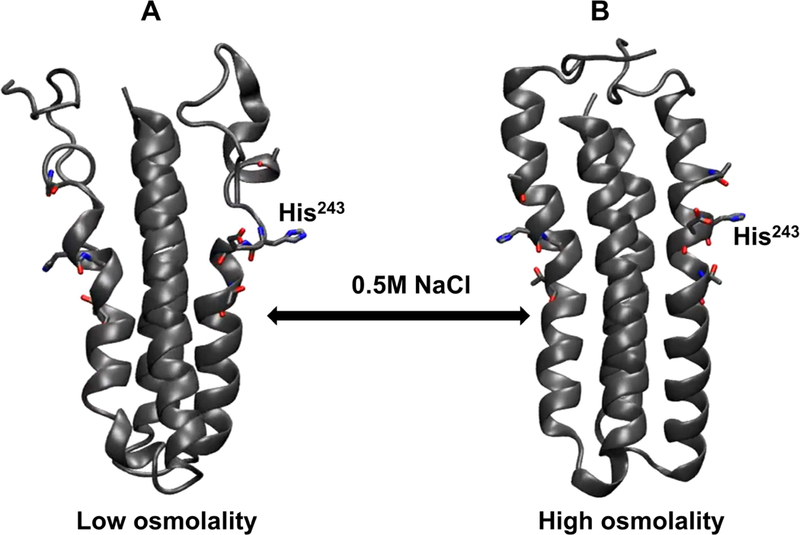
Figure 3:. Molecular dynamics simulations demonstrate osmolyte-induced secondary structural stabilization of EnvZc
In silico models of EnvZ four helix bundle subdomain (residues 223–289) were generated under conditions mimicking low and high osmolality. It is evident from these structures that under low osmolality (left), the four-helix bundle subdomain is highly flexible particularly within the His243-containing region. In presence of high osmolality (right), there is reduced flexibility of the peptide backbone with more defined secondary structures being observed across the subdomain. These models further reinstate the model of EnvZ osmosensing proceeding through osmolyte-mediated peptide backbone stabilization of the four helix bundle.
Figure 4:
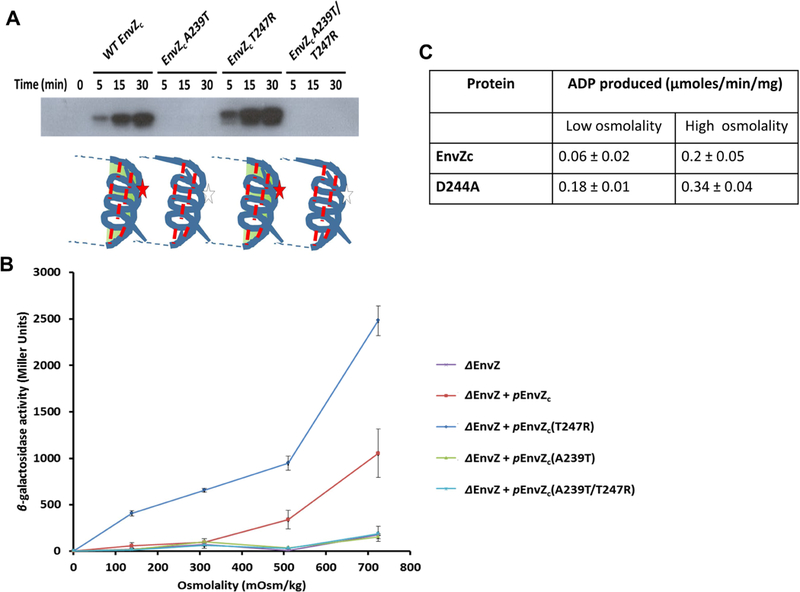
Figure 4:. EnvZc autophosphorylation is highly sensitive to mutations in the His243 microenvironment
(A) Wild-type (WT), A239T, T247R and A239T/T247R EnvZc were tested for their ability to undergo autophosphorylation using a [γ−32P]-ATP kinase assay for kinase reaction times 0, 5, 15 and 30 min. WT EnvZc showed increased levels of autophosphorylation over time. The point mutants A239T and T247R revealed contrasting phenotypes with the A239T mutant showing negligible autophosphorylation while the T247R mutant showing constitutively higher levels of autophosphorylation in comparison to WT EnvZc. These results were consistent with the phenotypes observed for the same mutants in intact EnvZ (Matsuyama et al., 1986; Russo and Silhavy, 1991). The A239T/T247R EnvZc double mutant was surprisingly unable to autophosphorylate, indicating that the Ala239 residue has a significant role in modulating autophosphorylation in EnvZc (see Discussion). (B) WT EnvZc and the mutants were also examined for their ability to phosphotransfer to OmpR. Phosphorylated OmpR (OmpR~P) enhances transcription of the reporter gene fusion ompC-lacZ. In the envZ deletion (ΔenvZ) strain of E. coli PG189, a low level of ompC-lacZ expression (purple curve) is observed for cells grown in minimal A medium across a range of sucrose concentrations (0, 5, 10, and 15% (w/v), indicated as 139, 311, 510, and 724 mOsm/kg on the x-axis). When a plasmid carrying envZc (penvZc) was transformed into the ΔenvZ E. coli strain, expression of ompC-lacZ was rescued (red curve). EnvZc A239T (orange curve) and the EnvZc A239T/T247R double mutant (DM) (green curve) failed to rescue ompC-lacZ expression while EnvZc T247R (blue curve) showed higher OmpC-LacZ expression than WT EnvZc at all osmolyte concentrations. The results were reported as mean ± SEM from at least three independent measurements. (C) Autophosphorylation by EnvZ was measured using the in vitro ADP-Glo™ Kinase assay (Promega, Madison, WI), which quantifies the amount of ADP formed as a product in a kinase reaction using a luminescence-based detection method in low and high osmolality conditions as described in STAR methods.
Figure 5:
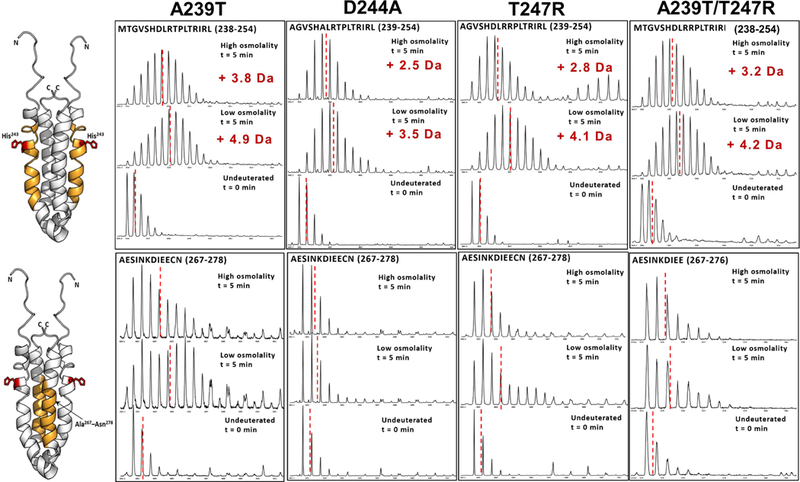
Figure 5:. Mutation-induced altered peptide backbone dynamics can be correlated to His243 autophosphorylation
ESI-Q-TOF mass spectra shown here compare backbone dynamics of A239T, D244A, T247R and A239T/T247R EnvZc, for two critical regions within the four helix bundle. (A) In the His243-spanning locus (highlighted in orange in the NMR structure of the four helix bundle; His243 shown as sticks; PDB ID: 1JOY) A239T mutant undergoes deuterium exchange similar to WT under low osmolality, while a significantly reduced deuterium exchange is observed for the other mutants. However, osmolyte-induced reduction in deuterium exchange is observed for all mutants. (B) In the putative OmpR-binding region (highlighted in yellow), the A239T mutant populates a conformational ensemble, evident from the characteristic bimodal feauture of the mass spectral envelope, in the low osmolality condition, with an osmolality-induced predominance of the lower exchanging conformer. The lower exchanging conformer dominates in the other mutants with a minor population of the higher exchanging conformer observed in T247R and A239T/T247R EnvZc. Reduced backbone dynamics in the four-helix bundle of mutants D244A and T247R correlates with their constitutive kinase activity.
Figure 6:
Figure 6:. H-bonding propensities show that local secondary structure is highly sensitive to mutations in the His243 locus
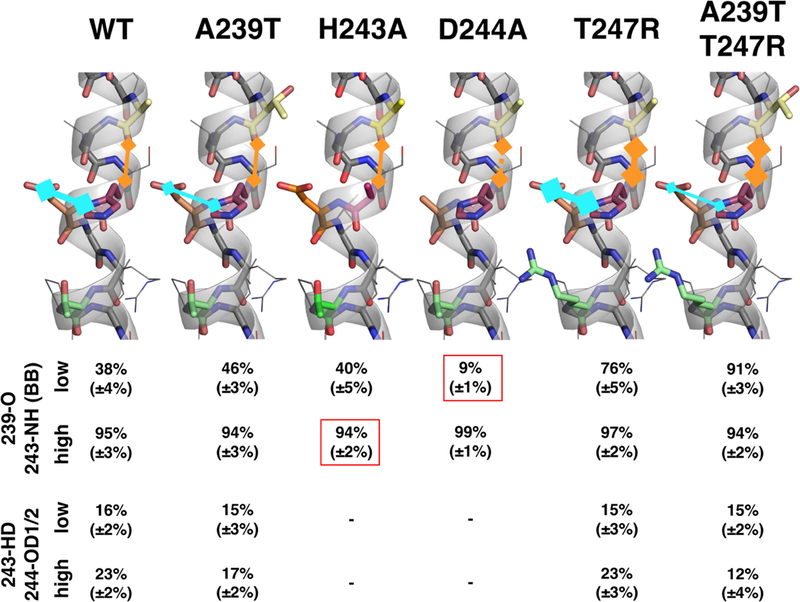
This figure compares bonding propensities of two critical bonds in the His243 locus in WT EnvZc and EnvZc mutants A239T, D244A, T247R and A239T/T247R, as measured by molecular dynamics simulations. In the wild-type, hydrogen bonding propensitiesincrease with increased osmolality . In all mutants, the sensitivity of this bonding behavior is abolished. A239T and the double mutant stabilize bonding propensity at a constant low level, whereas the T247R mutant locks the bonding propensity in a high state. All values are given as mean of both simulations with errors stated in brackets. The backbone H-bond propensity between Ala239 and His243 is indicated by 239-O/243-NH (carbonyl oxygen of Ala239/amide backbone of His243) (orange) while side chain interaction between His243 and Asp244 are indicated by 243-HD/244-OD1/2 (H on Nδ of His243/O on Asp244) (blue). The boxed values indicate the H-bonding propensities not matching experimental HDXMS measurements.
Figure 7:
Figure 7:. His243 autophosphorylation and osmosensing is controlled by His243 rotamerization, coordinated side-chain and backbone interactions in the His243 microenvironment
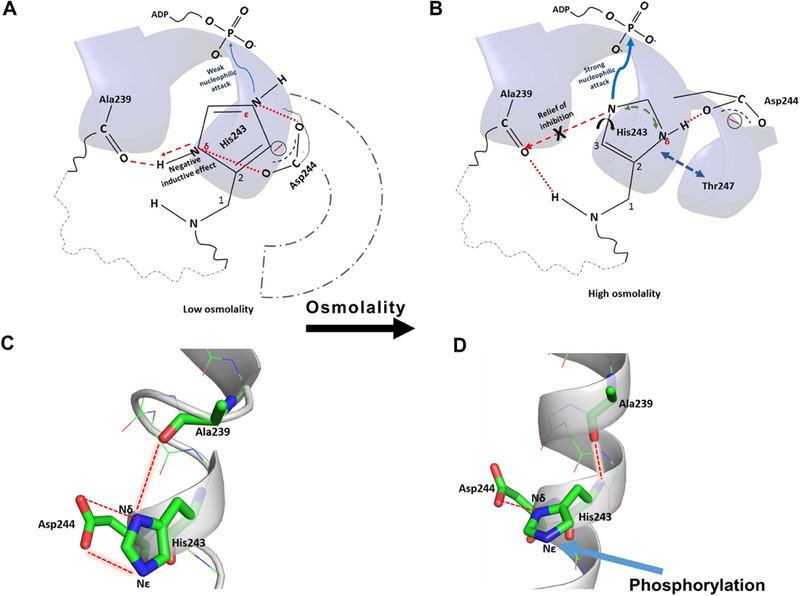
(A) Under low osmolality, there is local disorder in the His243 helix and two cooperative interactions mediated by Asp244 side chain with the His243 imidazole nitrogen atoms that suppress the nucleophilicity of Nε, by promoting delocalization of the imidazole protons between Nε and Nδ (red dashed lines). Presence of the Asp244 side chain also impedes free rotamerization of the imidazole side chain, essential for effective His243 phosphorylation. The Ala239 backbone carbonyl group forms mutually exclusive and competing H-bonds; one with the H on Nδ of His243 and the backbone amide proton of His243, further drawing the electron density away from the imidazole ring (red dashed arrow). Substitution of Asp244 by alanine leads to enhanced autophosphorylation in D244A EnvZc, in low osmolality, through relief of inhibition. (B) Osmolality removes the impeding effect of the Asp244 carboxylate group and osmolyte-induced backbone stabilization strengthens the backbone H-bond between Ala239 carbonyl and amide H of His243, weakening the H-bond between Ala239 carbonyl and Nδ of His243 (marked ‘X’). Relief of Asp244 inhibitory interactions frees His243 rotamerization. Relief from these two inhibitory interactions enhances the nucleophilicity of the Nε promoting enhanced phosphorylation. High resolution structures of the His243 neighborhood under conditions of low ((C); PDB ID: 1JOY) and high osmolality ((D); PDB ID: 4KP4) show that the residues His243, Ala239 and Asp244 are aligned in a particular geometry to favor the interactions described above.

References

    1. Antommattei FM, and Weis RM (2006). 12 Reversible methylation of glutamate residues in the receptor proteins of bacterial sensory systems. Enzymes 24, 325–382. - PubMed
    1. Baron R, and McCammon JA (2013). Molecular recognition and ligand association. Annual Review of Physical Chemistry 64, 151–175. - PubMed
    1. Beier D, and Gross R (2006). Regulation of bacterial virulence by two-component systems. Curr Opin Microbiol 9, 143–152. - PubMed
    1. Berendsen HJC, van der Spoel D, and van Drunen R (1995). GROMACS: A message-passing parallel molecular dynamics implementation. Computer Physics Communications 91, 43–56.
    1. Bhate MP, Molnar KS, Goulian M, and DeGrado WF (2015). Signal transduction in histidine kinases: insights from new structures. Structure 23, 981–994. - PMC - PubMed

Publication types

MeSH terms

LinkOut - more resources