


Long circulating genetically encoded intrinsically disordered zwitterionic polypeptides for drug delivery
- PMID: 30504081
- PMCID: PMC6376874
- DOI: 10.1016/j.biomaterials.2018.11.012
Long circulating genetically encoded intrinsically disordered zwitterionic polypeptides for drug delivery
Abstract
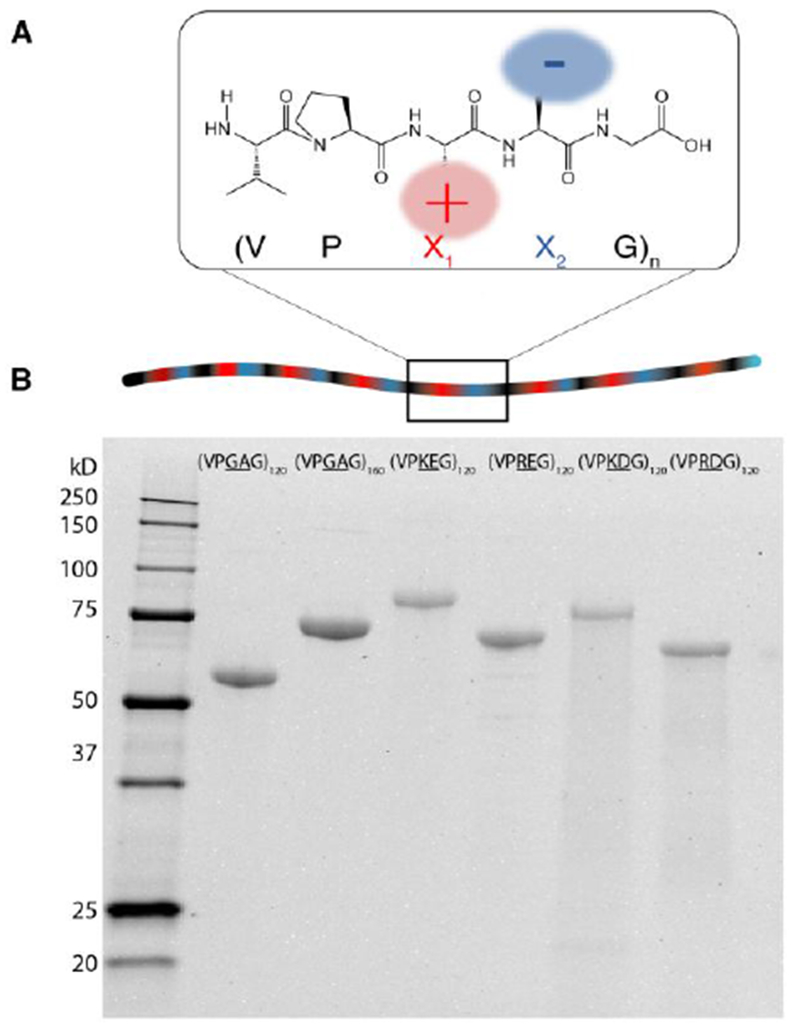
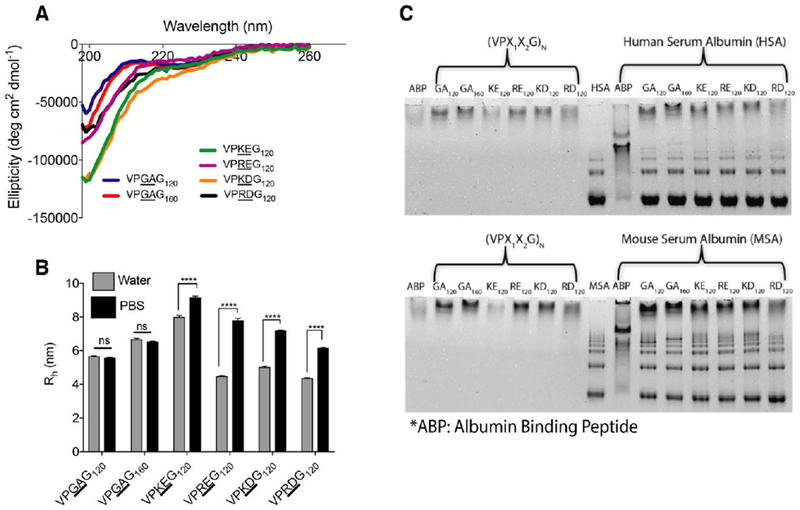
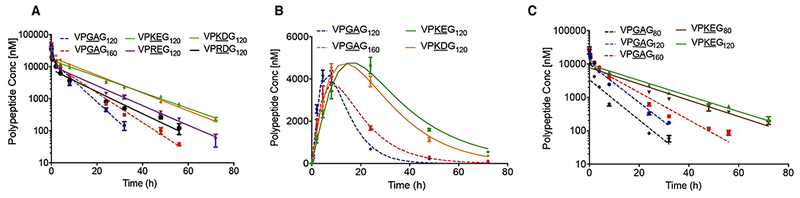
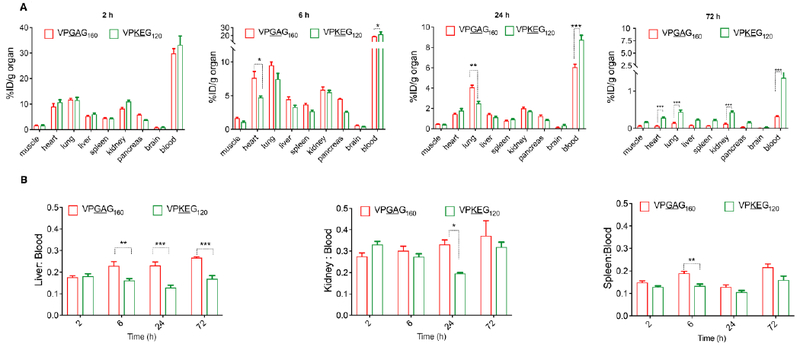
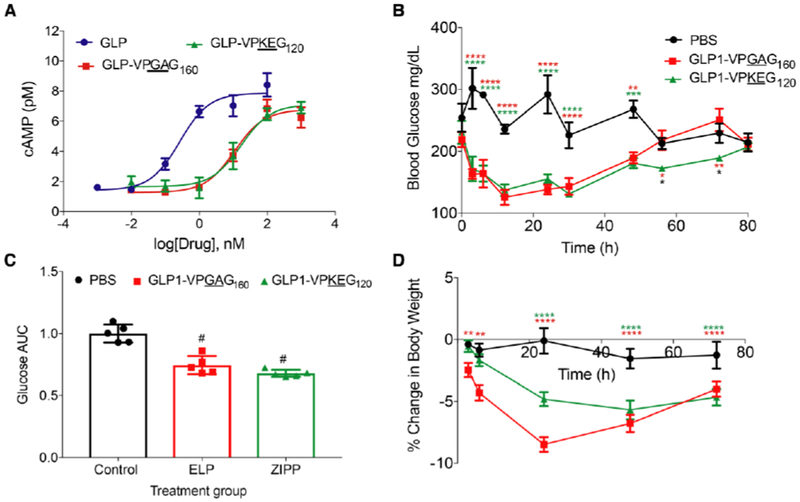
The clinical utility of many peptide and protein drugs is limited by their short in-vivo half-life. To address this limitation, we report a new class of polypeptide-based materials that have a long plasma circulation time. The design of these polypeptides is motivated by the hypothesis that incorporating a zwitterionic sequence, within an intrinsically disordered polypeptide motif, would impart "stealth" behavior to the polypeptide and increase its plasma residence time, a behavior akin to that of synthetic stealth polymers. We designed these zwitterionic polypeptides (ZIPPs) with a repetitive (VPX1X2G)n motif, where X1 and X2 are cationic and anionic amino acids, respectively, and n is the number of repeats. To test this hypothesis, we synthesized a set of ZIPPs with different pairs of cationic and anionic residues with varied chain length. We show that a combination of lysine and glutamic acid in the ZIPP confer superior pharmacokinetics, for both intravenous and subcutaneous administration, compared to uncharged control polypeptides. Finally, to demonstrate their clinical utility, we fused the best performing ZIPP sequence to glucagon-like peptide-1 (GLP1), a peptide drug used for treatment of type-2 diabetes and show that the ZIPP-GLP1 fusion outperforms an uncharged polypeptide of the same molecular weight in a mouse model of type-2 diabetes.
Keywords: Bioinspired materials; Recombinant proteins; Unstructured polypeptides; Zwitterionic polypeptides.
Copyright © 2018. Published by Elsevier Ltd.
Conflict of interest statement
Conflict of interest:
A.C. is a scientific advisor and serves on the board of directors for PhaseBio Pharmaceuticals, Inc., which has licensed the ELP technology for drug delivery applications from Duke University. The remaining authors declare no competing financial interests.
Figures
References
-
- Qi Y, Simakova A, Ganson NJ, Li X, Luginbuhl KM, Ozer I, Liu W, Hershfield MS, Matyjaszewski K, Chilkoti A, A brush-polymer/exendin-4 conjugate reduces blood glucose levels for up to five days and eliminates polyethylene glycol) antigenicity, Nature Biomedical Engineering. 1 (2017)25–29. doi: 10.1038/s41551-016-0002. - DOI - PMC - PubMed
-
- Alconcel SNS, Baas AS, Maynard HD, FDA-approved poly(ethylene glycol)-protein conjugate drugs, Polymer Chemistry. 2 (2011) 1442. doi: 10.1039/clpy00034a. - DOI
Publication types
MeSH terms
Substances
Grants and funding
LinkOut - more resources
Full Text Sources
Other Literature Sources
