. 2018 Nov 30;9(1):5094.
doi: 10.1038/s41467-018-07370-z.

The phylogeography and incidence of multi-drug resistant typhoid fever in sub-Saharan Africa

Se Eun Park  1   2 Duy Thanh Pham  2 Christine Boinett  2   3 Vanessa K Wong  4   5 Gi Deok Pak  1 Ursula Panzner  1 Ligia Maria Cruz Espinoza  1 Vera von Kalckreuth  1 Justin Im  1 Heidi Schütt-Gerowitt  1   6 John A Crump  7   8   9   10 Robert F Breiman  11   12 Yaw Adu-Sarkodie  13   14 Ellis Owusu-Dabo  13   14 Raphaël Rakotozandrindrainy  15 Abdramane Bassiahi Soura  16 Abraham Aseffa  17 Nagla Gasmelseed  18   19 Karen H Keddy  20   21 Jürgen May  22   23 Amy Gassama Sow  24   25 Peter Aaby  26   27 Holly M Biggs  7   8 Julian T Hertz  7   8 Joel M Montgomery  11 Leonard Cosmas  11 Beatrice Olack  28 Barry Fields  11 Nimako Sarpong  13   23 Tsiriniaina Jean Luco Razafindrabe  15 Tiana Mirana Raminosoa  15 Leon Parfait Kabore  29 Emmanuel Sampo  29 Mekonnen Teferi  17 Biruk Yeshitela  17 Muna Ahmed El Tayeb  18 Arvinda Sooka  20 Christian G Meyer  30   31 Ralf Krumkamp  22 Denise Myriam Dekker  22   23 Anna Jaeger  22 Sven Poppert  32 Adama Tall  25 Aissatou Niang  25 Morten Bjerregaard-Andersen  26   27 Sandra Valborg Løfberg  26   27 Hye Jin Seo  1 Hyon Jin Jeon  1 Jessica Fung Deerin  1 Jinkyung Park  1 Frank Konings  1 Mohammad Ali  1   33 John D Clemens  1   34   35 Peter Hughes  36 Juliet Nsimire Sendagala  36 Tobias Vudriko  36 Robert Downing  37   38 Usman N Ikumapayi  39 Grant A Mackenzie  39   40   41 Stephen Obaro  42   43   44 Silvia Argimon  4 David M Aanensen  4   45 Andrew Page  4 Jacqueline A Keane  4 Sebastian Duchene  46 Zoe Dyson  46 Kathryn E Holt  46 Gordon Dougan  4   47 Florian Marks  48   49 Stephen Baker  2   3   47
Affiliations

The phylogeography and incidence of multi-drug resistant typhoid fever in sub-Saharan Africa

Se Eun Park et al. Nat Commun. .

Abstract

There is paucity of data regarding the geographical distribution, incidence, and phylogenetics of multi-drug resistant (MDR) Salmonella Typhi in sub-Saharan Africa. Here we present a phylogenetic reconstruction of whole genome sequenced 249 contemporaneous S. Typhi isolated between 2008-2015 in 11 sub-Saharan African countries, in context of the 2,057 global S. Typhi genomic framework. Despite the broad genetic diversity, the majority of organisms (225/249; 90%) belong to only three genotypes, 4.3.1 (H58) (99/249; 40%), 3.1.1 (97/249; 39%), and 2.3.2 (29/249; 12%). Genotypes 4.3.1 and 3.1.1 are confined within East and West Africa, respectively. MDR phenotype is found in over 50% of organisms restricted within these dominant genotypes. High incidences of MDR S. Typhi are calculated in locations with a high burden of typhoid, specifically in children aged <15 years. Antimicrobial stewardship, MDR surveillance, and the introduction of typhoid conjugate vaccines will be critical for the control of MDR typhoid in Africa.


Conflict of interest statement

The authors declare no competing interests.

Figures
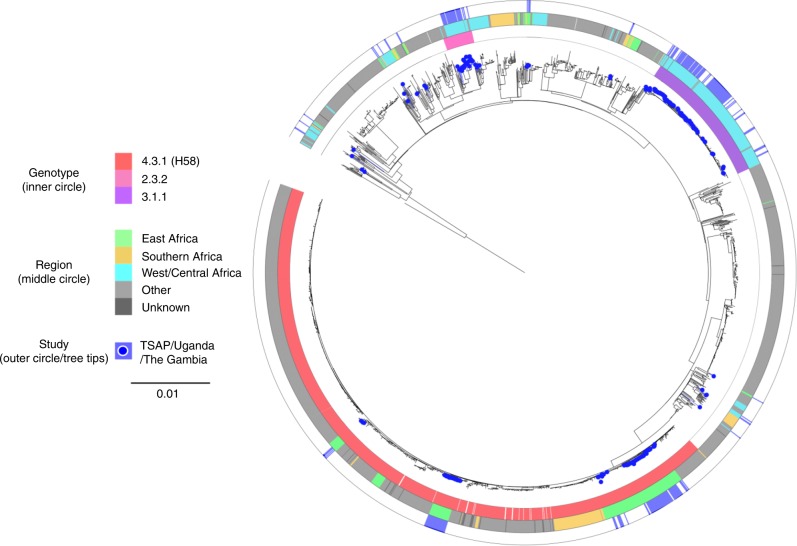
Fig. 1
Fig. 1
The phylogenetic context of Salmonella Typhi isolated in sub-Saharan Africa. Maximum likelihood tree outlining the phylogenetic structure of 249 S. Typhi isolates unique to this study (highlighted by the blue points) combined with 2,057 global S. Typhi isolates. The tree is adjacent to three concentric circles highlighting associated metadata. The inner most circle represents the three most predominant genotypes (colour coded according to top of key), the middle circle represents the geographical sub-regions of Africa from where the S. Typhi organisms were isolated (colour coded according to top of key), and the outer circle (blue) again highlights the organisms unique to this study. The scale bar indicates the number of substitutions per variable site
Fig. 2
Fig. 2
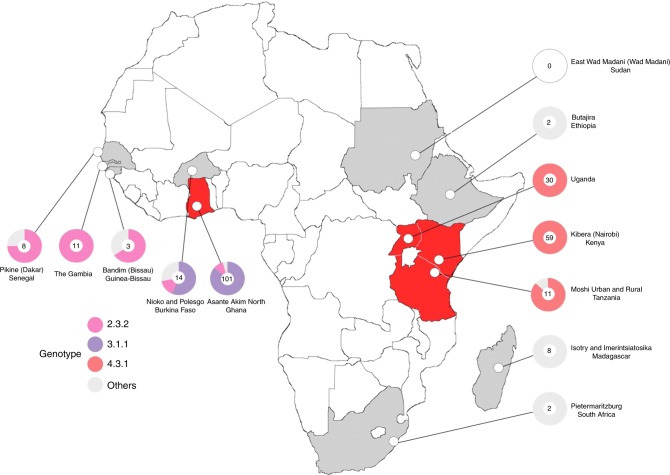
The distribution of multi-drug resistant Salmonella Typhi isolated in Africa. Map of the African continent showing the locations of the field sites from where the S. Typhi organisms were isolated for this study. Countries in which multi-drug resistant (MDR) S. Typhi were isolated are coloured in red, countries in which MDR S. Typhi were not isolated are coloured in grey. Pie charts correspond with the proportion of the main genotypes isolated (see key), with the number of isolates from each location in the centre
Fig. 3
Fig. 3
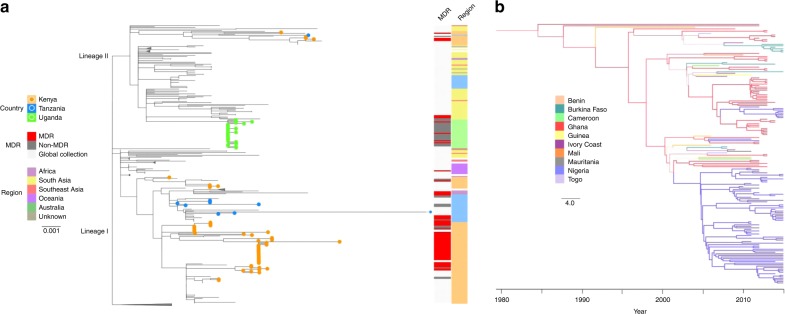
The phylogenetic structures of the major Salmonella Typhi genotypes in sub-Saharan Africa. a Maximum likelihood tree of genotype 4.3.1 S. Typhi isolates from this study in the context of other global genotype 4.3.1 S. Typhi isolates; the two distinct sub-lineages are labeled at the base of the tree. 4.3.1 S. Typhi isolates from this study (Kenya, Tanzania, and Uganda) are highlighted in corresponding coloured branches and circles at the tip of each tree. The first coloured bar shows the MDR phenotypes of study isolates. The second coloured bar outlines the continents and African regions where 4.3.1 S. Typhi have been detected. Scale bar indicates the number of substitutions per variable site; nodes of the tree have been collapsed for better visualization. b Maximum clade credibility tree (reconstructed using BEAST2) of genotype 3.1.1 S. Typhi isolates from this study in the context of other global genotype 3.1.1 S. Typhi isolates. Tree shows a phylogeographical reconstruction of genotype 3.1.1 S. Typhi isolates in West Africa. Branches are weighted by the support for the location changes; thicker branches have higher support. Branches and nodes are coloured according to the location that had the highest posterior probability values for some nodes of the tree. The scale bar indicates the number of substitutions per variable site per year
Fig. 4
Fig. 4
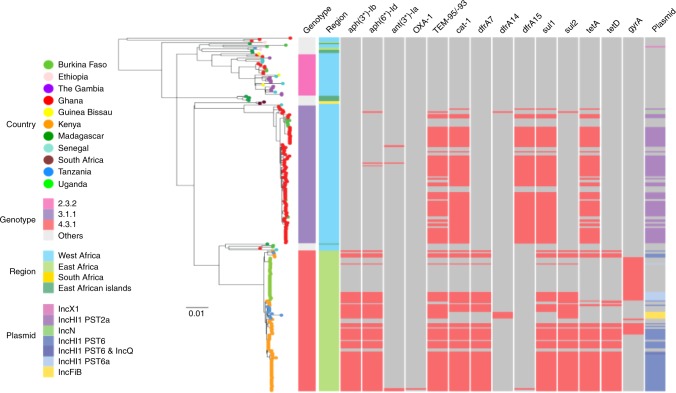
The antimicrobial gene distribution within sub-Saharan African Salmonella Typhi. Maximum likelihood phylogenetic tree of 249 S. Typhi isolates from this study with corresponding metadata including genotype, location, antimicrobial resistance genes (AMR), and plasmids (see keys). Countries where S. Typhi isolates were isolated are highlighted by coloured circles at the tip of the branches. The three major genotypes and sub-regions of the Africa continent are shown by the coloured bars; present AMR genes are shown in red. The scale bar indicates the number of substitutions per variable site

References

    1. Crump JA, Luby SP, Mintz ED. The global burden of typhoid fever. Bull. World Health Organ. 2004;82:346–353. - PMC - PubMed
    1. Marks F, et al. Incidence of invasive salmonella disease in sub-Saharan Africa: a multicentre population-based surveillance study. Lancet Glob. Heal. 2017;5:e310–e323. doi: 10.1016/S2214-109X(17)30022-0. - DOI - PMC - PubMed
    1. Von Kalckreuth V, et al. The typhoid fever surveillance in africa program (TSAP): clinical, diagnostic, and epidemiological methodologies. Clin. Infect. Dis. 2016;62:s9–s16. doi: 10.1093/cid/civ693. - DOI - PMC - PubMed
    1. Thanh DP, et al. A novel ciprofloxacin-resistant subclade ofh58. Salmonella Typhi is associated with fluoroquinolone treatment failure. eLife. 2016;5:1–13. - PMC - PubMed
    1. Rowe Bernard, Ward Linda R., Threlfall E. John. Multidrug-Resistant Salmonella typhi: A Worldwide Epidemic. Clinical Infectious Diseases. 1997;24(Supplement_1):S106–S109. doi: 10.1093/clinids/24.Supplement_1.S106. - DOI - PubMed

Publication types

Substances