. 2012;149(3-4):407-440.
doi: 10.1163/156853912X638454.

Behavioral characteristics of pair bonding in the black tufted-ear marmoset (Callithrix penicillata)

Affiliations

Behavioral characteristics of pair bonding in the black tufted-ear marmoset (Callithrix penicillata)

Anders Ågmo et al. Behaviour. 2012.

Abstract

The present study describes how the development of a pair bond modifies social, sexual and aggressive behavior. Five heterosexual pairs of marmosets, previously unknown to each other, were formed at the beginning of the study. At the onset of pairing, social, sexual, exploratory and aggressive behaviors were recorded for 40 min. The animals were then observed for 20 min, both in the morning and afternoon for 21 days. The frequency and/or duration of behaviors recorded on Day 1 were compared to those recorded at later observations. The behavior displayed shortly after pairing should be completely unaffected by the pair bond, while such a bond should be present at later observations. Thus, it was possible to determine how the behavior between the pair was modified by the development of a pair bond. Social behaviors increased from Day 1 to Days 2-6 and all subsequent days observed. Conversely, other behaviors, such as open mouth displays (usually considered to be an invitation to sexual activity), had a high frequency during the early part of cohabitation but declined towards the end. Consequently, pair bonding manifests itself in an increased intensity of social behaviors. It is suggested that the intrinsically rewarding properties of grooming and perhaps other social behaviors turn the pair mate into a positive incentive, activating approach and further interactions when possible. Thus, the pair bond may be a motivational state activated by the conditioned incentive properties of the partner. This notion can explain all forms of pair bonds, including those occurring between individuals of the same sex and in promiscuous species.

Keywords: marmoset; pair bonding; social behavior.


Figures
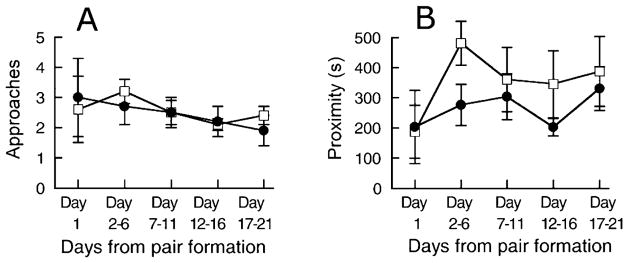
Figure 1
Figure 1
Frequency of approaches per 20 min (A) and duration of proximity per 20 min (B) at the morning (□) and at the afternoon (●) observations in marmosets observed for 21 days following pairing. Data are mean ± SEM from Day 1 and from the following 5 day periods. Durations are expressed in s.
Figure 2
Figure 2
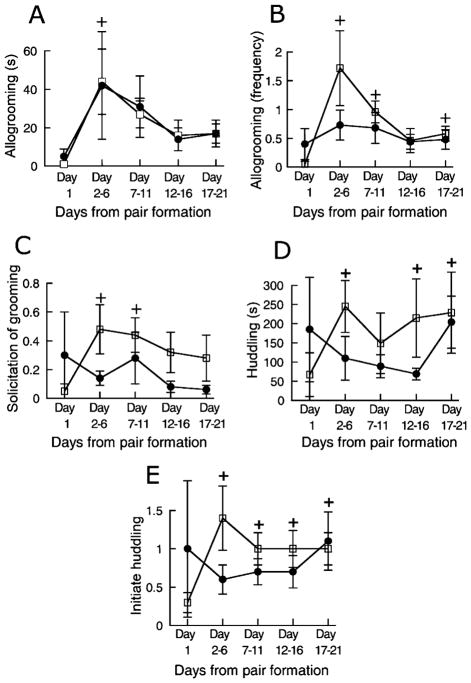
Duration (A) and frequency (B) of allogrooming, solicitation of grooming (C) and the duration of huddling (D) as well as the frequency of initiation of huddling (E) at the morning (□) and at the afternoon (●) observations in marmosets observed for 21 days following pairing. Data are mean ± SEM from Day 1 and from the following 5-day periods expressed as number per 20 min or seconds per 20 min. +, different from the morning of Day 1, p < 0.05. for less time on the morning of Day 1 than on the mornings on Days 2–6, Days 12–16 and Days 17–21 but not on Days 7–11. Data are illustrated in Figure 2D. The marmosets huddled as much in the morning as they did in the afternoon (morning, 203 ± 74 s; afternoon, 121 ± 25 s; z = 0.40, NS). Since huddling involves both individuals in the pair, no sex comparison could be made.
Figure 3
Figure 3
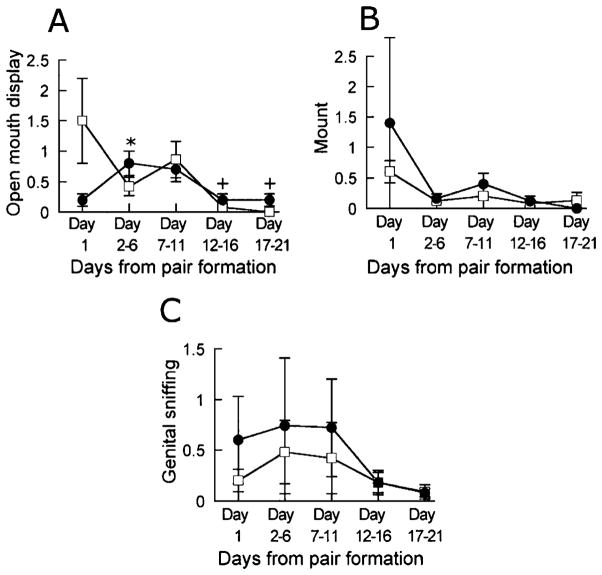
Frequency of open mouth displays (A), number of mounts (B) and the frequency of genital sniffing (C) at the morning (□) and at the afternoon (●) observations in marmosets observed for 21 days following pairing. Data are mean ± SEM of number of occurrences per 20 min from Day 1 and from the following 5-day periods. +, different from the morning of Day 1, p < 0.05. *, different from the afternoon of Day 1, p < 0.05.
Figure 4
Figure 4
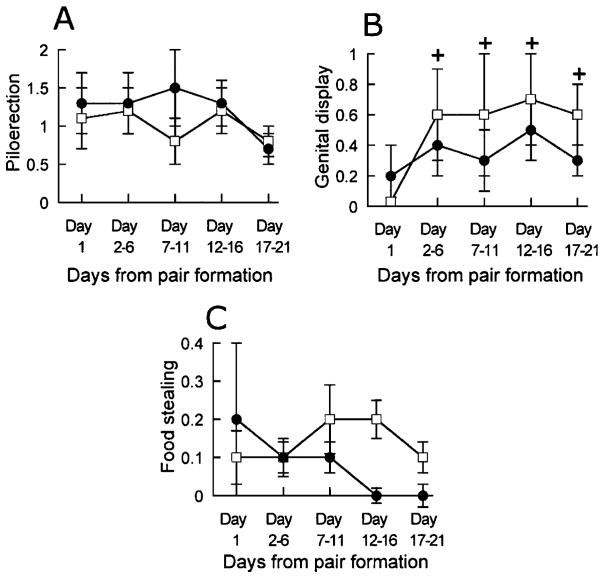
The frequency of piloerection (A), genital display (B) and food stealing (C) at the morning (□) and at the afternoon (●) observations in marmosets observed for 21 days following pairing. Data are mean ± SEM of number of occurrences per 20 min from Day 1 and from the following 5-day periods. +, different from the morning of Day 1, p < 0.05.
Figure 5
Figure 5
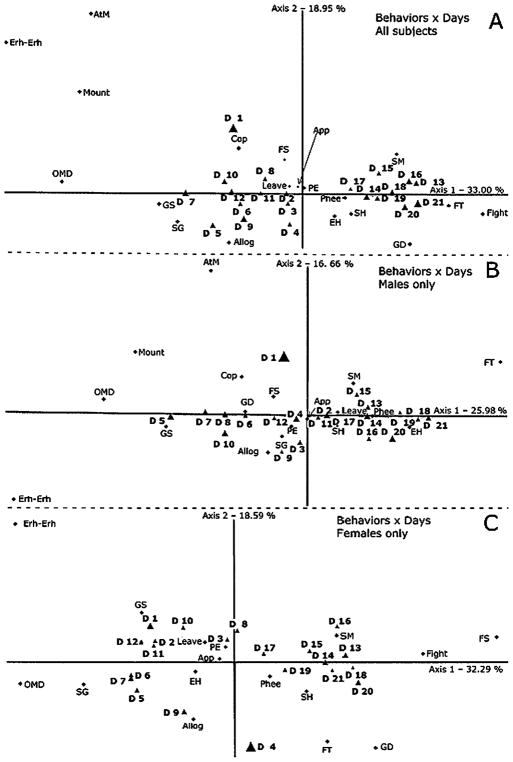
(A) Results of the multivariate correspondence analysis based on the daily means of each behavior. Both males and females are included. (B, C) Multivariate correspondence analysis based on the daily means of each behavior in males and females, respectively. In all panels, axis 1 seems to be associated with social behaviors while axis 2 is associated with sexual behaviors in panels A and B. In panel C (females) axis 2 does not seem to be closely related to any particular behavior pattern, and it is unclear what it represents. This might be due to the fact that the females did not display any of the most frequent sexual behaviors, i.e., mount attempts and mounts. Nevertheless, the trajectories over days of both sexes are remarkably similar. Diamonds indicate the position of behaviors, and triangles indicate the position of the days of observation (D 1 to D 21). The size of the day symbols is proportional to their contribution to the axes. Abbreviations: Allog, allogrooming; App, approach; AtM, mount attempt; Cop, copulation; EH, end huddling; FS, food steal; FT, food transfer; GD, genital display; GS, genital sniff; OMD, open mouth display; PE, piloerection; Phee, phee call; SG, solicit grooming; SH, start huddling; SM, scent marking.

References

    1. Abbott DH, Hearn JP. Physical, hormonal and behavioral aspects of sexual development in the marmoset monkey, Callithrix jacchus. J Reprod Fertil. 1978;53:155–166. - PubMed
    1. Ågmo A, Berenfeld R. Reinforcing properties of ejaculation in the male rat: role of opioids and dopamine. Behav Neurosci. 1990;104:177–182. - PubMed
    1. Alberts JR, Brunjes PC. Ontogeny of thermal and olfactory determinants of huddling in the rat. J Comp Physiol Psychol. 1978;92:897–906. - PubMed
    1. Aureli F, Preston SD, de Waal FBM. Heart rate responses to social interactions in free-moving rhesus macaques (Macaca mulatta): a pilot study. J Comp Psychol. 1999;113:59–65. - PubMed
    1. Azevedo CVM, Menezes AAL, Queiroz JW, Moreira LFS. Circadian and ultradian periodicities of grooming behavior in family groups of common marmosets (Callithrix jacchus) in captivity. Biol Rhythm Res. 1996;27:374–385.

LinkOut - more resources