. 2018 Dec:40:154-181.
doi: 10.3767/persoonia.2018.40.07. Epub 2018 Mar 27.

New Ceratocystis species associated with rapid death of Metrosideros polymorpha in Hawai'i

Affiliations

New Ceratocystis species associated with rapid death of Metrosideros polymorpha in Hawai'i

I Barnes et al. Persoonia. 2018 Dec.

Abstract

The native 'ōhi'a lehua (Metrosideros polymorpha) has cultural, biological and ecological significance to Hawai'i, but it is seriously threatened by a disease commonly referred to as rapid 'ōhi'a death (ROD). Preliminary investigations showed that a Ceratocystis species similar to C. fimbriata s.lat. was the cause of the disease. In this study, we used a combination of the phylogenetic, morphological and biological species concepts, as well as pathogenicity tests and microsatellite analyses, to characterise isolates collected from diseased 'ōhi'a trees across Hawai'i Island. Two distinct lineages, representing new species of Ceratocystis, were evident based on multigene phylogenetic analyses. These are described here as C. lukuohia and C. huliohia. Ceratocystis lukuohia forms part of the Latin American clade (LAC) and was most closely associated with isolates from Syngonium and Xanthosoma from the Caribbean and elsewhere, including Hawai'i, and C. platani, which is native to eastern USA. Ceratocystis huliohia resides in the Asian-Australian clade (AAC) and is most closely related to C. uchidae, C. changhui and C. cercfabiensis, which are thought to be native to Asia. Morphology and interfertility tests support the delineation of these two new species and pathogenicity tests show that both species are aggressive pathogens on seedlings of M. polymorpha. Characterisation of isolates using microsatellite markers suggest that both species are clonal and likely represent recently-introduced strains. Intensive research is underway to develop rapid screening protocols for early detection of the pathogens and management strategies in an attempt to prevent the spread of the pathogens to the other islands of Hawai'i, which are currently disease free.

Keywords: Ceratocystidaceae; ITS types; fungal barcoding genes; invasive species; new taxa.


Figures
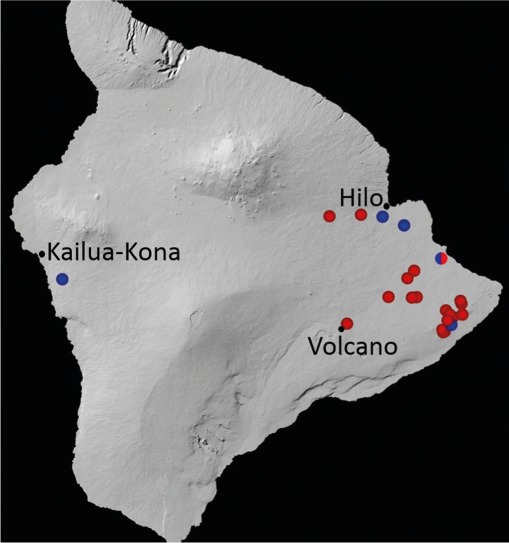
Fig. 1
Fig. 1
Distribution of samples yielding isolates of Ceratocystis lukuohia (red circles) and C. huliohia (blue circles) on Hawai’i Island during 2014–2015.
Fig. 2
Fig. 2
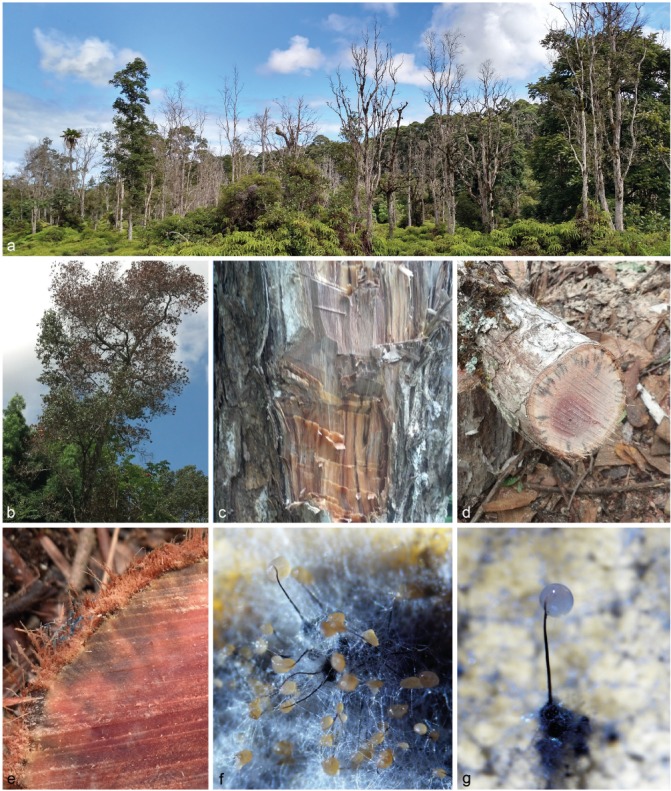
Typical symptoms associated with Ceratocystis lukuohia (sp. A). a, b. Affected trees exhibiting rapid, synchronized death of leaves on a major trunk fork or the entire crown; c. dark brown to black vertical streaks of discolouration seen in the woody xylem of an affected tree; d–e. radiating pattern of sapwood discolouration in stem cross-sections of wilting trees; f–g. ascomata of C. lukuohia with long necks supporting sticky masses of ascospores.
Fig. 3
Fig. 3
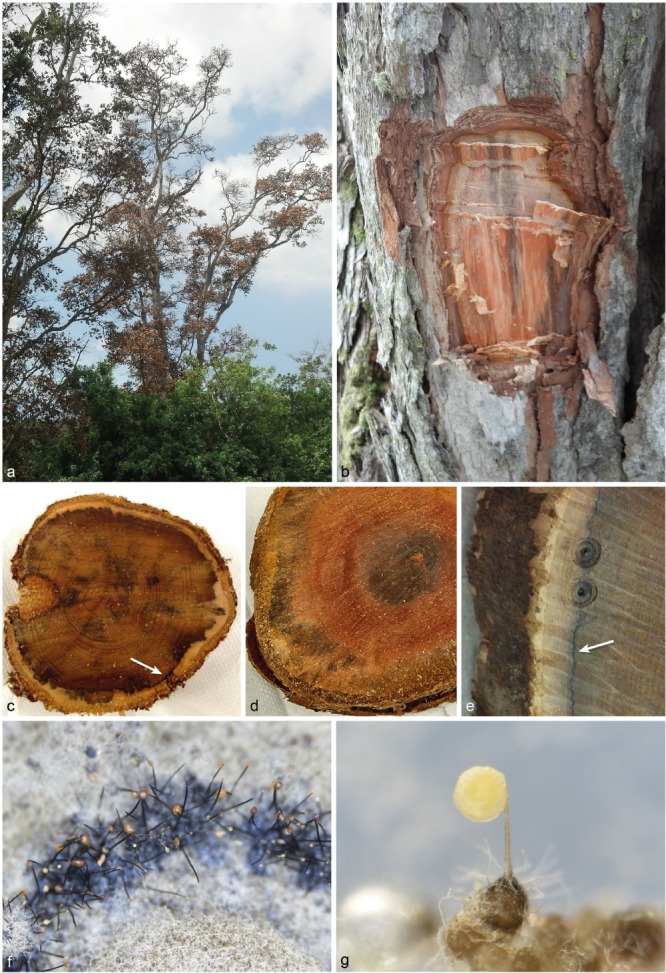
Typical symptoms associated with Ceratocystis huliohia (sp. B). a. Affected trees exhibiting rapid, synchronized death of leaves on individual branches and spreading to the entire crown; b. brown to grey-black vertical streaks of discolouration in the woody xylem of an affected tree; c–e. blotchy, diffuse black to grey staining of sapwood; and thin black lines of host reaction following the contours of the cambium (arrows); f–g. ascomata of C. huliohia with necks supporting sticky masses of ascospores.
Fig. 4
Fig. 4
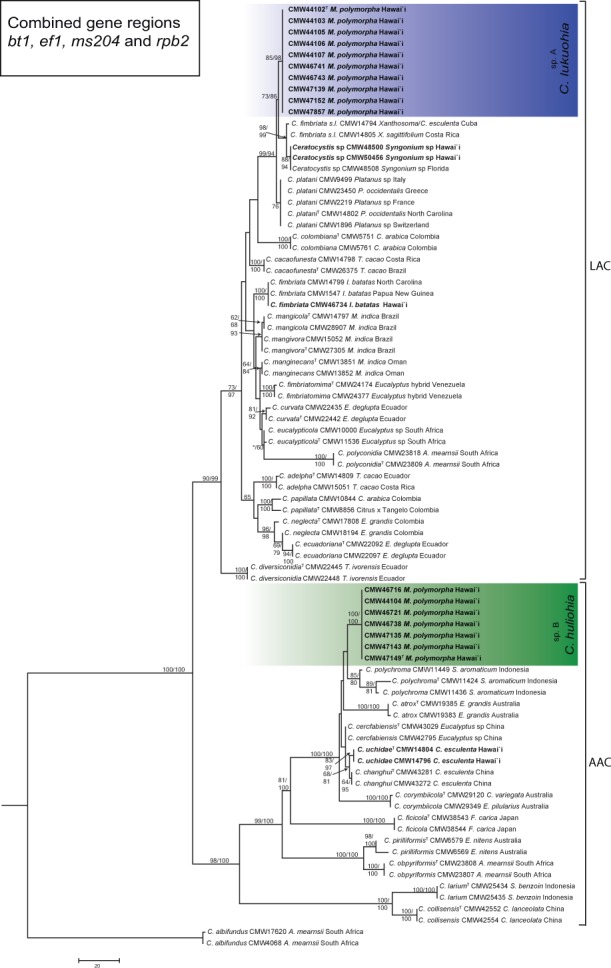
Maximum parsimony tree based on the combined dataset of four gene regions (bt1, tef1, ms204 and rpb2) for species in the Latin American clade (LAC) and the Asian-Australian clade (AAC) of Ceratocystis. Isolates sequenced in this study from M. polymorpha in Hawai’i are highlighted in blue in the LAC, as C. lukuohia (sp. A), and in green in the AAC, as C. huliohia (sp. B). Bootstrap values > 60 % for MP/ML are presented at the branches. Bootstrap values lower than 70 % are indicated with *. Ceratocystis albifundus (CMW 4068) from the African clade was used as the outgroup.
Fig. 5
Fig. 5
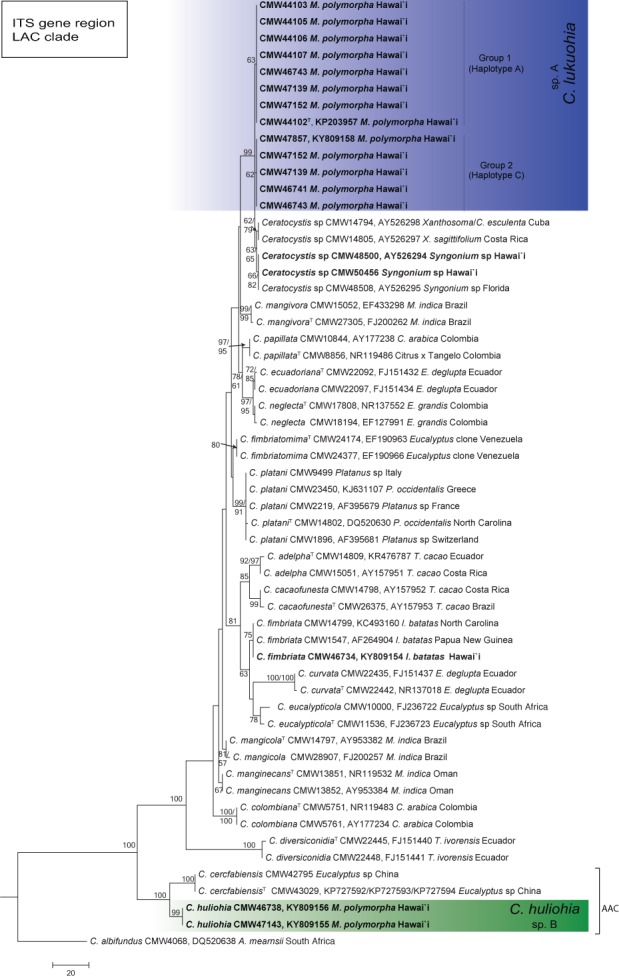
Phylogenetic tree based on MP of the ITS-rDNA of Ceratocystis species in the Latin American clade (LAC). Two ITS haplotypes (Group 1 and Group 2) were evident in the isolates of C. lukuohia (sp. A) from M. polymorpha in Hawai’i. These grouped closest to isolates from Xanthosoma sp. from Cuba and Costa Rica and Syngonium sp. from Hawai’i and Florida. Bootstrap values > 70 % for MP/ML are presented at the branches. Ceratocystis albifundus (CMW 4068) from the African clade was used as the outgroup.
Fig. 6
Fig. 6
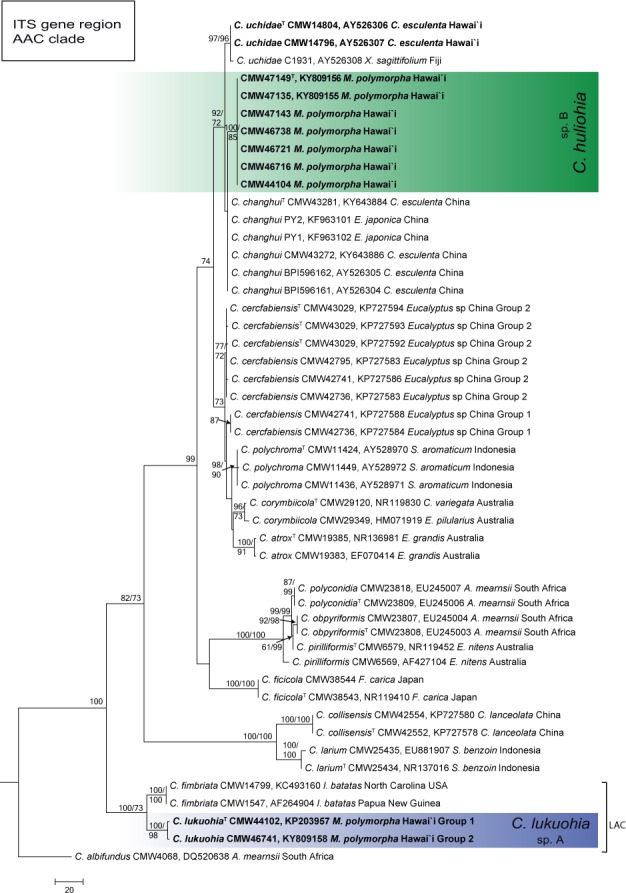
Phylogenetic tree based on MP of the ITS-rDNA of Ceratocystis species in the Asian-Australian clade (AAC). Ceratocystis huliohia (sp. B) forms a monophyletic clade and is closest to species of C. uchidae, also described from Hawai’i and C. changhui. Bootstrap values > 70 % for MP/ML are presented at the branches. Ceratocystis albifundus (CMW 4068) from the African clade was used as the outgroup.
Fig. 7
Fig. 7
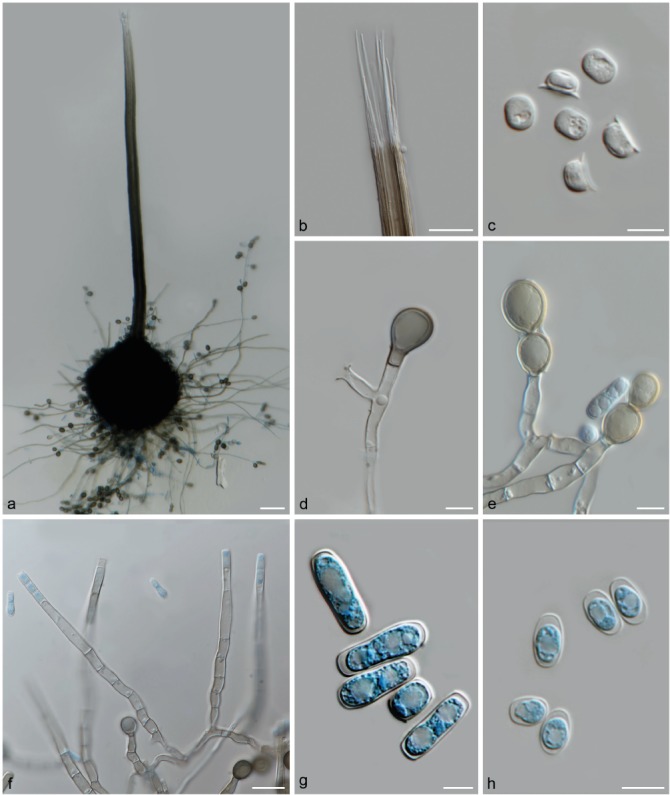
Morphological characteristics of Ceratocystis lukuohia (sp. A). a. Globose ascomata base with long neck; b. straight ostiolar hyphae; c. hat-shaped ascospores from top and side view; d. terminal thick-walled aleurioconidium; e. aleurioconidia in chains; f. flask-shaped conidiophores; g. cylindrical conidia; h. short, barrel-shaped conidia. — Scale bars: a = 50 μm; b, f = 20 μm; c, g–h = 5 μm; d–e = 10 μm.
Fig. 8
Fig. 8
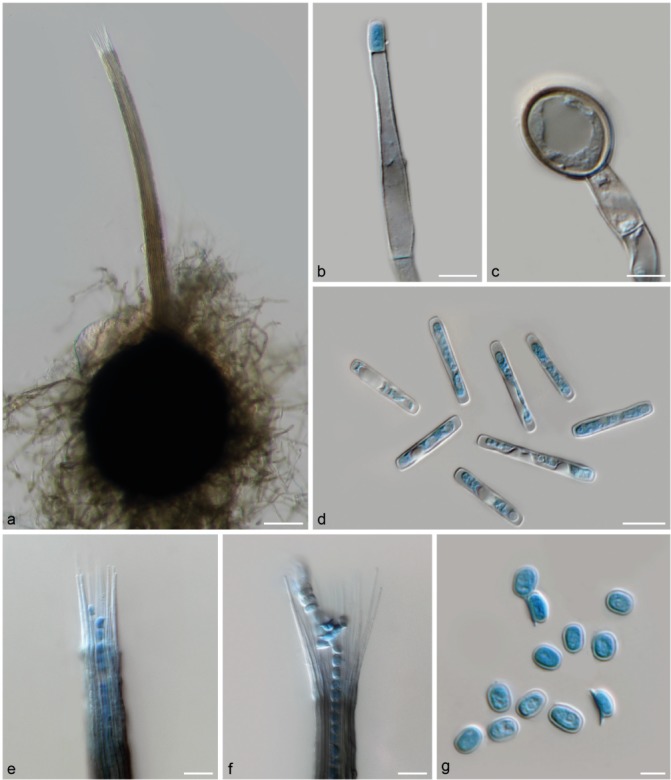
Morphological characteristics of Ceratocystis huliohia (sp. B). a. Ascomata with globose to obpyriform base and short neck; b. conidiophore with emerging, short, barrel-shaped conidium; c. terminal aleurioconidium; d. cylindrical conidia; e. short, straight ostiolar hyphae; f. divergent ostiolar hyphae; g. hat-shaped ascospores in side and top view. — Scale bars: a = 50 μm; b, d–f = 10 μm; c, g = 5 μm.
Fig. 9
Fig. 9
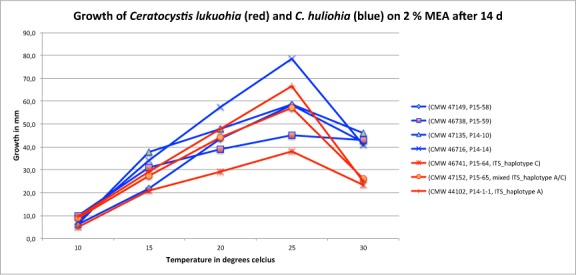
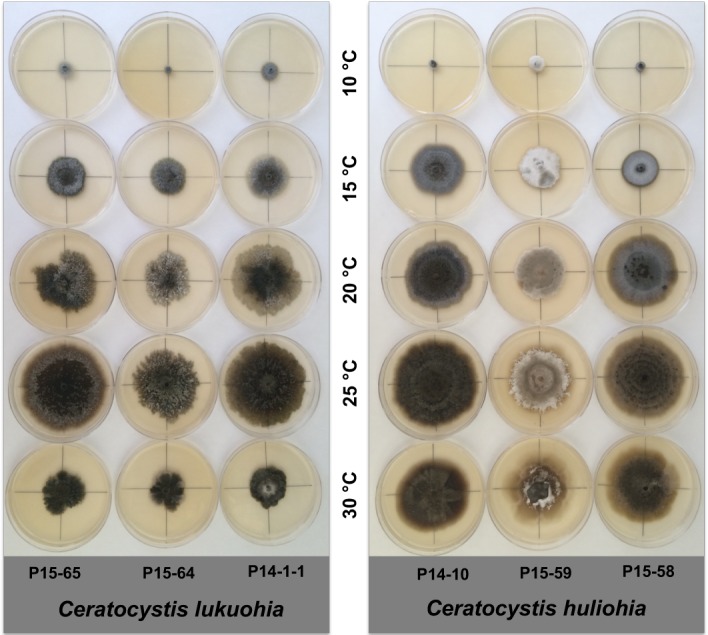
Diameter of colonies in mm of Ceratocystis lukuohia (sp. A) and C. huliohia (sp. B) isolates on 2 % malt extract agar at five different temperatures taken after 14 d growth. Ceratocystis huliohia grows slightly faster than C. lukuohia. Both species have optimal growth at 25 °C.
Fig. 10
Fig. 10
Variation in culture morphology of isolates of Ceratocystis lukuohia (sp. A) and C. huliohia (sp. B) after 14 d growth on 2 % MEA at temperatures 10, 15, 20, 25 and 30 °C.

References

    1. Al Adawi AO, Barnes I, Khan IA, et al. 2013. Ceratocystis manginecans associated with a serious wilt disease of two native legume trees in Oman and Pakistan. Australasian Plant Pathology 42: 179–193.
    1. Al Adawi AO, Barnes I, Khan IA, et al. 2014. Clonal structure of Ceratocystis manginecans populations from mango wilt disease in Oman and Pakistan. Australasian Plant Pathology 43: 393–402.
    1. Al Adawi AO, Deadman ML, Al Rawahi AK, et al. 2006. Aetiology and causal agents of mango sudden decline disease in the Sultanate of Oman. European Journal of Plant Pathology 116: 247–254.
    1. Baker CJ, Harrington TC, Krauss U, et al. 2003. Genetic variability and host specialization in the Latin American clade of Ceratocystis fimbriata. Phytopathology 93: 1274–1284. - PubMed
    1. Barnes I, Gaur A, Burgess T, et al. 2001. Microsatellite markers reflect intra-specific relationships between isolates of the vascular wilt pathogen Ceratocystis fimbriata. Molecular Plant Pathology 2: 319–325. - PubMed

LinkOut - more resources