


doi: 10.1021/acscatal.8b02928.
Epub 2018 Sep 13.
Cu-Catalyzed Decarboxylative Borylation
Affiliations
- PMID: 30505624
- PMCID: PMC6257631
- DOI: 10.1021/acscatal.8b02928
Item in Clipboard
Cu-Catalyzed Decarboxylative Borylation
ACS Catal.
.
Abstract
A simple method for the conversion of carboxylic acids to boronic esters via redox-active esters (RAEs) is reported using copper catalysis. The scope of this transformation is broad, and compared with the known protocols available, it represents the most inexpensive, rapid, and operationally simple option. In addition to a full exploration of the scope, a kinetic study was performed to elucidate substrate and reagent concentration dependences.
Conflict of interest statement
The authors declare no competing financial interest.
Figures
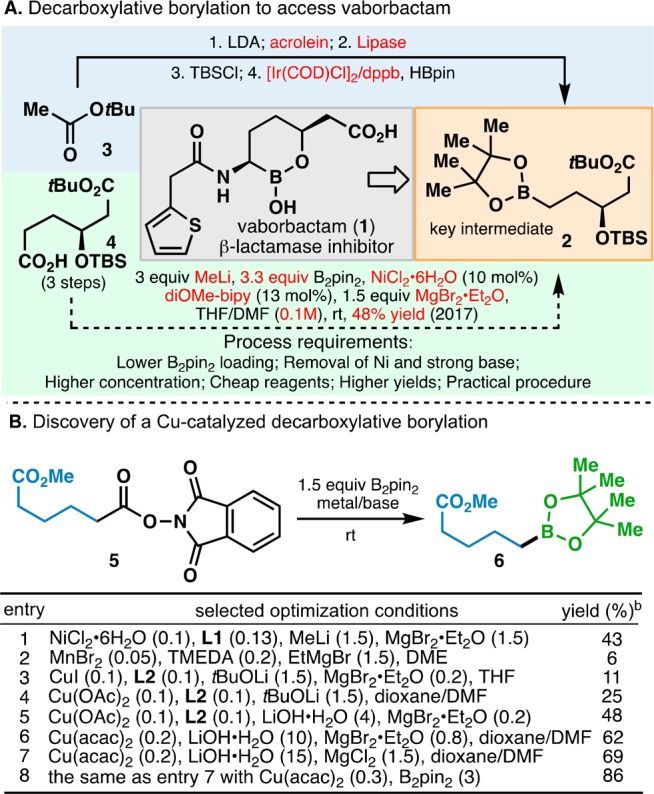
(A) Decarboxylative borylation to access vaborbactam.
(B) Discovery
of a Cu-catalyzed decarboxylative borylation and optimization of reaction
conditions. B2pin2 = bis(pinacolato)diboron,
TMEDA = N,N,N′,N′-tetramethylethylenediamine.
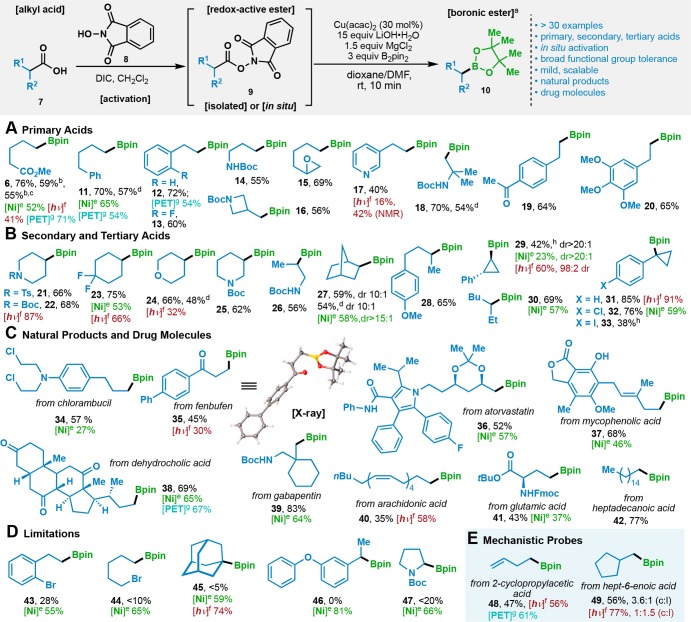
Reaction conditions:
(a) RAE (1.0 equiv), Cu(acac)2 (30 mol %), LiOH·H2O (15.0 equiv), MgCl2 (1.5 equiv), B2pin2 (3.0 equiv), dioxane/DMF, rt, 10 min. (b) Cu(acac)2 (20 mol %) and B2pin2 (1.5 equiv) were
used. (c) 3.5 mmol scale. (d) In situ reaction with NHPI (1.0 equiv)
and DIC (1.0 equiv). (e) [Ni] yield referred to reported
yield in ref (2). (f)
[hν] yield referred to reported
yield in ref (3). (g)
[PET] yield referred to reported yield in ref (4). (h) solvent MTBE/DMF was
used. Ts = tosyl, Boc = tert-butyloxycarbonyl, Fmoc
= fluorenylmethyloxycarbonyl. NHPI = N-hydroxyphthalimide,
DIC = N,N’-diisopropylcarbodiimide.
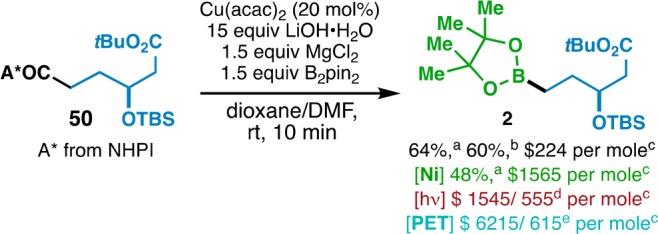
(a) 0.1 mmol
scale.
(b) 2.5 mmol scale. (c) The cost of raw materials for one mole reaction
setup. See the Supporting Information for
details. (d) B2cat2 prepared from B2(NMe2)4 and catechol. e) Ir[(ppy)2dtbpy]PF6 prepared from IrCl3 × H2O in 2 steps.
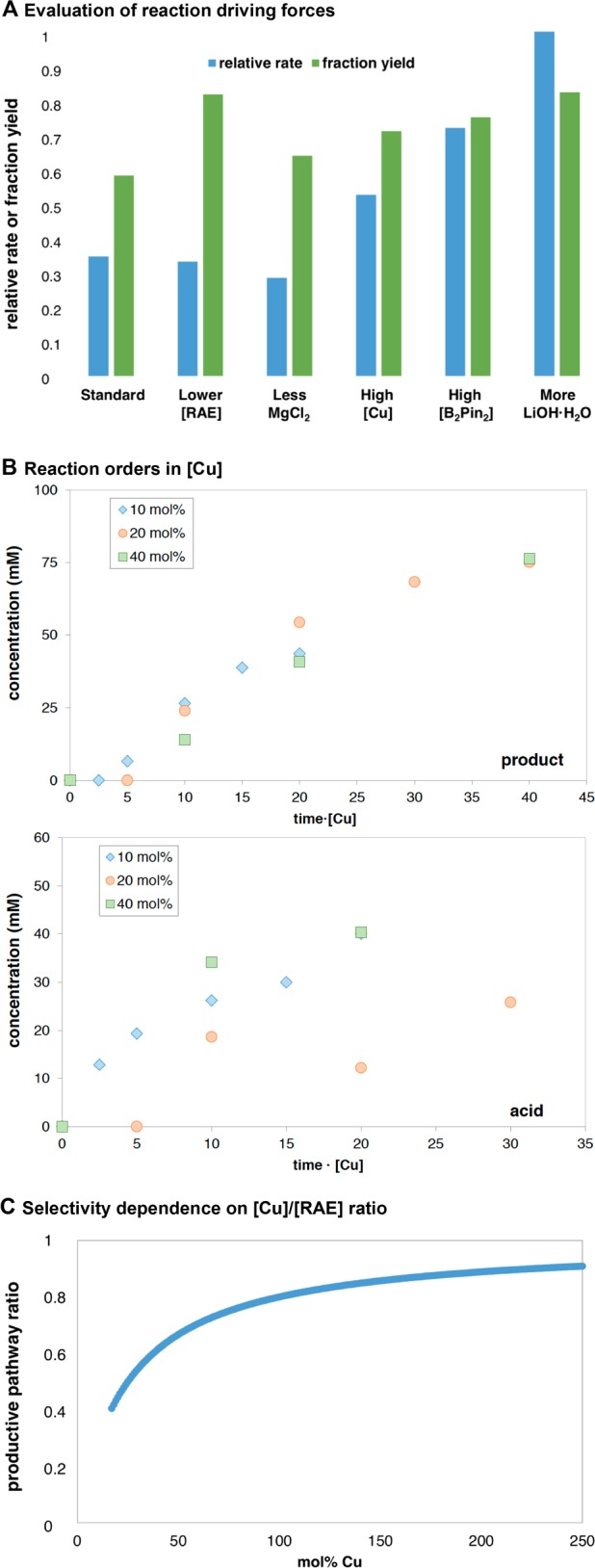
Selectivity to desired product
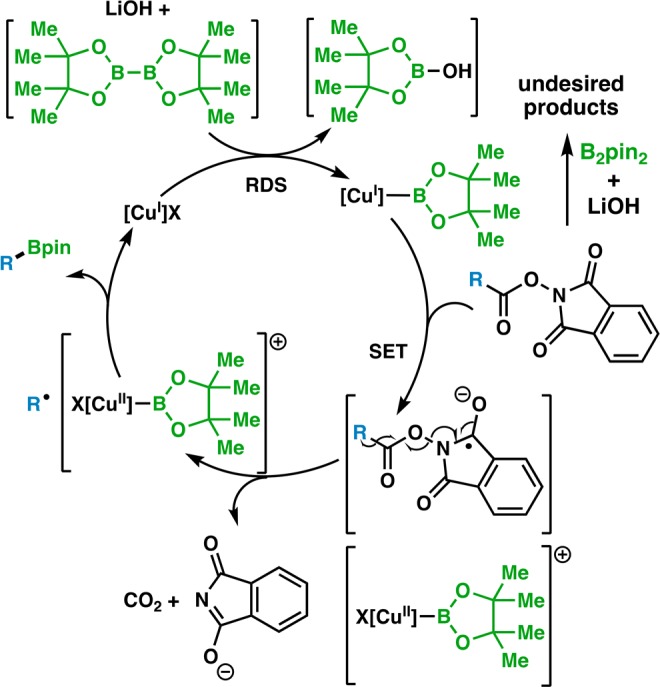
is enhanced by high [Cu] and low [RAE]. Yields were determined by
LC-UV.
References
-
- Trippier P. C.; McGuigan C. Boronic Acids in Medicinal Chemistry: Anticancer, Antibacterial and Antiviral Applications. MedChemComm 2010, 1, 183–198. 10.1039/c0md00119h. - DOI
- Draganov A.; Wang D.; Wang B.. The Future of Boron in Medicinal Chemistry: Therapeutic and Diagnostic Applications. In Atypical Elements in Drug Design, Schwarz J., Ed.; Springer, 2014; pp 1–27.
- Ballatore C.; Huryn D. M.; Smith A. B. 3rd Carboxylic Acid (Bio)Isosteres in Drug Design. ChemMedChem 2013, 8, 385–395. 10.1002/cmdc.201200585. - DOI - PMC - PubMed
-
-
Redox-active esters were also employed in sp2-boronic ester formation, see:
- Candish L.; Teders M.; Glorius F. Transition-Metal-Free, Visible-Light-Enabled Decarboxylative Borylation of Aryl N-Hydroxyphthalimide Esters. J. Am. Chem. Soc. 2017, 139, 7440–7443. 10.1021/jacs.7b03127. - DOI - PubMed
- Cheng W.-M.; Shang R.; Zhao B.; Xing W.-L.; Fu Y. Isonicotinate Ester Catalyzed Decarboxylative Borylation of (Hetero)Aryl and Alkenyl Carboxylic Acids through N-Hydroxyphthalimide Esters. Org. Lett. 2017, 19, 4291–4294. 10.1021/acs.orglett.7b01950. - DOI - PubMed
-
Grants and funding
LinkOut - more resources
Full Text Sources