. 2019 Apr;11(2):206-214.
doi: 10.1111/1758-2229.12724. Epub 2019 Jan 13.

Targeted metagenomics approach to capture the biodiversity of Saccharomyces genus in wild environments

Affiliations

Targeted metagenomics approach to capture the biodiversity of Saccharomyces genus in wild environments

Haya F Alsammar et al. Environ Microbiol Rep. 2019 Apr.

Abstract

The species of the genus Saccharomyces are commonly inhabiting tree bark and the surrounding soil, but their abundance have likely been underestimated due to biases in culturing methods. Metagenomic studies have so far been unable to detect Saccharomyces species in wild environments. Here, we sequenced the mycobiome of soils surrounding different trees at various altitudes in the Italian Alps. To survey for yeasts species belonging to Saccharomyces genus rather than other fungal species, we performed a selectivity step involving the isolation of the internal transcribed spacer (ITS) region that is specific to this yeast group. Reads mapping to Saccharomyces species were detected in all soil samples, including reads for S. mikatae and for S. eubayanus. ITS1 alignment of the S. cerevisiae, S. paradoxus and S. kudriavzevii sequences showed up to three base pair polymorphisms with other known strains, indicating possible new lineages. Basidiomycetous fungi were still the dominant species, compared to the Ascomycota, but the selectivity step allowed for the first time the detection and study of the biodiversity of the Saccharomyces species in their natural environment.


Conflict of interest statement

The authors declare no conflict of interest.

Figures
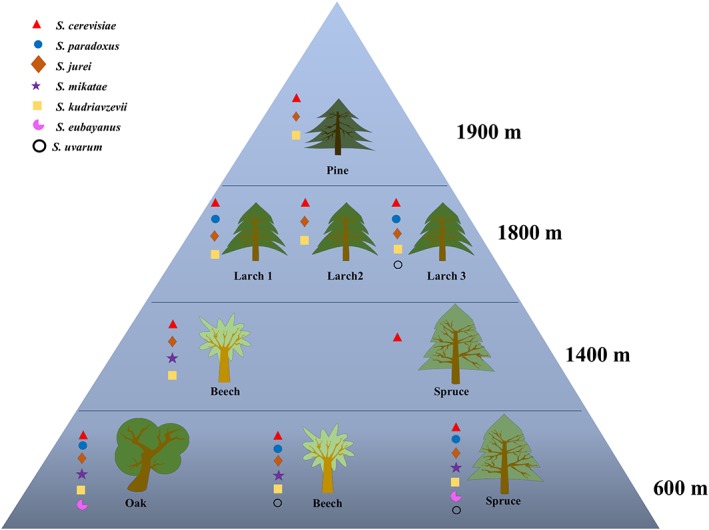
Figure 1
Figure 1
Distribution of Saccharomyces species in the mycobiome of soil surrounding different tree species at elevated altitudes. The presence of species is expressed as Operational taxonomic units (OTUs) which consist of at least two identical reads. Three individual Larch trees were sampled in the area of 1800 m altitude.
Figure 2
Figure 2
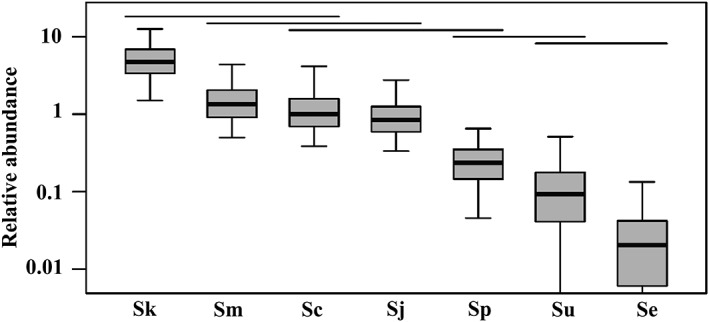
Relative abundance of seven Saccharomyces species across all samples in our study. Saccharomyces species are abbreviated as: Sk (S. kudriavzevii), Sm (S. mikatae), Sj (S. jurei), Sc (S. cerevisiae), Sp (S. paradoxus), Su (S.uvarum) and Se (S. eubayanus). Abundance is reported relative to the abundance of S. cerevisiae in the observed data. Box plots show 50% (boxes) and 95% (whiskers) confidence intervals around the observed relative abundance. Our bootstrap analysis could not identify a lower bound for the 95% confidence interval around the abundance of S. uvarum or S. eubayanus. The abundance of species under the same horizontal line are not significantly different (study‐wide type I error rate α = 0.05).
Figure 3
Figure 3
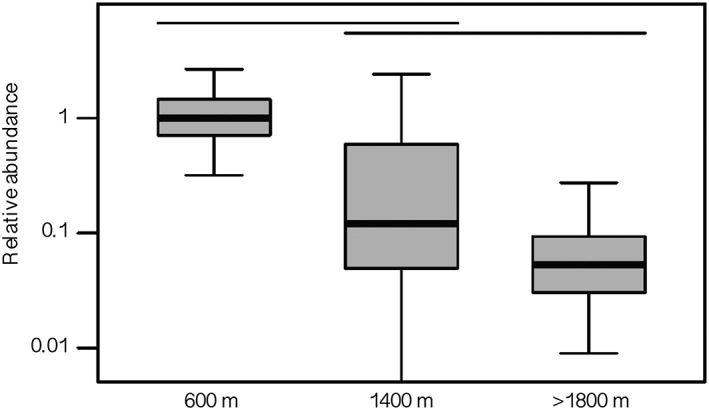
Relative abundance of Saccharomyces in patches at three different altitudes. Abundance is reported relative to the abundance of Saccharomyces in the patch at 600 m. Box plots show 50% (boxes) and 95% (whiskers) confidence intervals around the observed relative abundance. Our bootstrap analysis could not identify a lower bound for the 95% confidence interval around the abundance of Saccharomyces in the patch at 1400 m. Abundance in patches under the same horizontal line are not significantly different (study‐wide type I error rate α = 0.05).

References

    1. Almeida, P. , Goncalves, C. , Teixeira, S. , Libkind, D. , Bontrager, M. , Masneuf‐Pomarede, I. , et al (2014) A Gondwanan imprint on global diversity and domestication of wine and cider yeast Saccharomyces uvarum . Nat Commun 5: 4044. - PMC - PubMed
    1. Almeida, P. , Barbosa, R. , Zalar, P. , Imanishi, Y. , Shimizu, K. , Turchetti, B. , et al (2015) A population genomics insight into the Mediterranean origins of wine yeast domestication. Mol Ecol 24: 5412–5427. - PubMed
    1. Bellemain, E. , Carlsen, T. , Brochmann, C. , Coissac, E. , Taberlet, P. , and Kauserud, H. (2010) ITS as an environmental DNA barcode for fungi: an in silico approach reveals potential PCR biases. BMC Microbiol 10: 189. - PMC - PubMed
    1. Bing, J. , Han, P.J. , Liu, W.Q. , Wang, Q.M. , and Bai, F.Y. (2014) Evidence for a Far East Asian origin of lager beer yeast. Curr Biol 24: R380–R381. - PubMed
    1. Boix‐Amoros, A. , Martinez‐Costa, C. , Querol, A. , Collado, M.C. , and Mira, A. (2017) Multiple approaches detect the presence of fungi in human Breastmilk samples from healthy mothers. Sci Rep 7: 13016. - PMC - PubMed

Publication types

LinkOut - more resources