


Control of Lead Sources in the United States, 1970-2017: Public Health Progress and Current Challenges to Eliminating Lead Exposure
- PMID: 30507765
- PMCID: PMC6522252
- DOI: 10.1097/PHH.0000000000000889
Control of Lead Sources in the United States, 1970-2017: Public Health Progress and Current Challenges to Eliminating Lead Exposure
Abstract
Context: During the past 45 years, exposure to lead has declined dramatically in the United States. This sustained decline is measured by blood and environmental lead levels and achieved through control of lead sources, emission reductions, federal regulations, and applied public health efforts.
Objective: Explore regulatory factors that contributed to the decrease in exposure to lead among the US population since 1970.
Design/setting: We present historical information about the control of lead sources and the reduction of emissions through regulatory and selected applied public health efforts, which have contributed to decreases in lead exposure in the United States. Sources of lead exposure, exposure pathways, blood lead measurements, and special populations at risk are described.
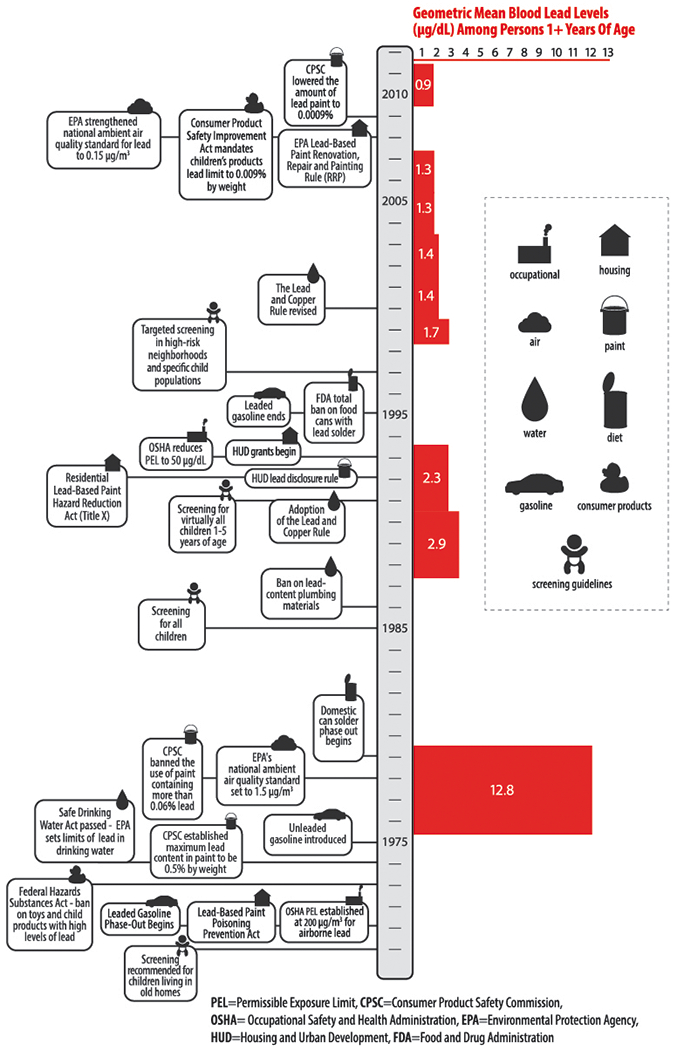
Results: From 1976-1980 to 2015-2016, the geometric mean blood lead level (BLL) of the US population aged 1 to 74 years dropped from 12.8 to 0.82 μg/dL, a decline of 93.6%. Yet, an estimated 500 000 children aged 1 to 5 years have BLLs at or above the blood lead reference value of 5 μg/dL established by the Centers for Disease Control and Prevention. Low levels of exposure can lead to adverse health effects. There is no safe level of lead exposure, and child BLLs less than 10 μg/dL are known to adversely affect IQ and behavior. When the exposure source is known, approximately 95% of BLLs of 25 μg/dL or higher are work-related among US adults. Despite much progress in reducing exposure to lead in the United States, there are challenges to eliminating exposure.
Conclusions: There are future challenges, particularly from the inequitable distribution of lead hazards among some communities. Maintaining federal, state, and local capacity to identify and respond to populations at high risk can help eliminate lead exposure as a public health problem. The results of this review show that the use of strong evidence-based programs and practices, as well as regulatory authority, can help control or eliminate lead hazards before children and adults are exposed.
Conflict of interest statement
The authors declare no conflicts of interest.
Figures
References
-
- Agency for Toxic Substances and Disease Registry. Toxicological profile for lead. https://www.atsdr.cdc.gov/toxprofiles/tp13.pdf. Published August 2007 Accessed March 2, 2016. - PubMed
-
- Mahaffey KR, Annest JL, Roberts J, Murphy RS. National estimates of blood lead levels: United States 1976-1980. N Engl J Med. 1982;307:573–579. Bibliographic Links - PubMed
-
- Centers for Disease Control and Prevention. Low Level Lead Exposure Harms Children: A Renewed Call for Primary Prevention. Atlanta, GA: US Department of Health & Human Services; 2012. http://www.cdc.gov/nceh/lead/acclpp/final_document_030712.pdf Accessed July 25, 2017.
-
- Pirkle JL, Brody DJ, Gunter EW, et al. The decline of blood lead levels in the United States: the National Health and Nutrition Examination Surveys (NHANES). JAMA. 1994;272:284–291. Bibliographic Links - PubMed
-
- National Institute for Occupational Safety and Health. Adult blood lead epidemiology and surveillance. Reference blood lead level for adults. https://www.cdc.gov/niosh/topics/ables/description.html. Published 2015 Accessed June 7, 2018.
MeSH terms
Substances
Grants and funding
LinkOut - more resources
Full Text Sources
Miscellaneous
