


Rationale for vaccination with trivalent or quadrivalent live attenuated influenza vaccines: Protective vaccine efficacy in the ferret model
- PMID: 30507951
- PMCID: PMC6277076
- DOI: 10.1371/journal.pone.0208028
Rationale for vaccination with trivalent or quadrivalent live attenuated influenza vaccines: Protective vaccine efficacy in the ferret model
Abstract
Background and aim: The majority of seasonal influenza vaccines are trivalent, containing two A virus strains (H1N1 and H3N2) and one B virus strain. The co-circulation of two distinct lineages of B viruses can lead to mismatch between the influenza B virus strain recommended for the trivalent seasonal vaccine and the circulating B virus. This has led some manufacturers to produce quadrivalent influenza vaccines containing one strain from each B lineage in addition to H1N1 and H3N2 strains. However, it is also important to know whether vaccines containing a single influenza B strain can provide cross-protectivity against viruses of the antigenically distinct lineage. The aim of this study was to assess in naïve ferrets the potential cross-protective activity of trivalent live attenuated influenza vaccine (T-LAIV) against challenge with a heterologous wild-type influenza B virus belonging to the genetically different lineage and to compare this activity with effectiveness of quadrivalent LAIV (Q-LAIV) in the ferret model.
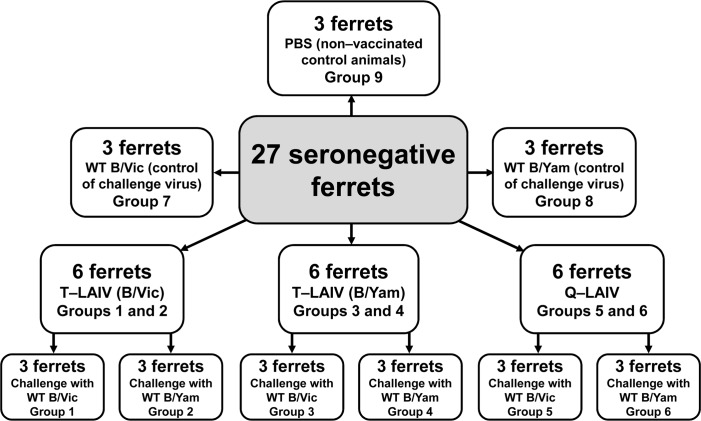
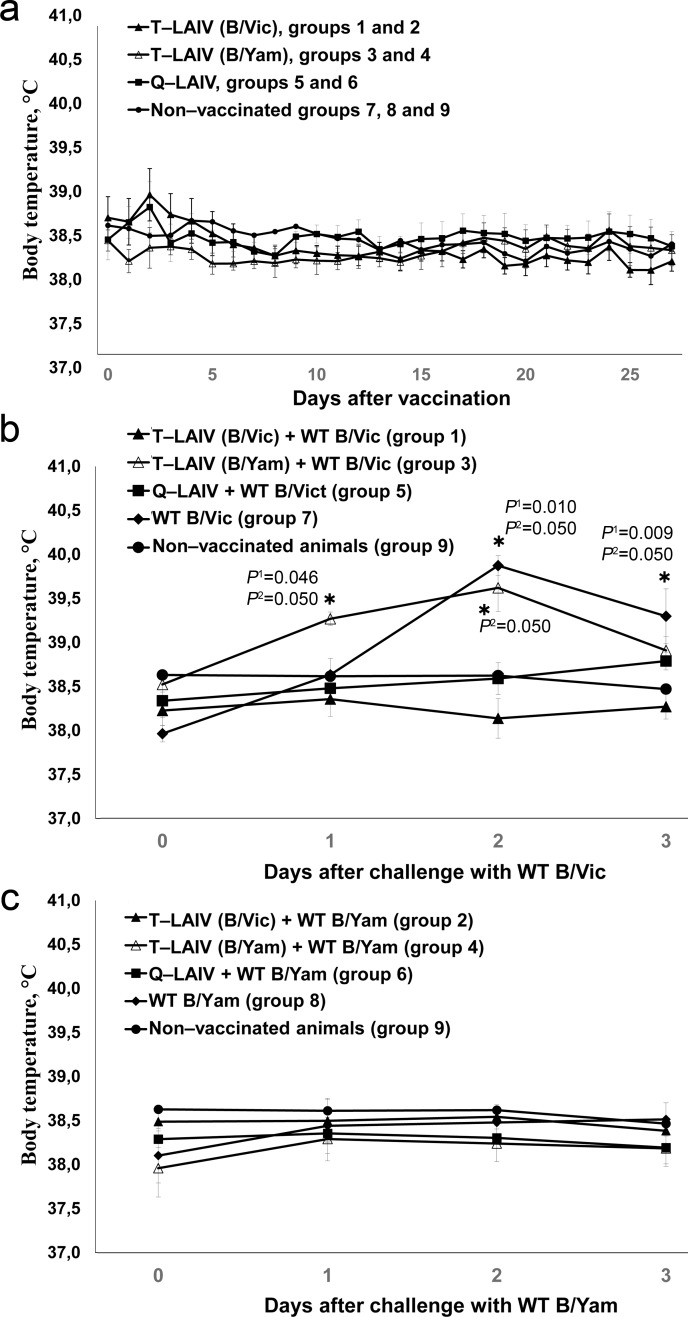
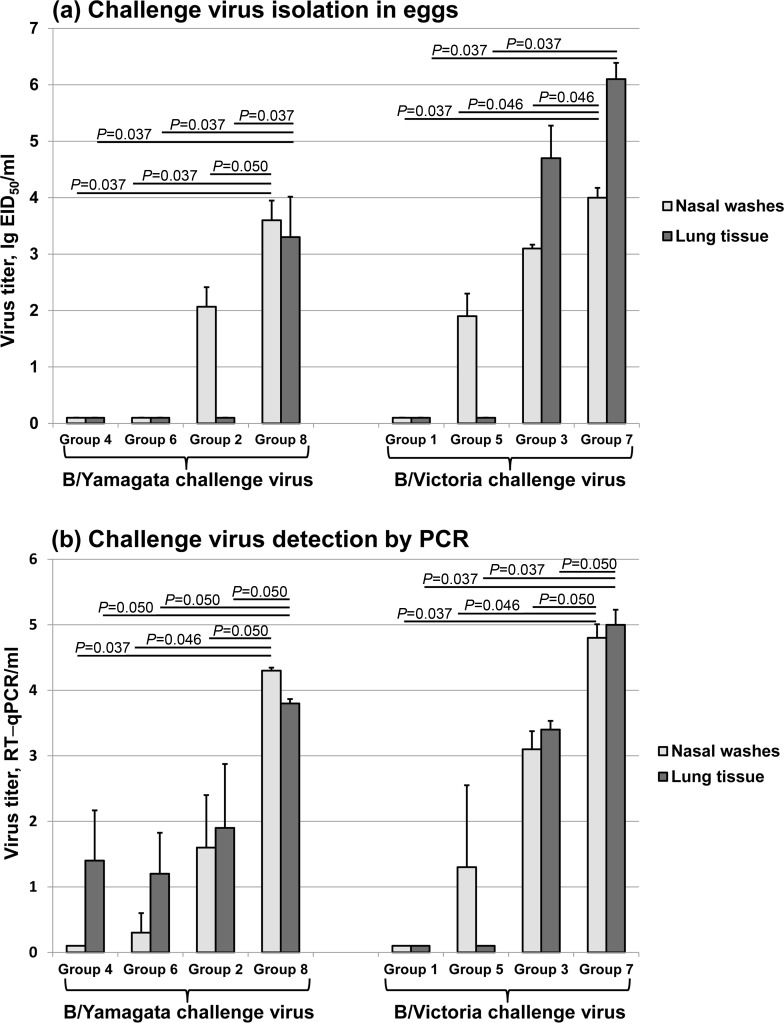
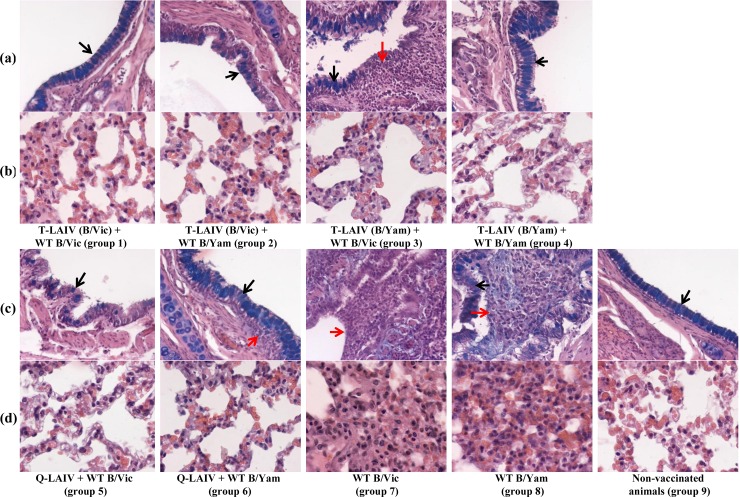
Methods and results: Ferrets were vaccinated with either one dose of trivalent LAIV containing B/Victoria or B/Yamagata lineage virus, or quadrivalent LAIV (containing both B lineages), or placebo. They were then challenged with B/Victoria or B/Yamagata lineage wild-type virus 28 days after vaccination. The ferrets were monitored for clinical signs and morbidity. Nasal swabs and lung tissue samples were analyzed for the presence of challenge virus. Antibody response to vaccination was assessed by routine hemagglutination inhibition assay. All LAIVs tested were found to be safe and effective against wild-type influenza B viruses based on clinical signs, and virological and histological data. The absence of interference between vaccine strains in trivalent and quadrivalent vaccine formulations was confirmed. Trivalent LAIVs were shown to have the potential to be cross-protective against infection with genetically different influenza B/Victoria and B/Yamagata lineages.
Conclusions: In this ferret model, quadrivalent vaccine provided higher protection to challenge against both B/Victoria and B/Yamagata lineage viruses. However, T-LAIV provided some cross-protection in the case of a mismatch between circulating and vaccine type B strains. Notably, B/Victoria-based T-LAIV was more protective compared to B/Yamagata-based T-LAIV.
Conflict of interest statement
LR, IK, EK, ES, AR, SD, MP, EG, KK, AM, MM and MPK declare no conflict of interest. EGS and GT are employed by the study sponsor (World Health Organization, WHO). The founding sponsor, EGS and GT were involved in the design of the study, analyses of data and the decision to publish the results but were not involved in the collection or interpretation of data. The manuscript was reviewed by the study sponsor prior to submission. KK, AM and MM are employed by the commercial Institute of Preclinical Research Ltd, St Petersburg, Russia. However, this company was not the funding organization. Grant funding by WHO does not alter our adherence to all PLOS ONE policies on sharing data and materials. Participation of employees of commercial Institute of Preclinical Research Ltd, St Petersburg, Russia in this study does not alter our adherence to all PLOS ONE policies on sharing data and materials.
Figures
References
-
- Caini S, Spreeuwenberg P, Kusznierz GF, Rudi JM, Owen R, Pennington K et al. Distribution of influenza virus types by age using case-based global surveillance data from twenty-nine countries, 1999–2014. BMC Infect Dis. 2018. 18 (1): 269 10.1186/s12879-018-3181-y - DOI - PMC - PubMed
-
- Paul Glezen W, Schmier JK, Kuehn CM, Ryan KJ, Oxford J. The burden of influenza B: a structured literature review. Am J Public Health. 2013. 103 (3): e43–e51. 10.2105/AJPH.2012.301137 - DOI - PMC - PubMed
-
- Shaw MW, Xu X, Li Y, Normand S, Ueki RT, Kunimoto GY et al. Reappearance and global spread of variants of influenza B/Victoria/2/87 lineage viruses in the 2000–2001 and 2001–2002 seasons. Virology. 2002. 303(1):1–8. - PubMed
-
- Yang JR, Huang YP, Chang FY, Hsu LC, Lin YC, Huang HY et al. Phylogenetic and evolutionary history of influenza B viruses, which caused a large epidemic in 2011–2012, Taiwan. PLoS One. 2012. 7(10):e47179 10.1371/journal.pone.0047179 - DOI - PMC - PubMed
-
- Bedford T, Riley S, Barr IG, Broor S, Chadha M, Cox NJ et al. Global circulation patterns of seasonal influenza viruses vary with antigenic drift. Nature. 2015. 523(7559):217–220. 10.1038/nature14460 - DOI - PMC - PubMed
Publication types
MeSH terms
Substances
Grants and funding
LinkOut - more resources
Full Text Sources
Medical
