Ensuring Fairness in Machine Learning to Advance Health Equity
- PMID: 30508424
- PMCID: PMC6594166
- DOI: 10.7326/M18-1990
Ensuring Fairness in Machine Learning to Advance Health Equity
Abstract
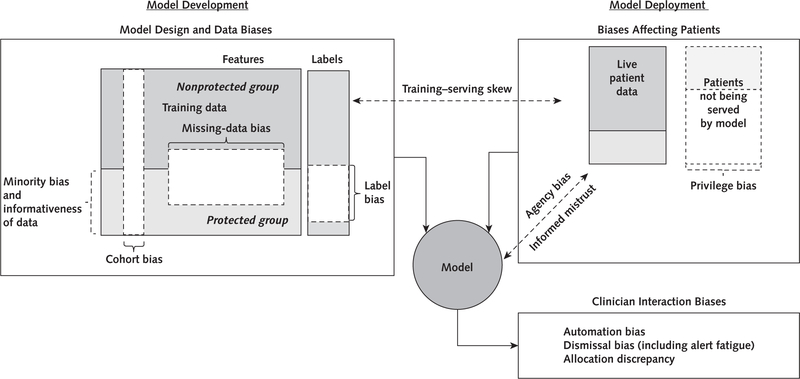
Machine learning is used increasingly in clinical care to improve diagnosis, treatment selection, and health system efficiency. Because machine-learning models learn from historically collected data, populations that have experienced human and structural biases in the past-called protected groups-are vulnerable to harm by incorrect predictions or withholding of resources. This article describes how model design, biases in data, and the interactions of model predictions with clinicians and patients may exacerbate health care disparities. Rather than simply guarding against these harms passively, machine-learning systems should be used proactively to advance health equity. For that goal to be achieved, principles of distributive justice must be incorporated into model design, deployment, and evaluation. The article describes several technical implementations of distributive justice-specifically those that ensure equality in patient outcomes, performance, and resource allocation-and guides clinicians as to when they should prioritize each principle. Machine learning is providing increasingly sophisticated decision support and population-level monitoring, and it should encode principles of justice to ensure that models benefit all patients.
Conflict of interest statement
Figures
Comment in
-
Machine Learning, Health Disparities, and Causal Reasoning.Ann Intern Med. 2018 Dec 18;169(12):883-884. doi: 10.7326/M18-3297. Epub 2018 Dec 4. Ann Intern Med. 2018. PMID: 30508423 No abstract available.
References
-
- Angwin J, Larson J, Kirchner L, Mattu S. Machine bias. ProPublica 23 May 2016. Accessed at www.propublica.org/article/machine-bias-risk-assessments-in-criminal-sen... on 13 December 2017.
-
- Kleinberg J Inherent trade-offs in algorithmic fairness [Abstract]. In: Abstracts of the 2018 Association for Computing Machinery International Conference on Measurement and Modeling of Computer Systems, Irvine, California, 18 –22 June 2018 New York: Association for Computing Machinery; 2018:40.
-
- Lum K, Isaac W. To predict and serve? Significance 2016;13:14–9.
-
- Chouldechova A, Benavides-Prado D, Fialko O, Vaithianathan R. A case study of algorithm-assisted decision making in child maltreatment hotline screening decisions. Proc Mach Learn Res 2018: 134–48.
Publication types
MeSH terms
Grants and funding
LinkOut - more resources
Full Text Sources
Medical
Miscellaneous