


Screening initiation with FIT or colonoscopy: Post-hoc analysis of a pragmatic, randomized trial
- PMID: 30508552
- PMCID: PMC6362977
- DOI: 10.1016/j.ypmed.2018.11.020
Screening initiation with FIT or colonoscopy: Post-hoc analysis of a pragmatic, randomized trial
Abstract
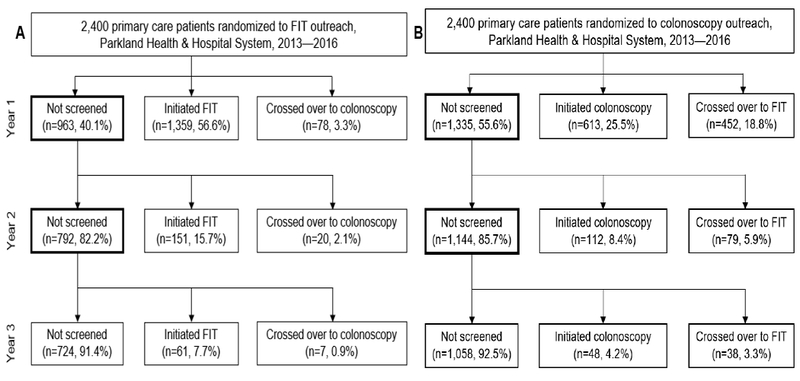
Screening with FIT or colonoscopy can reduce CRC mortality. In our pragmatic, randomized trial of screening outreach over three years, patients annually received mailed FITs or colonoscopy invitations. We examined screening initiation after each mailing and crossover from the invited to other modality. Eligible patients (50-64 years, ≥1 primary-care visit before randomization, and no history of CRC) received mailed FIT kits (n = 2400) or colonoscopy invitations (n = 2400) from March 2013 through July 2016. Among those invited for colonoscopy, we used multinomial logistic regression to identify factors associated with screening initiation with colonoscopy vs. FIT vs. no screening after the first mailing. Most patients were female (61.8%) and Hispanic (48.9%) or non-Hispanic black (24.0%). Among those invited for FIT, 56.6% (n = 1359) initiated with FIT, whereas 3.3% (n = 78) crossed over to colonoscopy; 151 (15.7%) and 61 (7.7%) initiated with FIT after second and third mailings. Among those invited for colonoscopy, 25.5% (n = 613) initiated with colonoscopy whereas 18.8% (n = 452) crossed over to FIT; 112 (8.4%) and 48 (4.2%) initiated with colonoscopy after second and third mailings. Three or more primary-care visits prior to randomization were associated with initiating with colonoscopy (OR 1.49, 95% CI 1.17-1.91) and crossing over to FIT (OR 1.63, 95% CI 1.19-2.23). Although nearly half of patients initiated screening after the first mailing, few non-responders in either outreach group initiated after a second or third mailing. More patients invited to colonoscopy crossed over to FIT than those assigned to FIT crossed over to colonoscopy.
Keywords: Colorectal neoplasms; Health promotion; Mass screening; Pragmatic clinical trial; Safety-net providers.
Copyright © 2018 Elsevier Inc. All rights reserved.
Conflict of interest statement
Figures
References
-
- Bibbins-Domingo K, Grossman DC, Curry SJ, et al. Screening for colorectal cancer: US Preventive Services Task Force recommendation statement. Jama 2016;315:2564–2575. - PubMed
Publication types
MeSH terms
Grants and funding
LinkOut - more resources
Full Text Sources
Medical
