


Climate-induced phenological shifts in a Batesian mimicry complex
- PMID: 30509987
- PMCID: PMC6338869
- DOI: 10.1073/pnas.1813367115
Climate-induced phenological shifts in a Batesian mimicry complex
Erratum in
-
Correction for Hassall et al., Climate-induced phenological shifts in a Batesian mimicry complex.Proc Natl Acad Sci U S A. 2019 Feb 26;116(9):3933. doi: 10.1073/pnas.1900966116. Epub 2019 Feb 19. Proc Natl Acad Sci U S A. 2019. PMID: 30782838 Free PMC article. No abstract available.
Abstract
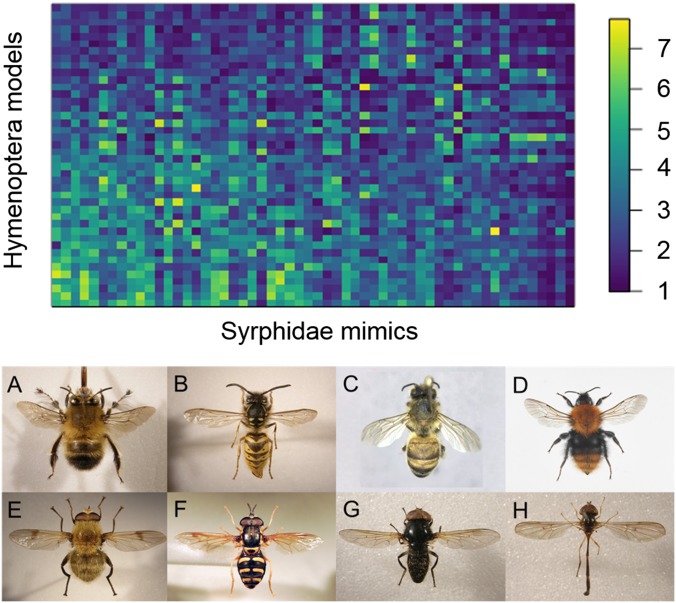
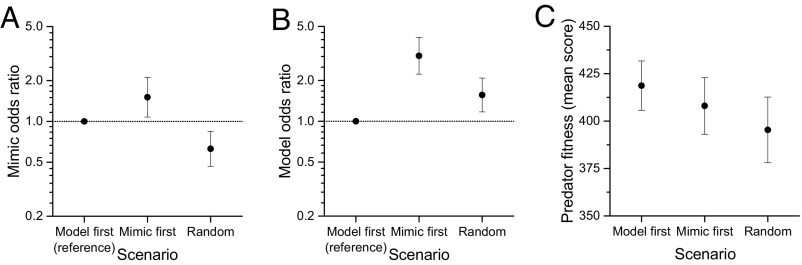
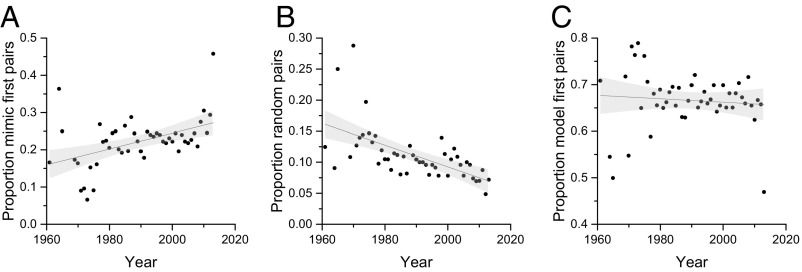
Climate-induced changes in spatial and temporal occurrence of species, as well as species traits such as body size, each have the potential to decouple symbiotic relationships. Past work has focused primarily on direct interactions, particularly those between predators and prey and between plants and pollinators, but studies have rarely demonstrated significant fitness costs to the interacting, coevolving organisms. Here, we demonstrate that changing phenological synchrony in the latter part of the 20th century has different fitness outcomes for the actors within a Batesian mimicry complex, where predators learn to differentiate harmful "model" organisms (stinging Hymenoptera) from harmless "mimics" (hoverflies, Diptera: Syrphidae). We define the mimetic relationships between 2,352 pairs of stinging Hymenoptera and their Syrphidae mimics based on a large-scale citizen science project and demonstrate that there is no relationship between the phenological shifts of models and their mimics. Using computer game-based experiments, we confirm that the fitness of models, mimics, and predators differs among phenological scenarios, creating a phenologically antagonistic system. Finally, we show that climate change is increasing the proportion of mimetic interactions in which models occur first and reducing mimic-first and random patterns of occurrence, potentially leading to complex fitness costs and benefits across all three actors. Our results provide strong evidence for an overlooked example of fitness consequences from changing phenological synchrony.
Keywords: Batesian mimicry; climate change; hover flies; mismatch; phenology.
Conflict of interest statement
The authors declare no conflict of interest.
Figures
Comment in
-
Creative citizen science illuminates complex ecological responses to climate change.Proc Natl Acad Sci U S A. 2019 Jan 15;116(3):720-722. doi: 10.1073/pnas.1820266116. Epub 2019 Jan 4. Proc Natl Acad Sci U S A. 2019. PMID: 30610180 Free PMC article. No abstract available.
References
-
- Hickling R, Roy DB, Hill JK, Fox R, Thomas CD. The distributions of a wide range of taxonomic groups are expanding polewards. Glob Change Biol. 2006;12:1–6.
-
- Thackeray SJ, et al. Trophic level asynchrony in rates of phenological change for marine, freshwater and terrestrial environments. Glob Change Biol. 2010;16:3304–3313.
-
- Visser ME, Holleman LJM, Gienapp P. Shifts in caterpillar biomass phenology due to climate change and its impact on the breeding biology of an insectivorous bird. Oecologia. 2006;147:164–172. - PubMed
-
- Iler AM, et al. Maintenance of temporal synchrony between syrphid flies and floral resources despite differential phenological responses to climate. Glob Change Biol. 2013;19:2348–2359. - PubMed
Publication types
MeSH terms
LinkOut - more resources
Full Text Sources
Medical
Miscellaneous
