


Variation of Risk Factors for Cause-Specific Reintubation: A Preliminary Study
- PMID: 30510604
- PMCID: PMC6230426
- DOI: 10.1155/2018/3654251
Variation of Risk Factors for Cause-Specific Reintubation: A Preliminary Study
Abstract
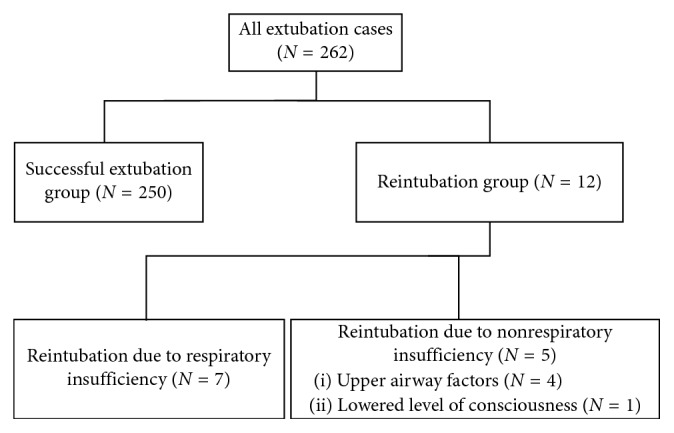
Unexpected reintubation may occur, even if the risk factors are considered and a spontaneous breathing trial is successful. Reintubation is thought to be caused by various factors. Several studies have investigated the risk factors of reintubation, but most did not classify reintubation by cause. We retrospectively classified patients undergoing reintubation at intensive care unit by cause (respiratory insufficiency vs. nonrespiratory insufficiency) to examine the cause-specific risk factors of reintubation. A total of 262 patients were included; reintubation within 48 hours after extubation was performed in 12 patients (reintubation rate, 4.5%). After classification by cause of reintubation, the pressure of arterial oxygen to fractional inspired oxygen concentration (P/F) ratio exhibited a significant association with reintubation only in the respiratory insufficiency group (odds ratio (OR) 0.989, 95% confidence interval (CI) 0.980 to 0.999, p=0.036, and OR 0.989, 95% CI 0.979 to 0.999, p=0.026, in the univariate and multivariate analyses, respectively). In the propensity score analysis, a P/F ratio ≤ 200 may be a risk factor for reintubation in the respiratory insufficiency group (OR 7.811, 95% CI 1.345 to 45.367, p=0.022). In the nonrespiratory insufficiency group, intubation duration was significantly related to reintubation (OR 1.165, 95% CI 1.012 to 1.342, p=0.033, and OR 1.163, 95% CI 1.004 to 1.348, p=0.044, in the univariate and multivariate analyses, respectively). In conclusion, a low P/F ratio at extubation may be a risk factor for reintubation due to respiratory insufficiency. In the nonrespiratory insufficiency group, intubation duration may be significantly related to reintubation. The risk factors for reintubation may differ by the cause of reintubation. Further large-scale randomized controlled trials are required.
References
MeSH terms
LinkOut - more resources
Full Text Sources
Medical
