


(Un)folding mechanisms of adaptation to ER stress: lessons from aneuploidy
- PMID: 30511161
- PMCID: PMC6421085
- DOI: 10.1007/s00294-018-0914-9
(Un)folding mechanisms of adaptation to ER stress: lessons from aneuploidy
Abstract
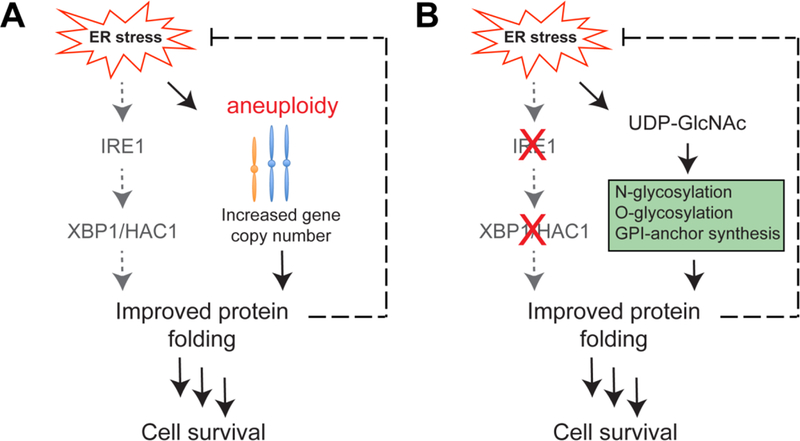
During stress, accumulation of misfolded proteins in the endoplasmic reticulum (ER) triggers activation of the adaptive mechanisms that restore protein homeostasis. One mechanism that eukaryotic cells use to respond to ER stress is through activation of the unfolded protein response (UPR) signaling pathway, which initiates degradation of misfolded proteins and leads to inhibition of translation and increased expression of chaperones and oxidative folding components that enhance ER protein folding capacity. However, the mechanisms of adaptation to ER stress are not limited to the UPR. Using yeast Saccharomyces cerevisiae, we recently discovered that the protein folding burden in the ER can be alleviated in a UPR-independent manner through duplication of whole chromosomes containing ER stress-protective genes. Here we discuss our findings and their implication to our understanding of the mechanisms by which cells respond to protein misfolding in the ER.
Keywords: Aneuploidy; ER stress resistance; Genome instability; Next-generation sequencing; Unfolded protein response.
Figures
References
-
- Walter P & Ron D (2011) The unfolded protein response: from stress pathway to homeostatic regulation. Science 334(6059):1081–1086. - PubMed
-
- Travers KJ, et al. (2000) Functional and genomic analyses reveal an essential coordination between the unfolded protein response and ER-associated degradation. Cell 101(3):249–258. - PubMed
Publication types
MeSH terms
Grants and funding
LinkOut - more resources
Full Text Sources
Molecular Biology Databases
