


"Candidatus Neoehrlichia mikurensis" in Ixodes ricinus ticks collected near the Arctic Circle in Norway
- PMID: 30514355
- PMCID: PMC6278014
- DOI: 10.1186/s13071-018-3168-y
"Candidatus Neoehrlichia mikurensis" in Ixodes ricinus ticks collected near the Arctic Circle in Norway
Abstract
Background: "Candidatus Neoehrlichia mikurensis" is a gram-negative bacterium belonging to the family Anaplasmataceae that, in Europe, is transmitted by Ixodes ricinus ticks. "Candidatus N. mikurensis" can cause a severe systemic inflammatory syndrome, neoehrlichiosis, mostly in persons with other underlying diseases. To date, "Ca. N. mikurensis" has been found in ticks in different countries in Asia and Europe, but never as far north as at the Arctic Circle.
Methods: A total of 1104 I. ricinus ticks collected from vegetation and from animals in northern Norway (64-68°N) were analysed for the prevalence of "Ca. N. mikurensis". Of them, 495 ticks were collected from vegetation by flagging and 609 ticks were collected from dogs and cats. Total nucleic acid extracted from the ticks were converted to cDNA and analyzed with real-time PCR targeting the 16S rRNA gene of "Ca. N. mikurensis". Positive samples were further analysed by nested PCR and sequencing.
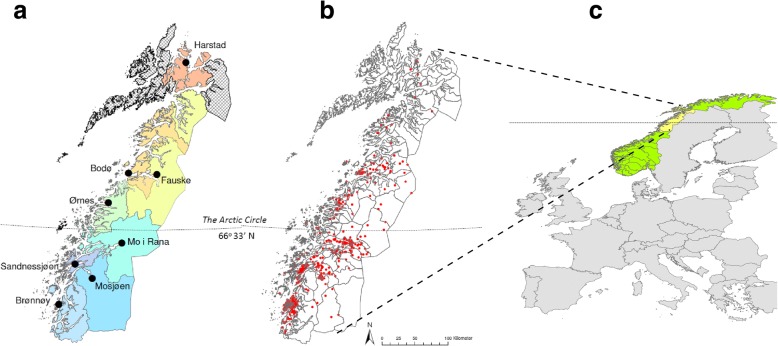
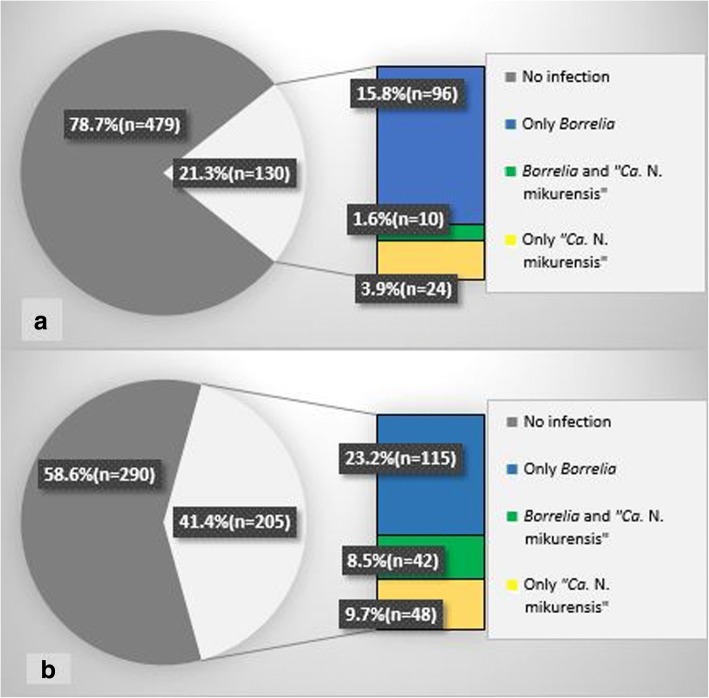
Results: "Candidatus N. mikurensis" was detected in 11.2% of all collected I. ricinus ticks in northern Norway. The prevalence differed between ticks collected from vegetation (18.2%; 90/495) compared to ticks collected from dogs and cats (5.6%; 34/609). The ticks from dogs and cats were collected in Brønnøy area and seven additional districts further north. The prevalence of "Ca. N. mikurensis" in these ticks differed between geographical localities, with the highest prevalence in the Brønnøy area.
Conclusions: The detection of "Ca. N. mikurensis" in I. ricinus ticks from the Arctic Circle in northern Norway indicates potential risk for tick-bitten humans at this latitude to be infected with "Ca. N. mikurensis".
Keywords: Arctic Circle; Ixodes ricinus; Neoehrlichiosis; Norway; Tick-borne pathogen; “Candidatus Neoehrlichia mikurensis”.
Conflict of interest statement
Ethics approval and consent to participate
Ethical approval has not been relevant for this study, because the analyses have been performed on cDNA from ticks that have either been collected in nature or removed from animals as part of the regular animal welfare.
Consent for publication
Not applicable
Competing interests
The authors declare that they have no competing interests.
Publisher’s Note
Springer Nature remains neutral with regard to jurisdictional claims in published maps and institutional affiliations.
Figures
References
-
- von Loewenich FD, Geissdorfer W, Disque C, Matten J, Schett G, Sakka SG, Bogdan C. Detection of ‘Candidatus Neoehrlichia mikurensis’ in two patients with severe febrile illnesses: evidence for a European sequence variant. J Clin Microbiol. 2010;48:2630–2635. doi: 10.1128/JCM.00588-10. - DOI - PMC - PubMed
-
- Kawahara M, Rikihisa Y, Isogai E, Takahashi M, Misumi H, Suto C, et al. Ultrastructure and phylogenetic analysis of ‘Candidatus Neoehrlichia mikurensis’ in the family Anaplasmataceae, isolated from wild rats and found in Ixodes ovatus ticks. Int J Syst Evol Microbiol. 2004;54:1837–1843. doi: 10.1099/ijs.0.63260-0. - DOI - PubMed
MeSH terms
Substances
Grants and funding
LinkOut - more resources
Full Text Sources
Miscellaneous
