. 2018 Dec 18;115(51):12973-12978.
doi: 10.1073/pnas.1806438115. Epub 2018 Dec 4.

Structural mechanism for HIV-1 TAR loop recognition by Tat and the super elongation complex

Affiliations

Structural mechanism for HIV-1 TAR loop recognition by Tat and the super elongation complex

Ursula Schulze-Gahmen et al. Proc Natl Acad Sci U S A. .

Abstract

Promoter-proximal pausing by RNA polymerase II (Pol II) is a key regulatory step in human immunodeficiency virus-1 (HIV-1) transcription and thus in the reversal of HIV latency. By binding to the nascent transactivating response region (TAR) RNA, HIV-1 Tat recruits the human super elongation complex (SEC) to the promoter and releases paused Pol II. Structural studies of TAR interactions have been largely focused on interactions between the TAR bulge and the arginine-rich motif (ARM) of Tat. Here, the crystal structure of the TAR loop in complex with Tat and the SEC core was determined at a 3.5-Å resolution. The bound TAR loop is stabilized by cross-loop hydrogen bonds. It makes structure-specific contacts with the side chains of the Cyclin T1 Tat-TAR recognition motif (TRM) and the zinc-coordinating loop of Tat. The TAR loop phosphate backbone forms electrostatic and VDW interactions with positively charged side chains of the CycT1 TRM. Mutational analysis showed that these interactions contribute importantly to binding affinity. The Tat ARM was present in the crystallized construct; however, it was not visualized in the electron density, and the TAR bulge was not formed in the RNA construct used in crystallization. Binding assays showed that TAR bulge-Tat ARM interactions contribute less to TAR binding affinity than TAR loop interactions with the CycT1 TRM and Tat core. Thus, the TAR loop evolved to make high-affinity interactions with the TRM while Tat has three roles: scaffolding and stabilizing the TRM, making specific interactions through its zinc-coordinating loop, and making electrostatic interactions through its ARM.

Keywords: HIV-1 TAR; Tat; crystal structure; super elongation complex; transcriptional regulation.


Conflict of interest statement

The authors declare no conflict of interest.

Figures
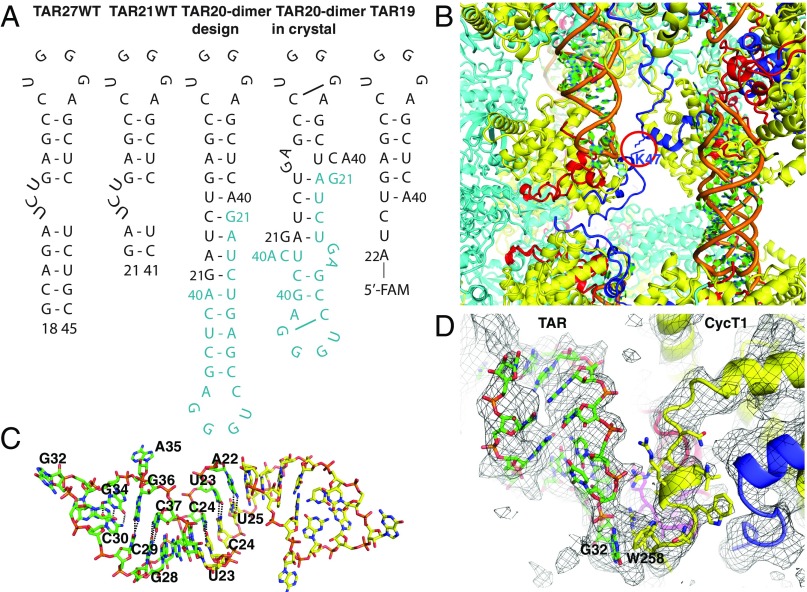
Fig. 1.
Fig. 1.
Crystal optimization. (A) Synthetic TAR oligonucleotides used for cocrystallization with Tat:AFF4:P-TEFb, EMSAs, and FP experiments. Symmetry-related molecules for TAR20 crystallization design and experimental result are shown in blue. (B) Crystal packing of the initial low-resolution crystal of the TAR-SEC complex. TAR (orange and green) forms extensive contacts in the direction of the threefold symmetry axis (vertical direction). CDK9 (cyan), CycT1 (yellow), and Tat (red) provide additional contacts. AFF4 (blue) makes unfavorable contacts between symmetry-related K47, indicated by the red circle. (C) Symmetry-related TAR molecules form a dimer with a continuous helical structure in the crystal environment. (D) 2Fo-Fc density (1.1σ) of refined TAR20 complex with Tat:AFF4:P-TEFb shows clear density for the TAR phosphate backbone and many of the nucleobases, as well as for the protein model.
Fig. 2.
Fig. 2.
HIV-1 TAR interactions with Tat:AFF4:P-TEFb. (A) Ribbon diagram showing an overview of the complex. (B) Surface representation of TAR (Left) and CycT1 (Right) with Coulombic surface coloring from −10 kcal/(mole) (red) to 10 kcal/(mole) (blue) using a dielectric constant of 4.0 in Chimera (47). (C and D) Cartoon and ball-and-stick diagram of the TAR contact site (orange and green) with Tat (red) and CycT1 (yellow). AFF4 is shown in dark blue.
Fig. 3.
Fig. 3.
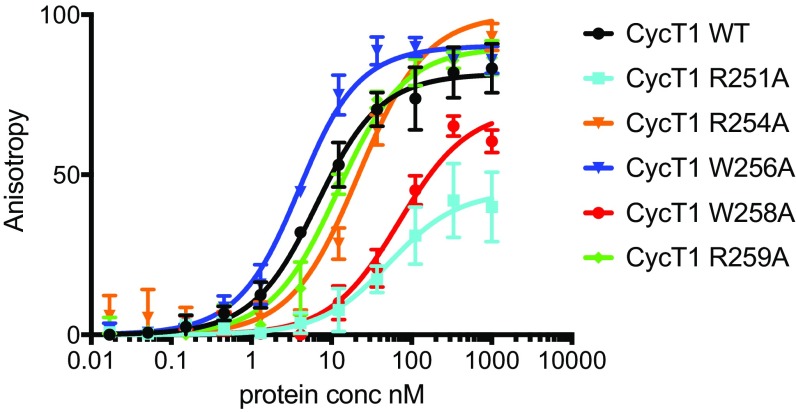
Effect of CycT1 TRM mutations on binding affinity for the HIV-1 TAR loop. Binding of Tat:AFF4:P-TEFb with WT CycT1 or with mutant CycT1 to 2 nM of fluorescently labeled TAR19 is monitored by the change in relative fluorescence anisotropy. Error bars reflect the SD from three experimental replicates. Control experiments are shown in SI Appendix, Fig. S1.
Fig. 4.
Fig. 4.
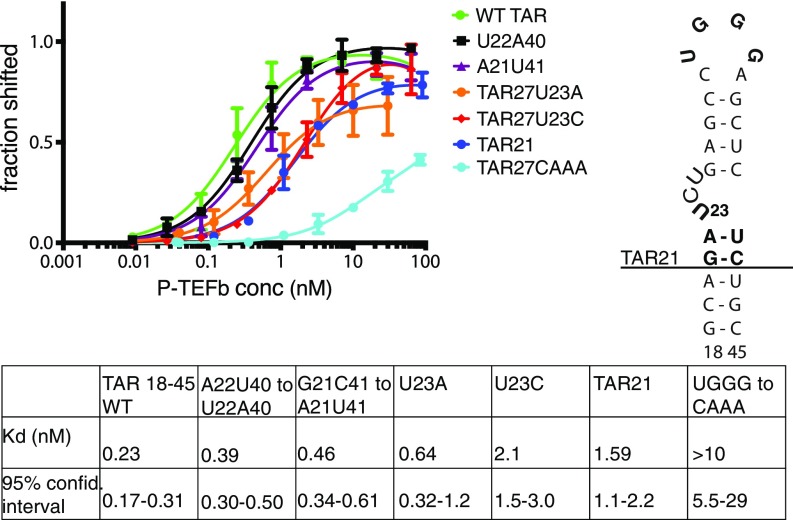
HIV-1 TAR binding to Tat:AFF4:P-TEFb. Binding of WT TAR and TAR mutants to WT Tat:AFF4:P-TEFb was measured in EMSAs with 100 pM 32P-labeled TAR27. Error bars reflect the SD from three experimental replicates. TAR mutations are indicated in bold letters in the schematic depiction of TAR (right).
Fig. 5.
Fig. 5.
Combined structure of the TAR-peptide complex and the TAR loop-SEC complex. The TAR-peptide complex (PDB ID 2KX5; TAR: slate; peptide: magenta) and the TAR loop-SEC complex (coloring as in Fig. 2) are aligned on the common TAR component. Tat and CycT1 TRM contact the TAR loop. The TAR bulge is positioned in a pocket formed by CycT1 helices H1, H3, and H4 and Tat residue G48, adjacent to the missing Tat ARM, whose binding site is indicated by the Tat-peptide mimetic bound in the major groove of TAR. Views A and B are rotated 180°.

References

    1. Cillo AR, Mellors JW. Which therapeutic strategy will achieve a cure for HIV-1? Curr Opin Virol. 2016;18:14–19. - PubMed
    1. Margolis DM, Garcia JV, Hazuda DJ, Haynes BF. Latency reversal and viral clearance to cure HIV-1. Science. 2016;353:aaf6517. - PMC - PubMed
    1. Mousseau G, et al. An analog of the natural steroidal alkaloid cortistatin A potently suppresses Tat-dependent HIV transcription. Cell Host Microbe. 2012;12:97–108. - PMC - PubMed
    1. Mousseau G, Mediouni S, Valente ST. Targeting HIV transcription: The quest for a functional cure. Curr Top Microbiol Immunol. 2015;389:121–145. - PMC - PubMed
    1. Darcis G, Van Driessche B, Van Lint C. HIV latency: Should we shock or lock? Trends Immunol. 2017;38:217–228. - PubMed

Publication types

MeSH terms

Substances

Associated data

LinkOut - more resources