


An assisted structured reflection on life events and life goals in advanced cancer patients: Outcomes of a randomized controlled trial (Life InSight Application (LISA) study)
- PMID: 30516096
- PMCID: PMC6529670
- DOI: 10.1177/0269216318816005
An assisted structured reflection on life events and life goals in advanced cancer patients: Outcomes of a randomized controlled trial (Life InSight Application (LISA) study)
Abstract
Background:: Diagnosis and treatment of incurable cancer as a life-changing experience evokes difficult existential questions.
Aim:: A structured reflection could improve patients’ quality of life and spiritual well-being. We developed an interview model on life events and ultimate life goals and performed a randomized controlled trial to evaluate the effect thereof on quality of life and spiritual well-being.
Design:: The intervention group had two consultations with a spiritual counselor. The control group received care as usual. EORTC QLQ-C15-PAL and the FACIT-sp were administered at baseline and 2 and 4 months after baseline. Linear mixed model analysis was performed to test between-group differences over time.
Participants:: Adult patients with incurable cancer and a life expectancy ⩾6 months were randomized in a 1:1 ratio to the intervention or control group.
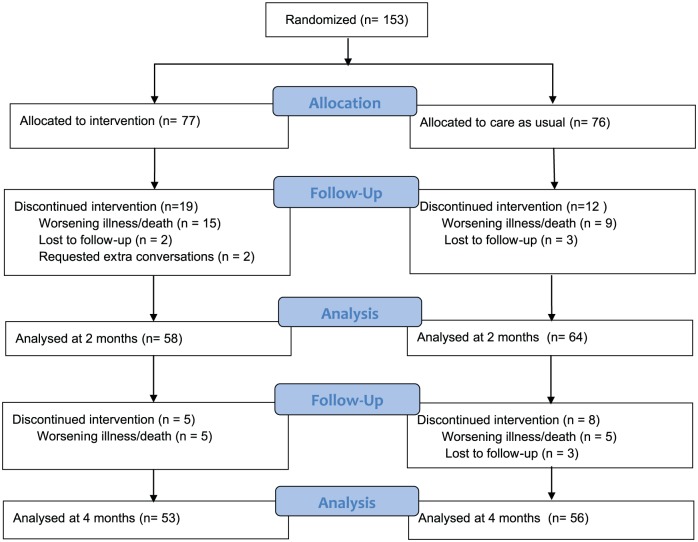
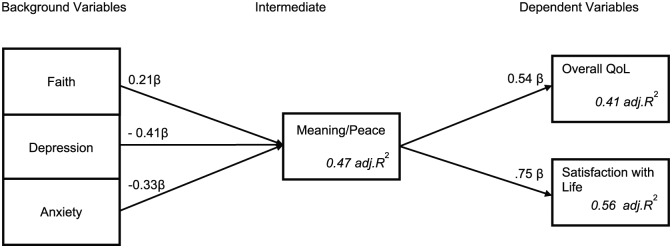
Results:: A total of 153 patients from six different hospitals were included: 77 in the intervention group and 76 in the control group. Quality of life and spiritual well-being did not significantly change over time between groups. The experience of Meaning/Peace was found to significantly influence quality of life (β = 0.52, adj. R2 = 0.26) and satisfaction with life (β = 0.61, adj. R2 = 0.37).
Conclusion:: Although our newly developed interview model was well perceived by patients, we were not able to demonstrate a significant difference in quality of life and spiritual well-being between groups. Future interventions by spiritual counselors aimed at improving quality of life, and spiritual well-being should focus on the provision of sources of meaning and peace.
Trial registration: ClinicalTrials.gov NCT01830075.
Keywords: Oncology; palliative care; randomized controlled trials; spiritual care; spiritual care givers; spirituality.
Conflict of interest statement
Figures
References
-
- Markowitz AJ, McPhee SJ. Spiritual issues in the care of dying patients: “… it’s okay between me and god.” JAMA 2006; 296(18): 2254–1392. - PubMed
-
- Salmon P, Manzi F, Valori RM. Measuring the meaning of life for patients with incurable cancer: the Life Evaluation Questionnaire (LEQ). Eur J Cancer 1996; 32A(5): 755–760. - PubMed
-
- Benzein E, Norberg A, Saveman BI. The meaning of the lived experience of hope in patients with cancer in palliative home care. Palliat Med 2001; 15(2): 117–126. - PubMed
-
- Puchalski CM, Ferrell B, Virani R, et al. Improving the quality of spiritual care as a dimension of palliative care: the report of the consensus conference. J Palliat Med 2009; 12(10): 885–904. - PubMed
-
- McClain CS, Rosenfeld B, Breitbart W. Effect of spiritual well-being on end-of-life despair in terminally-ill cancer patients. Lancet 2003; 361(9369): 1603–1607. - PubMed
Publication types
MeSH terms
Associated data
LinkOut - more resources
Full Text Sources
Medical
