


Algal Oxylipins Mediate the Resistance of Diatoms against Algicidal Bacteria
- PMID: 30518148
- PMCID: PMC6315584
- DOI: 10.3390/md16120486
Algal Oxylipins Mediate the Resistance of Diatoms against Algicidal Bacteria
Abstract
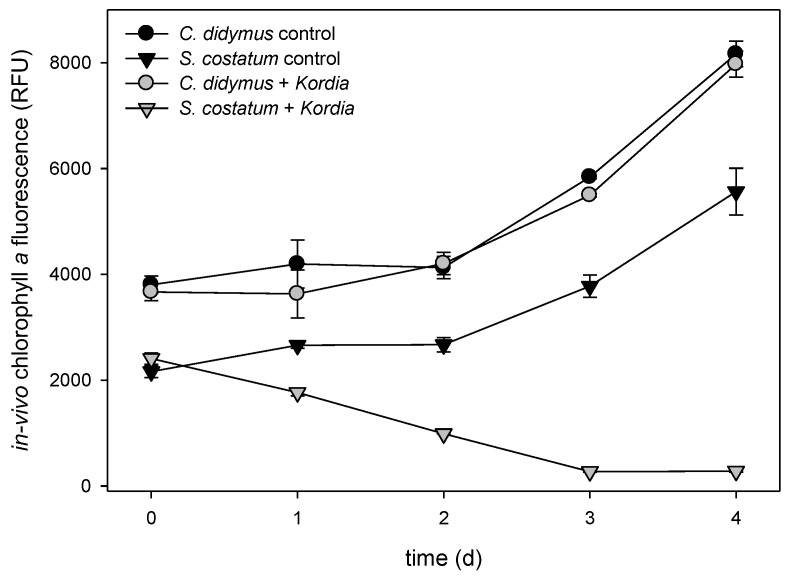
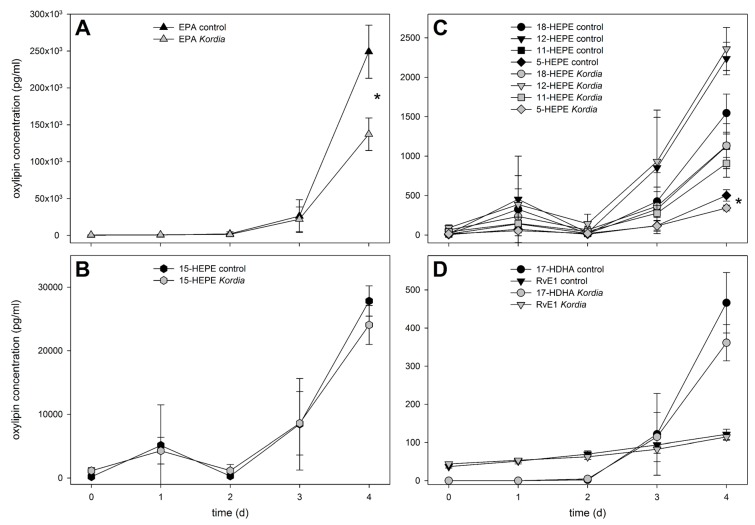
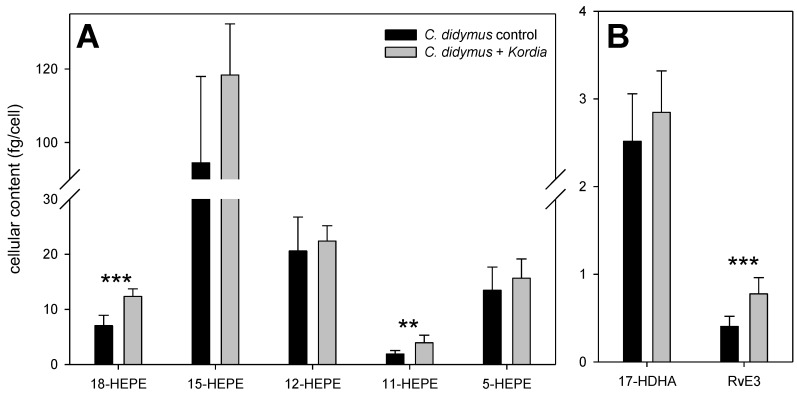
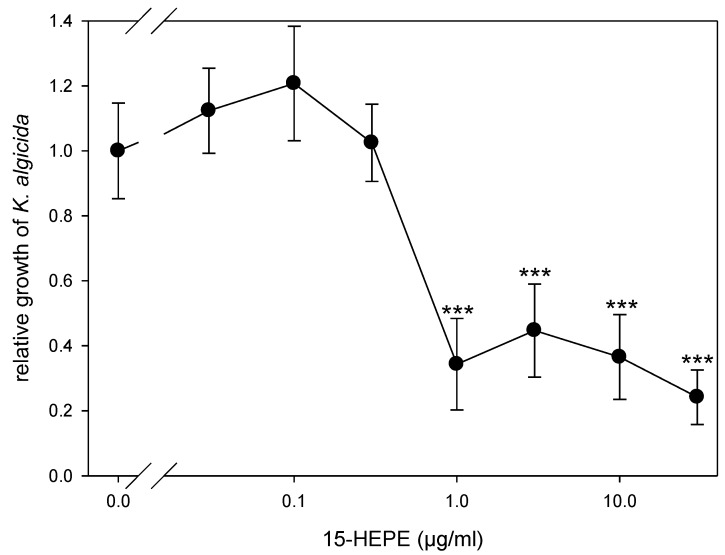
Algicidal bacteria can lyse microalgal blooms and trigger shifts within plankton communities. Resistant algal species can escape lysis, and have the opportunity to dominate the phytoplankton after a bacterial infection. Despite their important function in ecosystem regulation, little is known about mechanisms of resistance. Here, we show that the diatom Chaetoceros didymus releases eicosanoid oxylipins into the medium, and that the lytic algicidal bacterium, Kordia algicida, induces the production of several wound-activated oxylipins in this resistant diatom. Neither releases nor an induction occurs in the susceptible diatom Skeletonema costatum that is lysed by the bacterium within a few days. Among the upregulated oxylipins, hydroxylated eicosapentaenoic acids (HEPEs) dominate. However, also, resolvins, known lipid mediators in mammals, increase upon exposure of the algae to the algicidal bacteria. The prevailing hydroxylated fatty acid, 15-HEPE, significantly inhibits growth of K. algicida at a concentration of approximately 1 µM. The oxylipin production may represent an independent line of defense of the resistant alga, acting in addition to the previously reported upregulation of proteases.
Keywords: HEPE hydroxylated eicosapentaenoic acid; HETE hydroxylated eicosatetraenoic acid; algicidal bacteria; diatoms; induced chemical defense; oxylipins; plankton; resolvins.
Conflict of interest statement
The authors declare no conflict of interest. The founding sponsors had no role in the design of the study; in the collection, analyses, or interpretation of data; in the writing of the manuscript, and in the decision to publish the results.
Figures
References
-
- Hutchinson G.E. The paradox of the plankton. Am. Nat. 1961;95:137–145. doi: 10.1086/282171. - DOI
-
- Ianora A., Bentley M.G., Caldwell G.S., Casotti R., Cembella A.D., Engström-Öst J., Halsband C., Sonnenschein E., Legrand C., Llewellyn C.A., et al. The relevance of marine chemical ecology to plankton and ecosystem function: An emerging field. Mar. Drugs. 2011;9:1625–1648. doi: 10.3390/md9091625. - DOI - PMC - PubMed
-
- Rosenwasser S., Mausz M.A., Schatz D., Sheyn U., Malitsky S., Aharoni A., Weinstock E., Tzfadia O., Ben-Dor S., Feldmesser E., et al. Rewiring host lipid metabolism by large viruses determines the fate of Emiliania huxleyi, a bloom-forming alga in the ocean. Plant Cell. 2014;26:2689–2707. doi: 10.1105/tpc.114.125641. - DOI - PMC - PubMed
MeSH terms
Substances
Grants and funding
LinkOut - more resources
Full Text Sources
