. 2018 Dec 6;3(23):e125651.
doi: 10.1172/jci.insight.125651.

Training the physician-scientist: views from program directors and aspiring young investigators

Affiliations

Training the physician-scientist: views from program directors and aspiring young investigators

Christopher S Williams et al. JCI Insight. .

Abstract

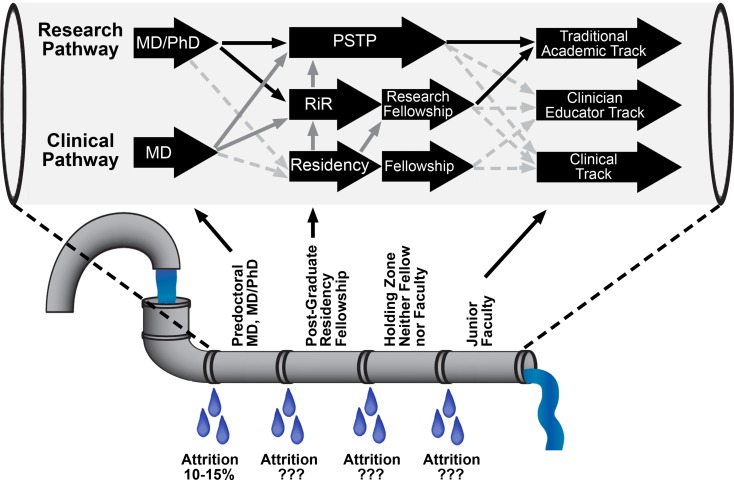
There is growing concern that the physician-scientist is endangered due to a leaky training pipeline and prolonged time to scientific independence (1). The NIH Physician-Scientist Workforce Working Group has concluded that as many as 1,000 individuals will need to enter the pipeline each year to sustain the workforce (2). Moreover, surveys of postgraduate training programs document considerable variability in disposition and infrastructure (3). Programs can be broadly grouped into two classes: physician-scientist training programs (PSTPs) that span residency and fellowship training, and research-in-residency programs (RiRs), which are limited to residency but trainees are able to match into PSTPs upon transitioning to fellowship (Figure 1). Funding sources for RiRs and PSTPs are varied and include NIH KL2 and T32 awards, charitable foundations, philanthropy, and institutional support. Furthermore, standards for research training and tools for evaluating programmatic success are lacking. Here, we share consensus generated from iterative workshops hosted by the Alliance of Academic Internal Medicine (AAIM) and the student-led American Physician Scientists Association (APSA).


Conflict of interest statement

Conflict of interest: LFB reports research support from DeuteRx and Janssen Research and Development. In addition, he holds two issued patents related to protease-activated receptors. MZ reports that he has consulted or spoken for Amgen, Shire, Alexion, Novartis, Merck, and Roche over the past 5 years. He also consults for Guidepoint, Coleman, and GLG financial houses. Mount Sinai holds one issued and two pending patents on follicle-stimulating hormone , bone mass, and body composition, which if commercialized, would yield income that will be shared with MZ.

Figures

Figure 1
Figure 1. The physician-scientist career path.
Representative schematic of the pipeline that yields the physician-scientist workforce and points of attrition, with best known estimates of losses. Also shown are multiple on-ramps for recruitment to this career path. Labeled block arrows represent training opportunities. Arrows indicate options for transitions between training programs, with solid black arrows denoting the standard research-based physician-scientist training pathway, solid gray arrows indicating on-ramps, and dashed gray arrows showing points of pipeline leakiness, where trainees opt not to pursue research-based careers. PSTP: physician-scientist training program; RiR: research in residency. The pipeline was adapted with permission from ref. , and the figure was conceptualized in its entirety by AJA and PJH.

References

    1. Milewicz DM, Lorenz RG, Dermody TS, Brass LF, National Association of MD-PhD Programs Executive Committee Rescuing the physician-scientist workforce: the time for action is now. J Clin Invest. 2015;125(10):3742–3747. doi: 10.1172/JCI84170. - DOI - PMC - PubMed
    1. Report from National Institutes of Health Physician-Scientists Workforce. National Institutes of Health. https://acd.od.nih.gov/documents/reports/PSW_Report_ACD_06042014.pdf Accessed November 12, 2018.

    1. Todd RF, et al. Career outcomes of the graduates of the American Board of Internal Medicine Research Pathway, 1995-2007. Acad Med. 2013;88(11):1747–1753. doi: 10.1097/ACM.0b013e3182a7f627. - DOI - PubMed
    1. Salata RA, et al. U.S. physician-scientist workforce in the 21st century: Recommendations to attract and sustain the pipeline. Acad Med. 2018;93(4):565–573. doi: 10.1097/ACM.0000000000001950. - DOI - PMC - PubMed
    1. Wong MD, Guerrero L, Sallam T, Frank JS, Fogelman AM, Demer LL. Outcomes of a novel training program for physician-scientists: Integrating graduate degree training with specialty fellowship. J Grad Med Educ. 2016;8(1):85–90. doi: 10.4300/JGME-D-15-00135.1. - DOI - PMC - PubMed

Publication types