. 2018;13(12):1208-1221.
doi: 10.1080/15592294.2018.1554521. Epub 2018 Dec 18.

Cannabinoid exposure and altered DNA methylation in rat and human sperm

Affiliations

Cannabinoid exposure and altered DNA methylation in rat and human sperm

Susan K Murphy et al. Epigenetics. 2018.

Abstract

Little is known about the reproductive effects of paternal cannabis exposure. We evaluated associations between cannabis or tetrahydrocannabinol (THC) exposure and altered DNA methylation in sperm from humans and rats, respectively. DNA methylation, measured by reduced representation bisulfite sequencing, differed in the sperm of human users from non-users by at least 10% at 3,979 CpG sites. Pathway analyses indicated Hippo Signaling and Pathways in Cancer as enriched with altered genes (Bonferroni p < 0.02). These same two pathways were also enriched with genes having altered methylation in sperm from THC-exposed versus vehicle-exposed rats (p < 0.01). Data validity is supported by significant correlations between THC exposure levels in humans and methylation for 177 genes, and substantial overlap in THC target genes in rat sperm (this study) and genes previously reported as having altered methylation in the brain of rat offspring born to parents both exposed to THC during adolescence. In humans, cannabis use was also associated with significantly lower sperm concentration. Findings point to possible pre-conception paternal reproductive risks associated with cannabis use.

Keywords: Cannabis; DNA methylation; epigenetic reprogramming; human; rat; sperm; tetrahydrocannabinol.


Figures
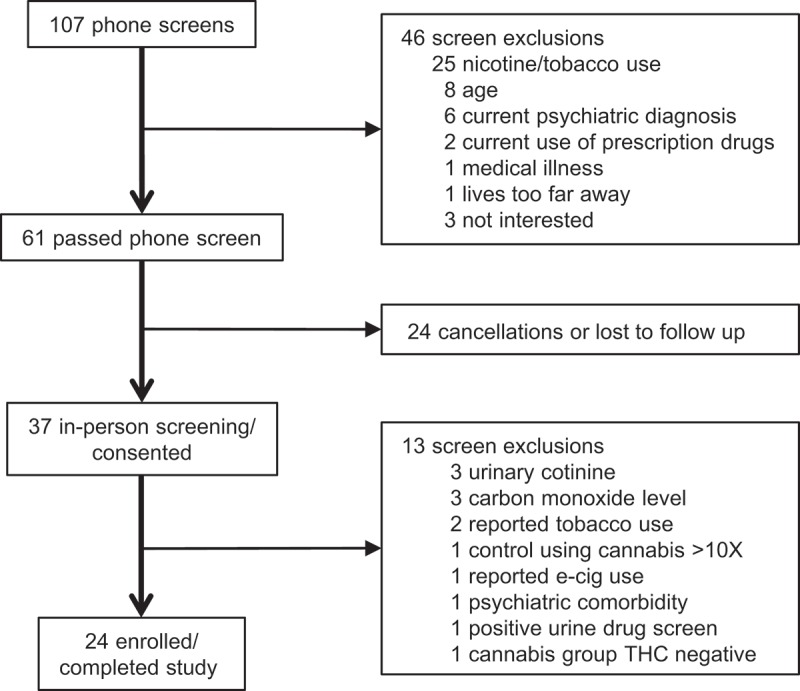
Figure 1.
Figure 1.
Study procedures for screening and consent. Twenty-four men, including 12 cannabis users and 12 non-users, were enrolled and participated in the study.
Figure 2.
Figure 2.
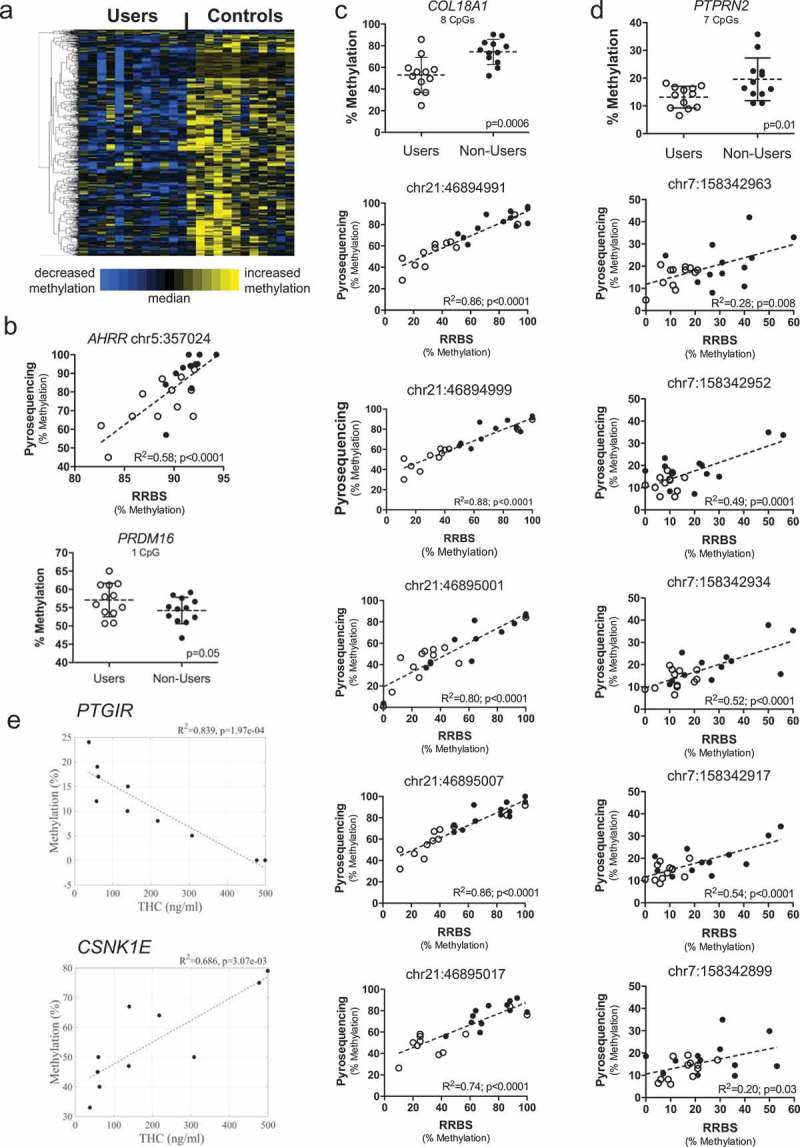
Cannabis use is associated with DNA methylation in sperm. (a) Heat map showing DNA methylation relative to the median for 708 CpG sites (rows) associated with 46 genes with differential methylation between cannabis users (left columns) and non-user controls (right columns). Each column represents one participant, while each row represents one CpG site. Row clustering was unsupervised. Methylation levels are median-centered. (b) Top, bisulfite pyrosequencing data compared to RRBS data from users to non-users for a CpG within the intragenic repeated sequence of AHRR by linear regression. Bottom, bisulfite pyrosequencing data for one of the few genes, PRDM16, showing increased methylation in the user group. Each data point is the average of replicate measures. The mean is shown by the center dashed bar with error bars representing standard deviation. Unpaired t test, one-tailed, F test to compare variances (p = 0.44). D’Agostino & Pearson normality test showed data was normally distributed in each group. (c) Top graph: bisulfite pyrosequencing data for COL18A1 showing all eight CpG sites analyzed together discriminate users from non-users. Each data point is the average of replicate measures. The mean is shown by the center dashed bar with error bars representing standard deviation. Unpaired t test, one-tailed, F test to compare variances (p = 0.27). D’Agostino & Pearson normality test showed data was normally distributed in each group. Bottom five graphs: Comparison of methylation values from RRBS versus bisulfite pyrosequencing for the five CpG sites identified as differentially methylated by RRBS, analyzed using linear regression. (d) Top graph: bisulfite pyrosequencing data for PTPRN2 showing all seven CpG sites analyzed together discriminate users from non-users. Each data point is the average of replicate measures. The mean is shown by the center bar with error bars representing standard deviation. Unpaired t test with Welch’s correction, one-tailed, F test to compare variances (p = 0.03). D’Agostino & Pearson normality test showed data was normally distributed in each group. Bottom five graphs: Comparison of methylation values from RRBS versus bisulfite pyrosequencing for the five CpG sites identified as differentially methylated by RRBS, analyzed by linear regression. (e) Correlations between urinary THC concentration in the human cannabis user group and sperm DNA methylation levels for CpGs identified as differentially methylated in PTGIR (top) and CSNK1E (bottom), analyzed by linear regression. Panels B-D: Users, open circles; non-users, closed circles.

References

    1. Gunn JK, Rosales CB, Center KE, et al. Prenatal exposure to cannabis and maternal and child health outcomes: a systematic review and meta-analysis. BMJ Open. 2016;6:e009986. - PMC - PubMed
    1. Funkhouser M. Governing the states and localities: state Marijuana laws in 2017 map. Governing News. Available from: http://www.governing.com: Dr. Mark Funkhouser, 2017.
    1. Center for Behavioral Health Statistics and Quality (CBHSQ) SAaMHSAS U.S. Department of Health and Human Services (HHS), and RTI international. results from the 2015 national survey on drug use and health: detailed tables In: Types of illicit drug use in lifetime PY, and past month among persons aged 18 to 25: percentages, 2014 and 2015. https://www.samhsa.gov/data/ 2017.
    1. Volkow ND, Swanson JM, Evins AE, et al. Effects of cannabis use on human behavior, including cognition, motivation, and psychosis: a review. JAMA Psychiatry. 2016;73:292–297. - PubMed
    1. Szutorisz H, Hurd YL.. High times for cannabis: epigenetic imprint and its legacy on brain and behavior. Neurosci Biobehav Rev. 2018;85:93–101. - PMC - PubMed

Publication types